
 Worksheets
Geography Unit 1 Assessment
Total questions: 22
Worksheet time: 11mins
Name
Class
Date
1.
Physical geography primarily focuses on –
a)
studying cultures and societies.
b)
examining landforms and geological processes.
c)
analyzing climate patterns.
d)
assessing natural resource management.
2.
Absolute location refers to –
a)
A place's position in relation to other places.
b)
The physical characteristics of a place.
c)
The exact coordinates of a place on Earth.
d)
The flow of people, goods, ideas, and information.
3.
Geographers describe relative location by –
a)
giving the exact coordinates of a place.
b)
describing physical features of a place.
c)
comparing a place's position to other places.
d)
studying the movement of people and goods.
4.
The theme of "Movement" in geography refers to the –
a)
flow of people, goods, ideas, and information across the Earth's surface.
b)
physical features and people that make a location unique.
c)
ways humans adapt to, modify, and depend on their surroundings.
d)
ways in which humans use exercise to stay healthy.
5.
A _________ map would be ideal for hiking and exploring nature.
a)
Road
b)
Topographic
c)
Political
d)
Thematic
6.

This map above of El Salvador is best described as a –
a)
Topographic Map
b)
Mental Map
c)
Political Map
d)
Thematic Map
7.
What does a map key or legend typically show?
a)
The cardinal directions
b)
The scale of the map
c)
Latitude and longitude lines
d)
Symbols and their meanings
8.
What does the compass rose on a map indicate?
a)
The elevation and terrain
b)
The population density
c)
The cardinal directions
d)
The climate and vegetation
9.
How can you estimate distances between places on a map?
a)
By using the map key
b)
By reading latitude and longitude
c)
By understanding the compass rose
d)
By using the map scale
10.

The world map seen here was created to minimize –
a)
Straight lines
b)
Landmass distortion.
c)
Travel times between continents.
d)
Political boundaries.
11.
In geography, the world is divided into regions in order to -
a)
Make it harder to study different areas.
b)
Better understand and compare different areas.
c)
Confuse people about different parts of the world.
d)
Prevent cultural understanding.
12.
Which type of region has clear boundaries and specific characteristics that set them apart?
a)
Formal regions
b)
Functional regions
c)
Perceptual regions
d)
Undefined regions
13.
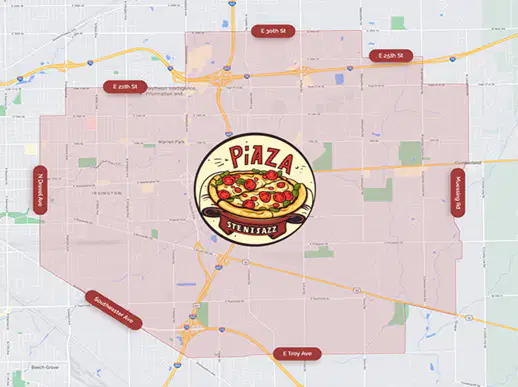
The map seen here shows the delivery area for a pizza shop. This is an example of a –
a)
Formal region
b)
Functional region
c)
Perceptual region
d)
Undefined region
14.
Which type of region is based on a person's feelings, attitudes, or opinions about a place?
a)
Formal
b)
Functional
c)
Perceptual
d)
Undefined
15.

When two of Earth’s tectonic plates are moving apart from each other it is a –
a)
Divergent plate boundary.
b)
Convergent plate boundary.
c)
Transform boundary.
d)
None of the above.
16.
Which landform is typically formed by the collision of tectonic plates or volcanic activity?
a)
Canyons
b)
Plains
c)
Valleys
d)
Mountains
17.
Which landform is a deep, narrow valley with steep sides, often carved by river erosion?
a)
Plateau
b)
Canyon
c)
Peninsula
d)
Island
18.
The overwhelming majority of Earth’s water is –
a)
freshwater.
b)
saltwater.
c)
frozen in glaciers.
d)
under the Earth’s crust.
19.
In 2005, Hurricane Katrina forced thousand of New Orleans residents to move out of Louisiana. This is an example of a –
a)
Economic push factor
b)
Environmental push factor
c)
Economic pull factor
d)
Political push factor.
20.
Culture is best defined as the –
a)
Visible manifestations of human life on Earth.
b)
Shared patterns of behaviors, beliefs, and values passed down from one generation to the next.
c)
Language spoken by a group of people.
d)
Way one community interacts with another between spaces.
21.
What is cultural diffusion?
a)
The spread of culture from one place to another.
b)
The visible manifestations of human cultures on Earth.
c)
Traditional rituals and celebrations.
d)
Efforts to preserve and protect cultural heritage.
22.
In which form of economic system would the government control the entire economy?
a)
Free Market Economy
b)
Mixed Economy
c)
Capitalism
d)
Command Economy
100 %

