
 Worksheets
Modern Ans Contemporary Theatre
Total questions: 15
Worksheet time: 8mins
Which intellectual work challenged religious views of human origins in the 19th century?
Freud’s Interpretation of Dreams
Darwin’s Origin of Species
Marx’s Das Kapital
Einstein’s Theory of Relativity
How did the Industrial Revolution influence theatre audiences?
They declined due to factory labor
They became limited to elites
They expanded, as urban working classes sought escapism
They only preferred religious drama
What best defines melodrama?
Experimental, dreamlike distortions
Poetic theatre with symbolic characters
Episodic scope, outsider heroes
Music drama with clear moral contrasts
Vaudeville shows were significant because they:
Rejected all music and dance
Offered variety acts blending song, dance, comedy, acrobatics
Focused only on elite audiences
Were banned in America
Which feature best distinguishes realism in theatre?
Stylized movement and ritual chant
Episodic scenes spanning centuries
Everyday settings and psychologically credible dialogue
Direct address to prevent emotional identification
Naturalism differs from realism primarily because it…
Seeks “slice-of-life” extremity and lower-class focus with minimal contrivance
Uses poetic symbolism to evoke mood
Depends on historical pageantry
Requires audience participation
Which pairing is correct?
Symbolism — photographic sets and everyday speech
Expressionism — distorted perspectives to reveal inner truth
Naturalism — dreamscapes and archetypes
Epic Theatre — hypnotic identification and catharsis
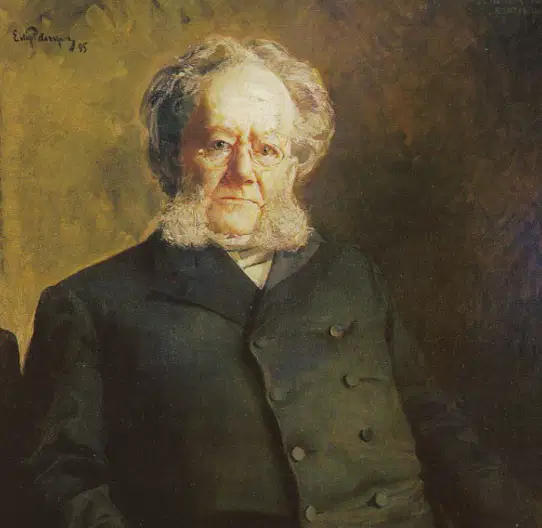
Henrik Ibsen is considered the "founder of modern realistic drama" because he:
Developed the first acting training system
Invented the three-act play structure
Confronted taboo subjects like unhappy marriages and religious hypocrisy
Introduced electric lighting to the theatre

Melodrama often relied on exaggerated plots. What purpose did scenes like this serve?
To explore philosophical ideas of realism
To create suspense and moral polarization between good and evil
To teach audiences about industrial safety regulations
To imitate Greek tragedy’s chorus
Symbolist theatre rejected realism by insisting that drama should evoke:
Political revolution and social change
Historical accuracy and documentary truth
The mystery of being and infinite qualities of the human spirit
Economic inequality and class struggle
Under authoritarian regimes, theatre has often been…
Repurposed for propaganda or suppressed, pushing artists toward coded critique
Free from political pressure
Banned globally without exception
Replaced by sports completely
Performance art (late 20th c.) typically differs from traditional scripted drama by…
Requiring a five-act structure
Favoring live, body-centered actions, mixed media, and blurred boundaries between art and life
Using only classical verse
Avoiding audience interaction at all costs
Why do AIDS activist dramas like Tony Kushner’s Angels in America matter in theatre history?
They avoided social issues to focus on timeless myths
They reinforced traditional religious perspectives
They reflected the cultural and political crises of their time
They marked the end of queer theatre movements
Postmodern theatre distinguishes itself by:
Rejecting all experimentation in favor of realism
Blending collage, intertextuality, and high/popular culture
Maintaining linear storytelling and classical rules
Avoiding global and diverse perspectives
According to Schechner (2013), theatre endures in the digital age because:
It's cheaper to produce than films or television
It requires no technology or special equipment
It appeals primarily to older audiences
It offers live, reciprocal presence between performers and audiences

