
 Worksheets
BIO- Exam 2 Review
Total questions: 96
Worksheet time: 3hrs 59mins

Which type of cell has no nucleus?
Eukaryote
Prokaryote
Animal
Plant
Plants and animal cells are examples of ___ cells
prokaryotic
eukaryotic
alien
animal
Which of the following are prokaryotic cells?
plants
animals
bacteria
battery

Which type of cell contains a nucleus?
Prokaryotic
Eukaryotic

Which is true of prokaryotic and eukaryotic cells?
Prokaryotic cells are larger than eukaryotic cells.
Eukaryotic cells do not have nuclei, and prokaryotic cells do have nuclei.
Prokaryotic cells lack membrane-bound organelles, and eukaryotic cells contain membrane-bound organelles.
Eukaryotic cells are simpler than prokaryotic cells.
What are the two categories of Prokaryotic Cells?
There is only one category
Plant and Animal
Bacteria and Archaea
Big and Small
What are Eukaryotic Cells?
Cells that contain a nucleus, membrane-bound organelles, and the basis of uni-cellular and multi-celled organisms
Cells that have a nucleus
Cells that do not have a membrane
Cells that have membrane-bound organelles
During a biology class, Arjun was asked to identify which of the following is an example of a prokaryotic organism. Which one should he choose?
Animals
Bacteria
Fungi
Plants

The Cell Theory:
1. All living organisms are composed of one or more (a) . (Unicellular or Multicellular)
2. All cells arise from (b) cells. (Not from Spontaneous Generation)
3. Cells are the structural and functional unit of (c) . (Nothing living smaller than a Cell)
Match the following
Complex Cells that contain a well-defined nucleus and membrane-bound organelles.
Eukaryotic Cells
Simple Cells that are missing a nucleus and membrane-bound organelles.
Prokaryotic Cells
Basic Unit of Life.
Cells
The monomers of nucleic acids are
Monosaccharides
Nucleotides
Amino Acids
Fatty Acids
DNA and RNA are an example of
Amino Acids
Proteins
Lipids
Nuclei Acids
Lipids are used for long-term storage of energy and also for
Genetic Information
Insulation
Structure
Fast energy
(question 11) Lipids are made up of which of the following?
glycerol and fatty acids tails
glycerol and monolipids
fatty acids and phosolipids
amino acids and nucleotides
(question 10) What is the monomer for a protein?
Monosaccharide
Triglyceride
Amino Acid
Nucleotide
(question 9) Which biomolecule includes fats, such as triglycerides, oils, waxes, and steroids (cholesterol); insoluble in water; provides energy storage, insulation, part of cell membrane, and hormones
Nucleic Acid
Lipids
Carbohydrate
Protein
(question 8) What are the four biological molecules?
proteins, carbohydrates, lipids, nucleic acids
proteins, enzymes, cells, lipids
water, air, earth, and fire
carbon, oxygen, nitrogen, phosphorous
(question 6) Which biomolecule contain your genetics?
Carbohydrate
Lipid
Nucleic Acid
Protein
(question 1) Enzymes are a type of which biomolecule?
Carbohydrate
Lipid
Nucleic Acid
Protein
(question 13) All polymers are made up of...
monosaccharides
monomers
proteins
None of these
(question 14) What are foods that are high in carbs?
Eggs, fish, poultry
Cheese, meats, vegetables
Bread, potatoes, and pasta
Multitude of oils, butter and condiments
(question 18) What is the purpose of an enzyme?
give permission for the reaction
raise activation energy
speed up reactions
control how many reactions occur
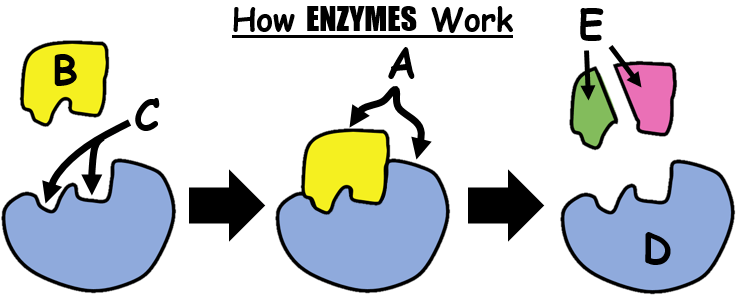
(question 19) What is the name of Letter D
active site
enzyme
substrate
products
(question 21) Which of the following is a simple sugar?
Glucose
Flour
Seeds
Lactase
(question 22) Which of these affects an enzymes ability to function? (2 answers)
The mood of the enzyme
pH (scale that measures acidity)
Catalyst
Temperature
Which of the following statements is TRUE of enzymes?.
Enzymes are not found in living organisms
Enzymes help to speed up chemical reactions
Enzymes are made carbohydrates
Enzymes increase the activation energy of a chemical reaction

Enzymes are also considered to be biological ____________
catalysts
organisms
life
denatures


CH4 and O2

CH4 and O2
What term is used to describe the process of an enzyme changing shape due to extreme heat or pH levels?
catalyze

Green reaction has an enzyme, so less energy is used than the purple reaction
Label the phases if the cell cycle.
G1
Gap or growth phase; cell doubles in size
G2
Cell prepares for division; doubles number of organelles
S
DNA is replicated
Mitosis
Process in which the nucleus is divided
Cytokinesis
Process of division of the cytoplasm
Which phase is known as the rest phase, when cells are not growing or preparing to divide?
G1
S
G0
G2
Which Phase does the cell spend 90% of its life in?
(a)
Place to following steps of Mitosis in order.
Prophase
Metaphase
Anaphase
Telophase
Genetic material condenses
Prophase
Chromosomes line up in middle of cell
Metaphase
Sister chromatid moves apart
Anaphase
The cell starts to split into two
Telophase
Cell growth, and DNA replicates
Interphase

What phase of the Cell Cycle is the arrow pointing to:
(a)
Anaphase
Interphase
Prophase

Identify the phase of Mitosis from the Illustration:
Nuclear membrane disappears
Chromosomes can now be seen
Centrioles move to opposite sides
(a)

Identify the phase of Mitosis in the Illustration:
Chromatids separate
(a)

What stage of the Cell Cycle is shown in the illustration?
(a)

Identify the phase of Mitosis in the Illustration:
Chromosomes line up at the equator of the cell
Spindle fibers extend from the centrioles to the middle of the chromosomes
(a)
Cells of organisms must go through cell division for?
growth
repair of damaged cells
replacement of dying cells.
All of these


What happens in cytokinesis?
The chromosomes become visible; nucleus disappears; spindles form
The chromosomes align in the middle of the cell
The DNA is duplicated
The cytoplasm divides into two new daughter cells

Which phase is this in?
Interphase
Metaphase
Anaphase
Telophase
Reorder the following stages of Mitosis from start to finish.
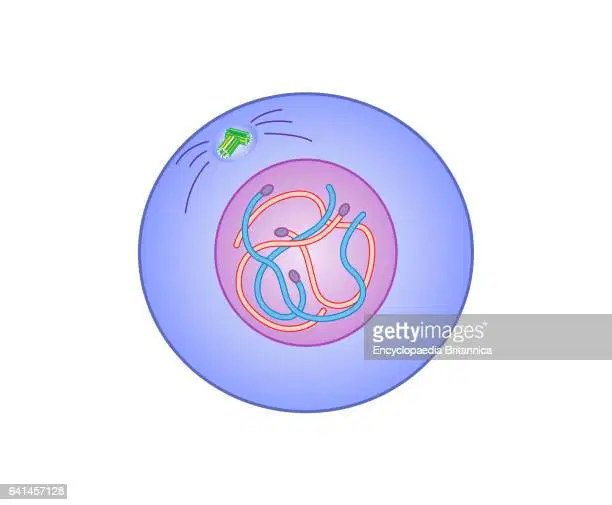


Select the following stage of mitosis: PROPHASE


Which of the following best describes the shape of a DNA molecule?
Single helix
Double helix
Triple helix
Linear strand
During DNA replication, which enzyme is responsible for adding new nucleotides to the growing DNA strand?
Helicase
Ligase
Primase
Polymerase
What is the complementary base pair for adenine in DNA?
Uracil
Thymine
Cytosine
Guanine
What is the function of the sugar-phosphate backbone in a DNA molecule?
It provides structural support to the DNA strand
It catalyzes DNA replication
It stores genetic information
It binds to ribosomes during translation
During DNA replication, which base pairs with cytosine?
Uracil
Adenine
Thymine
Guanine
What is the endosymbiotic theory?
The endosymbiotic theory explains how plants produce energy through photosynthesis.
The endosymbiotic theory is about the formation of the solar system.
The endosymbiotic theory describes the evolution of dinosaurs.
The endosymbiotic theory explains the origin of eukaryotic cells from symbiotic relationships between prokaryotic organisms.
List two key pieces of evidence supporting endosymbiosis.
1. Mitochondria and chloroplasts have double membranes. 2. They contain their own circular DNA.
Both organelles are derived from the nucleus of the cell.
Mitochondria and chloroplasts are found in all eukaryotic cells.
They are responsible for protein synthesis in the cell.
What are the three major principles of cell theory?
All living organisms are made of tissues and organs
1) All living organisms are composed of one or more cells, 2) The cell is the basic unit of life, 3) All cells arise from pre-existing cells.
Cells can spontaneously generate from non-living matter
All cells contain a nucleus
How do prokaryotic cells differ from eukaryotic cells?
Prokaryotic cells differ from eukaryotic cells in that they lack a nucleus and membrane-bound organelles, have circular DNA, and are generally smaller and simpler.
Prokaryotic cells contain linear DNA and are larger than eukaryotic cells.
Eukaryotic cells are generally smaller and simpler than prokaryotic cells.
Prokaryotic cells have a nucleus and complex organelles.

During which phase does DNA make a copy of itself?
G1
S
G2
M
What 3 phases make up Interphase?
G1
S
G2
M
C
True or False: A cell will not continue to the next phase if its DNA is damaged.
True
False
Osmosis is the movement of _________ through a membrane.
food
water
oxygen
energy
When materials move in and out of a cell at the same rate, the cell is in
Dynamic equilibrium
Metabolism
Imbalance
Inertia
Facilitated diffusion uses ___________ to move large or charged molecules from high to low concentration.
energy
cells
carbohydrates
proteins


When a cell forms a vesicle around unwanted particles and expels it OUT of the cell.
Pinocytosis
Endocytosis
Receptor-mediated
Exocytosis

The two components of a virus are nucleic acid and __________.
protein
carbohydrates
lipids
glucose
A virus is
living
non living
dead
Viruses need a ____________ in order to make copies of themselves.
bacterial cell
host cell
capsid
vaccine
Virus' genetic information contains the code to:
make copies of itself
obtain and use energy
reproduce
grow and develop
Which cycle kills the host cell immediately?
Lytic
Lysogenic
During which cycle does a virus's genetic information become a part of the host cell's genetic information?
Lytic
Lysogenic
A virus that hides within the host cell for up to years is going through the _______ cycle.
Lytic
Lysogenic
A virus that goes through the ______ cycle will allow you to feel symptoms immediately due to the cells lysing.
Lytic
Lysogenic
Vaccines are a preventative measure.
True
False

