
 Worksheets
Urinary System and Related Skills
Total questions: 28
Worksheet time: 26mins
The function of the urinary system is:
to remove waste products from the blood
to digest food
to pump blood throughout the body
to control body temperature
The inner region of the kidney is called the ________.
renal medulla
renal cortex
renal pelvis
renal capsule
Renal pyramids are triangular shaped systems where ________ empty into the loop of Henle.
nephrons
glomeruli
collecting ducts
renal arteries
The ureter is a tube connecting each kidney to the ________.
bladder
liver
stomach
pancreas
The urinary bladder is a ________ organ which sits on the pelvic floor and stores urine to be eliminated.
sac-like
tube-like
solid
spongy
Nephrons are:
the functional units of the kidney
a type of blood cell
digestive enzymes
hormones produced by the pancreas
Which condition is characterized by hard deposits within the kidney composed of minerals and salts?
Chronic kidney disease (CKD)
Urinary tract infection (UTI)
Kidney stones
Polycystic Kidney Disease (PKD)
Which disease / disorder is characterized by symptoms including pain or burning during urination, fever, urge to urinate, frequent urination, and/or odorous urine?
Chronic kidney disease
Urinary tract infection (UTI)
Urinary retention
Urinary incontinence
Which urinary system disorder occurs when the bladder does not completely empty?
Urinary incontinence
Urinary retention
Renal cell carcinoma
Glomerulonephritis
Name the three main regions of the kidney.
renal cortex, renal medulla, renal pelvis
renal capsule, renal sinus, renal papilla
renal artery, renal vein, renal hilum
renal tubule, renal glomerulus, renal calyx
Which of the following diseases / disorders is swelling of a kidney due to retention of urine?
Urinary tract infection
Chronic kidney disease
Polycystic kidney disease
Hydronephrosis
The renal pelvis attaches the kidneys to the ________.
ureters
bladder
liver
pancreas
The structures of the urinary system include:
kidneys, ureters, bladder, urethra
lungs, heart, liver, stomach
bones, muscles, tendons, ligaments
skin, hair, nails, glands
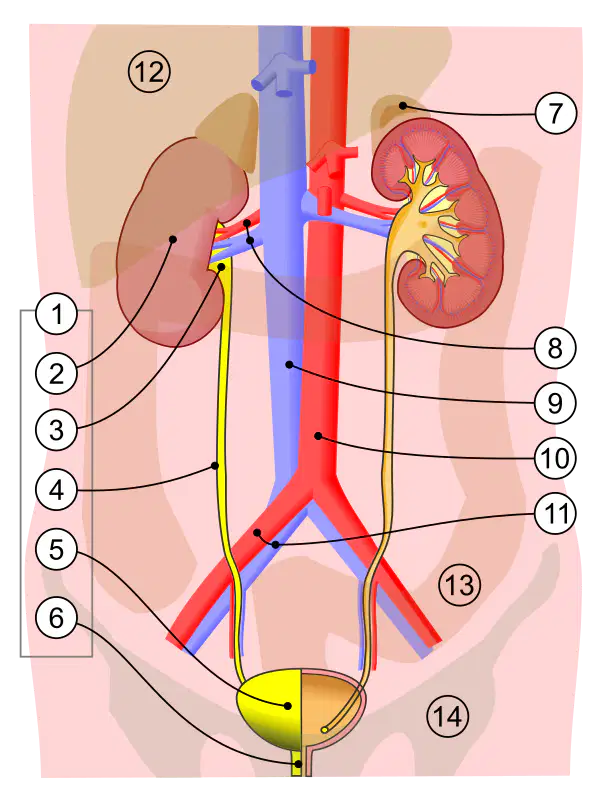
Which component of the urinary system does #6 represent?
(a)
Which component of the urinary system does #4 represent?
(a)

Identify the structure labeled "C" in the diagram.
Kidney
Ureter
Bladder
Urethra
The hilum is the indentation of the ________ shape of the kidney where blood vessels and nerves pass through.
bean
pear
oval
round

To convert ounces to milliliters, you should multiply by ___.
30
20
60
15
When calculating intake, which of the following should be recorded as half of what was actually taken?
Water
Ice
Frozen treats (ice cream, popsicles)
Broth
Convert 10 ounces to mL.
30 mL
300 mL
300 ounces
3000 mL
Which of the following units should intake / output be documented in?
ounces
pounds
milliliters
kilograms
During your shift, your patient had 12 oz coke, 24 oz broth, 8 oz ice chips, 1000 cc fluids via their IV, and a 4 oz cup of chocolate ice cream. Calculate their total intake during your shift and give your answer in mL.
Draw a simple example of the urinary system including the kidneys, ureters, urinary bladder, and urethra.

Give an example of what would be considered "insensible loss" when calculating output.
Which of the following would not be considered as part of your output calculation?
Vomit
Collections within an ostomy bag
Formed stool
Urine

During your shift, Mr. Louis had a total intake of 4,000 mL. His output is shown in the image. Which of the following might be a concern to consider based on his I&O?
Dehydration
Renal cell carcinoma
Fluid volume overload
Urinary tract infection

You drank both containers of coffee before your 12 hour shift. How many mL did you intake in that moment?
360
12
180
6

