wayground logo

Free Printable Worksheets

Font size

S
M
L
XL
Worksheets

Semester 1 Final Exam Review

Total questions: 215

Worksheet time: 8hrs 27mins

Name
Class
Date
1.
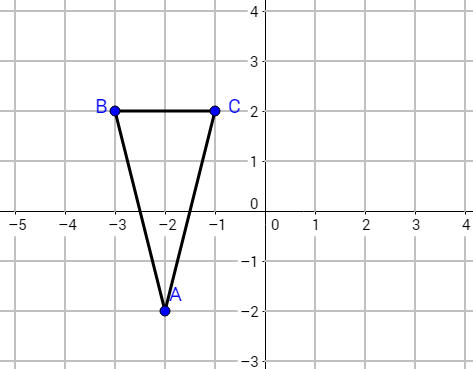
Determine how to translate triangle A'B'C' to triangle ABC.
a)
(x+2, y-5)
b)
(x+2, y-9)
c)
(x-2, y-9)
2.
Determine where X' would be if you translated X 3 units to the left and 9 units down.
a)
(-4, 4)
b)
(-10, 2)
c)
(-4, -5)
d)
(-1, 5)
3.
Determine where T' would be if you translated T 3 units to the right and 6 units up.
a)
(5, 1)
b)
(2, -5)
c)
(-1, 1)
d)
(8, -2)
4.
How was B translated to B' if B' is at (4, -2)?
a)
Translated 6 units down
b)
Translated 2 units to the left and 6 units down
c)
Translated 2 units to the right and 6 units down
d)
Translated 2 units to the right
5.
How is trapezoid ABCD translated to trapezoid A'B'C'D'?
a)
Translated 5 units down and 5 units to the right
b)
Translated 5 units down and 1 to the right
c)
Translated 8 units down and 5 units to the right
d)
Translated 5 units down and 4 units to the right
6.
How would you translate point P to P'?
a)
Translate 2 units to the right and  8 units down
b)
Translate 3 units down and 2 units to the right
c)
Translate 4 units down and 4 units to the left
d)
Translate 8 units to the right and 2 units down
7.
Where would A' be if you translated A 3 units to the right and 4 units down?
a)
(-4, 4)
b)
(-1, 0)
c)
(0, -1)
8.
Where would point J' be if you translated point J 5 units to the left and 2 units up?
a)
(5, 3)
b)
(3, -5)
c)
(-5, 3)
d)
(-3, 5)
9.
What does a translation do to an image?
a)
Turns it 90* clockwise
b)
Mirrors it
c)
Shrinks it
d)
Slides it
10.
How do you represent a translation Algebraically? 
a)
(-y, -x)
b)
(x + a, y + b)
c)
(-x , -y)
d)
(ax, by)
11.
How is Quadrilateral EFGH translated to E'F'G'H'?
a)
6 down
b)
6 down, 1 right
c)
6 down, 3 left
d)
8 down, 1 right
12.
Determine how to translate triangle A'B'C' to triangle ABC.
a)
(x+2, y-5)
b)
(x+2, y-9)
c)
(x-2, y-9)
13.
The result of a transformation.
a)
Pre-image
b)
Image
14.
The original figure prior to a transformation.
a)
Pre-image
b)
Image
15.
What transformation is happening?
(x, y) ----> (x + 2, y - 3) 
a)
slide up 2, left 3
b)
slide right 2, up 3
c)
slide right 2, down 3
d)
slide left 3, right 2
16.
What does this transformation say to do?
(x, y) -----> (x, y +4) 
a)
slide down 4
b)
slide up 4
c)
slide right 4
d)
slide left 4
17.
Point M (-3, 5) is translated using this rule. 
(x, y) ----> (x - 1, y) 
What are the coordinates of M'?
a)
(-4, 5)
b)
(-2, 5)
c)
(-4, 4)
d)
None of these
18.
Identify the transformation.
a)
Reflection across y-axis
b)
90 Rotation counter clockwise
c)
Translation 5 units left, 1 unit up.
d)
Translation 5 units right, 1 unit down
19.
What rule describes the translation?
a)
(x - 6, y + 2)
b)
(x - 2, y + 6)
c)
(x + 2, y - 6)
d)
(x + 6, y - 2)
20.
What happens to (-9, 3) when it is translated 4 units down and 3 units right?
a)
(-6, -1)
b)
(-13, 6)
c)
(-5, 6)
d)
(-6, 7)
21.
Reflect Point C over the y-axis:
a)
(-3, 2)
b)
(3,2)
c)
(-2,3)
d)
(3,0)
22.
Flipping a figures is a ...
a)
Rotation
b)
Reflection
c)
Dilation
d)
Translation
23.
Which answer shows a reflection across the x-axis?
a)
d
b)
c
c)
b
d)
a
24.
Reflect over x-axis. Which point would be at (3, -6)
a)
A
b)
B
c)
C
d)
H
25.
Which answer shows a reflection across the y-axis?
a)
a
b)
b
c)
c
d)
d
26.
State the line of reflection.
a)
Reflection across y-axis
b)
Reflection across x-axis
c)
Reflection across x = 1
d)
Reflection across y = 1
27.
Which axis is the horizontal (left-right) one?
a)
x-axis
b)
y-axis
28.
Which axis is the vertical (up-down) one?
a)
x-axis
b)
y-axis
29.
What is a reflection?
a)
When you turn an object around a point.
b)
When you slide an object form one place to another.
c)
When you flip or mirror an object across a line.
d)
When you resize an object.
30.
Find K' if the figure is reflected across the x-axis
a)
(4, 1)
b)
(-1, -4)
c)
(1, -4)
d)
(1, 4)
31.

The result of a transformation is called...

a)

Pre-image

b)

Image

32.

The original figure prior to a transformation is called...

a)

Pre-image

b)

Image

33.

Reflections are always _______

a)

Congruent

b)

Bigger

c)

Smaller

d)

Rotated

34.
Is the picture being reflected in the y-axis or x-axis?
a)
y-axis
b)
x-axis
35.
Reflections over the x-axis change the ____-__________. 
a)
y-coordinate
b)
x-coordinate
36.
∆QRS contains the points: Q(4, 2) R(5, 1) S(3,7). If the triangle is reflected across the y-axis, what will S' be?
a)
S'(3, 7)
b)
S'(-3, 7)
c)
S'(-3, -7)
d)
S'(3, 7)
37.

What axis is the triangle being reflected over?

a)

X-axis

b)

Y-axis

38.

What axis is the image reflected over?

a)

X-axis

b)

Y-axis

39.
Reflect Point C over the y-axis:
a)
(-3, 2)
b)
(3,2)
c)
(-2,3)
d)
(3,0)
40.

What shape is the reflection from shape E in the x-axis?

a)

A

b)

C

c)

B

41.
What is a reflection?
a)
When you turn an object around a point.
b)
When you slide an object form one place to another.
c)
When you flip or mirror an object across a line.
d)
When you resize an object.
42.
Which answer shows a reflection across the y-axis?
a)
a
b)
c
c)
d
d)
b
43.
Which answer shows a reflection across the x-axis?
a)
a
b)
b
c)
c
d)
d
44.
Triangle GHI is reflected across the x-axis.  What are the coordinates of I'?
a)
(-2, 6)
b)
(2, 6)
c)
(-6, -2)
d)
(6, 2)
45.

Is this a reflection over the X-axis or Y-axis

a)

X axis

b)

Y axis

46.
Reflect the point (2, -4) over the y-axis.
a)
(-4, 2)
b)
(-2, 4)
c)
(-2, -4)
d)
(2, 4)
47.

Reflect (-2, 5) over the x axis.

Think: What will change? the X or the Y?

a)

(-2, -5)

b)

(2, 5)

c)

(2, -5)

48.

Points G, and H are reflected over which axis?

a)

x-axis

b)

y-axis

c)

x and y-axes

49.

If you reflect point C ( -1, -4) over the x-axis, what is the reflected point?

a)

C' ( -1, 4)

b)

C' ( 1, 4)

c)

C' ( 1, -4)

d)

C' ( -1, -4)

50.
Reflect Point C over the y-axis:
a)
(-3, 2)
b)
(3,2)
c)
(-2,3)
d)
(3,0)
51.
Find K' if the figure is reflected across the x-axis
a)
(4, 1))
b)
(-1, -4)
c)
(1, -4)
d)
(1, 4)
52.
Where is point E located?
a)
( 2, 0 )
b)
( 2 , 2 )
c)
( 0 , 2 )
d)
( 0 , 0 )
53.

ΔXKT\Delta XKT  has vertices  X(1,0), K(4,1), T(5,3)X\left(1,0\right),\ K\left(4,1\right),\ T\left(5,-3\right) .  If reflected over the y-axis, where would  TT'  be?

a)

(5,3)\left(-5,-3\right)  

b)

(5,3)\left(5,-3\right)  

c)

(5,3)\left(5,3\right)  

d)

(5,3)\left(-5,3\right)  

54.

Identify the line of reflection in the picture.

a)

x=2x=-2

b)


y=2y=-2

c)

xaxisx-axis

d)

yaxisy-axis

55.

Another name for Reflection is...

a)

flip

b)

turn

c)

slide

d)

dilation

56.

Which answer shows a reflection over the x-axis?

a)
b)
c)
d)
57.

If you reflect the point D ( 5, -1) over the y-axis, what is the reflected point?

a)

D' ( -5, -1)

b)

D' ( 5, -1)

c)

D' ( -5, 1)

d)

D' ( 5, 1)

58.

Which graph best describes a shape that is reflected over the x - axis?

a)
b)
c)
d)
59.
State the line of reflection.
a)
Reflection across y-axis
b)
Reflection across x-axis
c)
Reflection across x = 1
d)
Reflection across y = 1
60.

Name the series of transformations that maps ABC onto DEF.

a)
reflect over x then translate left 6 up 1
b)
reflect over y then translate down 6 left 1
c)
translate right 6 down 1, then reflect over x
d)
rotate 90 clockwise then reflect over y
61.

A figure is rotated 180° clockwise with the origin as the center of rotation to create a new figure. Which rule describes rotating 180° clockwise?

a)

(x,y)→(x,y)

b)

(x,y)→(-y,x)

c)

(x,y)→(y, -x)

d)

(x,y)→(-x,-y)

62.

Rotate the point (-5,8) around the origin 180 degrees counterclockwise.

State the image of the point.

a)

(5, 8)

b)

(5, -8)

c)

(5, -8)

d)

(-5, 8)

63.

Rotate the point (-4,9) around the origin 270 degrees counterclockwise. State the image of the point.

a)

(9 , 4)

b)

(-9, 4)

c)

(9, -4)

d)

(-4, -9)

64.

How many turns on a coordinate plane is 360 degrees?

a)

1 turn

b)

2 turns

c)

3 turns

d)

4 turns

65.

What is a transformation that turns a figure about a fixed point for a given angle?

a)

Tanslation

b)

Reflection

c)

Rotation

d)

Point of Rotation

66.

When a figure is rotated Counter-Clockwise, what direction does it move?

a)

right to left

b)

left to right

67.

When Rotating, what is the center of Rotation on a Coordinate Plane?

a)

x- axis

b)

y- axis

c)

Origin

d)

Quadrant I, II, III, IV

68.

You have a rotation of 270° counterclockwise with the origin as the center of rotation to create a new figure. Which rule describes rotating 270° counterclockwise?

a)

(x,y)→(-x,-y)

b)

(x,y)→(y, -x)

c)

(x,y)→(-y,x)

d)

(x,y)→(x,y)

69.

The new figure created from a transformation is...

a)

Pre-Image

b)

Image

c)

Rotation

d)

Reflection

70.

What is the point that turns the image?

a)

Vertex

b)

Point of Rotation

c)

Rotation

d)

Image

71.

The name of the figure before the rotation is...

a)

Pre-Image

b)

Image

72.

Rotate the point (-1,-2) around the origin 180 degrees. State the image of the point.

a)

(-1,2)

b)

(1, -2)

c)

(1, 2)

d)

(-2, -1)

73.

Rotate A(-4,4) B(-5,1) C(-3, 1)....90 degrees clockwise

a)

A(4,4) B(-5,-1) C(3, -1)

b)

A(4, -4) B(1, -5) C(3, -1)

c)

A(-4, -4) B(-1, -5) C(-1,-3)

d)

A(4, 4) B(1,5) C(1,3)

74.

True or False......A 360 degrees rotation puts the image or the point back to it's original position.

a)

True

b)

False

75.

Which Rotation is the same clockwise and counterclockwise.

a)

90 degree Rotation

b)

180 degree Rotation

c)

270 degree Rotation

d)

360 degree Rotation

76.

Let A ( -2, 1), B (2, 4) and C (4, 2) be the three vertices of a triangle. If this triangle is rotated about 90° clockwise, what will be the new vertices A' , B' and C' ?

a)

A'(1,-2) B'(2, -4) C'(-2,4)

b)

A'(-1,-2) B'(-4,-2) C'(-2,-4)

c)

A'(2,1) B'(-2,4) C'(-4,2)

d)

A'(1, 2), B(4, -2) and C'(2, -4)

77.

Which symbol below represents a transformation has taken place?

a)

'

b)

''

c)

'''

d)

( )

78.

What is the new point for (-8, -8) after a 180 degree rotation

a)

(-8,8)

b)

(8,-8)

c)

(8,8)

d)

(-8, -8)

79.

What word do we use to represent a "Rotation"

a)

Slip

b)

Slide

c)

Turn

d)

Flip

80.

For the transformation shown at the right, what is the measure of the angle of rotation of ABCD about the origin?

a)

90 degrees

b)

180 degrees

c)

270 degrees

d)

360 degrees

81.
What is the angle of rotation for this counterclockwise rotation about the origin?
a)
90°
b)
180°
c)
270°
d)
360°
82.
How many degrees was the figure rotated?
a)
90 degrees counterclockwise 
b)
180 degrees
c)
90 degrees clockwise
83.
The image A'B'C' is a rotation of ABC.
a)
True
b)
False
84.
Triangle C is rotated 180° clockwise with the origin as the center of rotation to create a new figure. Which triangle shows the new location?
a)
A
b)
B
c)
C
d)
D
85.
Identify the transformation from A to D.
a)
90o Clockwise Rotation
b)
180o Rotation
c)
270o  clockwise Rotation
d)
360o Rotation
86.
If you were to rotate ABCD 180° about the origin, what would the coordinates of B' be?
a)
(0, 0)
b)
(-6, -5)
c)
(-1, 3)
d)
(-6, 2)
87.
If you were to rotate ABCD 90° counterclockwise about the origin, what would the coordinate of A' be?
a)
(-5, 5)
b)
(-3, 5)
c)
(-5, 3)
d)
(-3, 3)
88.

What are the two ways we can describe rotations?

a)

Slide angle and degrees.

b)

Direction and Degrees

c)

Trajectory and Distance

d)

Enlargement and Reduction

89.

Rotation Rules (clockwise):

90o rotation: (x, y)→(y, -x)

What are the coordinates for A' after a 90rotation clockwise?

a)

(1, 3)

b)

(3, 1)

c)

(3, -1)

d)

(1, -3)

90.

When you rotate 180 degrees the ( x , y ) becomes ?

a)

( y , x )

b)

( -y , x )

c)

( -x , y )

d)

( -x , -y )

91.
What is the angle of rotation for this counterclockwise rotation about the origin?
a)
90°
b)
180°
c)
270°
d)
360°
92.
How many degrees was the figure rotated?
a)
90 degrees counterclockwise 
b)
180 degrees
c)
90 degrees clockwise
93.
The image A'B'C' is a rotation of ABC.
a)
True
b)
False
94.
Triangle C is rotated 180° clockwise with the origin as the center of rotation to create a new figure. Which triangle shows the new location?
a)
A
b)
B
c)
C
d)
D
95.
Identify the transformation from A to D.
a)
90o Clockwise Rotation
b)
180o Rotation
c)
270o  clockwise Rotation
d)
360o Rotation
96.
If you were to rotate ABCD 180° about the origin, what would the coordinates of B' be?
a)
(0, 0)
b)
(-6, -5)
c)
(-1, 3)
d)
(-6, 2)
97.
If you were to rotate ABCD 90° counterclockwise about the origin, what would the coordinate of A' be?
a)
(-5, 5)
b)
(-3, 5)
c)
(-5, 3)
d)
(-3, 3)
98.

What are the two ways we can describe rotations?

a)

Slide angle and degrees.

b)

Direction and Degrees

c)

Trajectory and Distance

d)

Enlargement and Reduction

99.

Rotation Rules (clockwise):

90o rotation: (x, y)→(y, -x)

What are the coordinates for A' after a 90rotation clockwise?

a)

(1, 3)

b)

(3, 1)

c)

(3, -1)

d)

(1, -3)

100.

When you rotate 180 degrees the ( x , y ) becomes ?

a)

( y , x )

b)

( -y , x )

c)

( -x , y )

d)

( -x , -y )

101.
Dilate the figure by a scale factor of 3 with the origin as the center of dilation. What are the coordinates of the image?
A(3,3) B(6,6) C(9,3)
a)
A'(9,9) B'(18,18) C'(27,9)
b)
A'(6,6) B'(9,9) C'(12,6)
c)
A'(0,0) B'(3,3) C'(6,0)
d)
A'(1,1) B'(2,2) C'(3,1)
102.
Choose the correct scale factor:
a)
2
b)
3
c)
1/3
d)
1/2
103.
The point (8, 12) was dilated to become point (2, 3). What was the scale factor?
a)
½
b)
¼
c)
4
d)
2
104.
Dilate Point B by a scale factor of 1/2
a)
(1.5,-4)
b)
(-1.5,1)
c)
(-1,-1.5)
d)
(-2,-2)
105.
A dilation is which of the following: 
a)
only an enlargement
b)
only a reduction
c)
Either an enlargement or a reduction
d)
Neither an enlargement or a reduction
106.
Tell whether the transformation is a dilation. Explain.
a)
No, scale factor isn't the same.
b)
Yes, scale factor is the same.
107.
The __________ is the ratio of a length of the new figure to the corresponding length on the original figure.
a)
reduction
b)
enlargement
c)
scale factor
d)
center of dilation
108.
A scale factor of less than one means
a)
that the image will be larger than the pre-image.
b)
That the image will be the same as the pre-image.
c)
That you need to subtract that amount off  of each side.
d)
That the image will be a reduction of the pre-image.
109.
a)
A
b)
B
c)
C
d)
D
110.
In a dilation what mathematical operation is used with the scale factor?
a)
addition 
b)
subtraction 
c)
multiplication 
d)
division 
111.

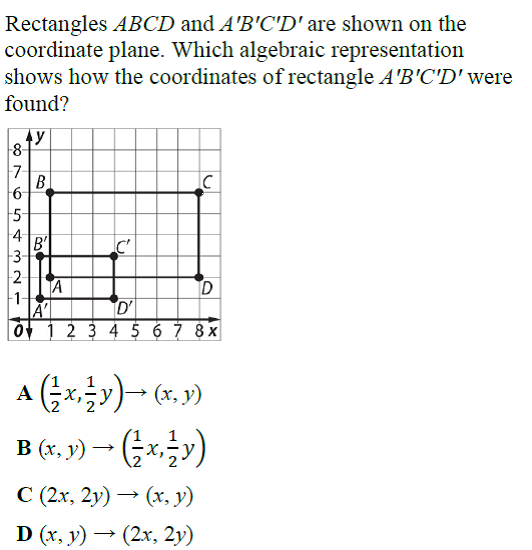
Write a rule for a dilation of (x, y) with a scale factor of 3.

a)

(1/3x, 1/3y)

b)

(-3x, -3y)

c)

(x + 3, y + 3)

d)

(3x, 3y)

112.

Write a rule for a dilation of 1/2?

a)

(2x, 2y)

b)

(1/2x, 1/2y)

c)

(-2x, -2y)

d)

(2x, 1/2y)

113.

A dilation preserves the orientation of the figure.

a)

True

b)

False

114.

A dilation produces a congruent figure

a)

True

b)

False

115.
When a dilation has a scale factor greater than one, the dilation is an enlargement.
a)
True
b)
False
116.
How do you write the algebraic notation when the scale factor is 3?
a)
(x, y) goes to (1/3x, 1/3y)
b)
(x, y) goes to (-3x, -3y)
c)
(x, y) goes to (x + 3, y + 3)
d)
(x, y) goes to (3x, 3y)
117.
Which of the following is the algebraic representation for a dilation?
a)
(x, y) → (x, 3y)
b)
(x, y) → (3x, 3y)
c)
(x, y) → (x, y - 3)
d)
(x, y) → (.5x, .4y)
118.
State the coordinate of the image of the given point B (-10,-6) under a dilation with center at the origin with the given scale factor k = 1/2.
a)
(5,3)
b)
(20,12)
c)
(-20,-12)
d)
(-5,-3)
119.

Choose the correct scale factor:

a)

2.5

b)

1.5

c)

3.5

d)

4

120.

To be exactly equal in size and shape.

a)

Corresponding

b)

Opposite

c)

Similar

d)

Congruent

121.
4* 42
a)
164
b)
42
c)
44
d)
82
122.
2 * 22 *22
a)
24
b)
84
c)
36
d)
25
123.
2n4 * 5n4
a)
7n4
b)
10n16
c)
10n8
d)
none of the above
124.
2n4 * 6n4
a)
8n4
b)
12n8
c)
8n16
d)
none of the above
125.
When you multiply like bases, you ______ the exponents.
a)
multiply
b)
add
c)
subtract
d)
divide
126.
Billy was asked to solve 35∙34. He got 920. What error did he make?
a)
When he multiplies exponents, he is supposed to add the base and the exponent
b)
When he multiplies exponents, he is supposed to multiply the base and keep the exponents
c)
When he multiplies exponents, he is supposed to keep the base and add the exponents if the base is the same
d)
None of the above
127.
The length of a rectangle is 4a4b5 and the width is 3a2b3, what is the expression that represents the area of the rectangle?Area = length ⋅ width
a)
12a6b8
b)
7a6b8
c)
12a8b15
d)
12a2b2
128.
7v*10u3v
a)
70u3v6
b)
17u3v8
c)
70u3v8
d)
none of the above
129.
10xy3 * 8x5y3
a)
80xy3
b)
80x6y3
c)
80x6y6
d)
none of the above
130.
(2a2b4z)(6a3b2z5)
a)
8a5b6z6
b)
12a6b8z5
c)
12a5b6z6
d)
8a6b8z5
131.
The length of a rectangle is 4a4b5 and the width is 3a2b3, what is the expression that represents the area of the rectangle?Area = length ⋅ width
a)
12a6b8
b)
7a6b8
c)
12a8b15
d)
12a2b2
132.
Simplify
6m3n* 8m2n3
a)
48m5n9
b)
48m6n6
c)
48m5n6
d)
none of the above
133.
a)
3y10
b)
3y21
c)
27y10
d)
27y21
134.


(3n4)3\left(3n^4\right)^3  

a)

9n129n^{12}  

b)

9n79n^7  

c)

27n727n^7  

d)

27n1227n^{12}  

135.
According to exponent rules, when we raise a power to another exponent we _______ the exponents.
a)
add
b)
subtract
c)
multiply
d)
divide
136.

Simplify: (5ab2)2

a)

25a2b4

b)

10a2b4

c)

5a2b4

d)

25ab2

137.
52 , in this example 2 is the _____________
a)
base
b)
exponent
138.
a)
8a12b3
b)
16a12b3
c)
2a12b3
d)
16a10b3
139.


Simplify:

(x5y2)4\left(-x^5y^2\right)^4  

a)

8x12y68x^{12}y^6  

b)

256

c)

x20y8x^{20}y^8  

d)

1256x8y20\frac{1}{256x^8y^{20}}  

140.
Simplify:
(7y4)2
a)
7y6
b)
14y8
c)
14y6
d)
49y8
141.
a)

43

b)

415

c)

13

d)

115

142.
a)
110
b)
126
c)
z10
d)
z26
143.
a)
4y6
b)
4y22
c)
30y6
d)
30y22
144.
a)
y14
b)
y10
c)
114
d)
110
145.
a)
2y24
b)
210
c)
2y10
d)
2y14
146.
a)

8x4

b)

8x8

c)

6x4

d)

6x8

147.
a)
95
b)
99
c)
15
d)
9-5
148.
a)
x13
b)
x5
c)
x36
d)
x-5
149.
a)
122
b)
130
c)
622
d)
630
150.
a)
b5
b)
b
c)
b-1
d)
b6
151.
a)
34
b)
1/34
c)
3-12
d)
332
152.
a)
1
b)
g10
c)
g25
d)
g
153.
a)
76
b)
7-5
c)
1/75
d)
75
154.
a)
214 z13
b)
22/z7
c)
214/ z7
d)
2z7
155.
49 / 46
a)
43
b)
415
c)
13
d)
115
156.
In 2what is the base?
a)
2
b)
3
c)
23
157.
In 2what is the exponent?
a)
2
b)
3
c)
23
158.
Simplify the exponential expression:
a)
10x-2
b)
2x2
c)
2x12
d)
10x12
159.
a)
110
b)
126
c)
z10
d)
z26
160.
a)
1/p2
b)
p4
c)
1/p4
d)
p
161.
(3x + 4y - 3z) - (2x - 6y + 7z)
a)
x + 10y - 10z
b)
-x +10y - 10z
c)
x -10y - 10z
d)
-x -10y - 10z
162.
Which of the following are examples of like terms?
a)
2 and 2x
b)
yand x3
c)
y and x
d)
-3x and 3x
163.
Add the polynomials.
(2x + 5y) + (3x - 2y)
a)
3x + 5y
b)
5x + 3y
c)
5x + 7y
d)
7xy + 1xy
164.
Add the polynomials.
(3x3 + 3x2 – 4x + 5) + (x3 – 2x2 + x – 4)
a)
4x3 + 1x2 – 3x + 1
b)
2x3 + 1x2 - 5x + 9
c)
6x3 + 1x - 1x2 - 3
d)
3x5 +1x - 1x5 - 3x
165.
What is the standard form of the polynomial,
 9x2 + 5x + 27 + 2x3
a)
27 + 5x + 9x2 + 2x3
b)
9x2 + 5x + 2x3 + 27
c)
9x2 + 5x + 27 + 2x3
d)
2x3 + 9x2 + 5x + 27
166.
Find the sum.
(3x3 + 3x2 – 4x + 5) + (x3 – 2x2 + x – 4)
a)
4x3 + 1x2 – 3x + 1
b)
2x3 + 1x2 - 5x + 9
c)
6x3 + 1x - 1x2 - 3
d)
3x5 +1x - 1x5 - 3x
167.
Add: (3x - 2) + (3x2 + 6x)
a)
3x2 + 9x - 2
b)
6x+ 4x
c)
3x+ 3x - 2
d)
6x2 + 6x - 2
168.
Add: (3x2 + 2x + 1) + (2x2 - 4x - 5) + (3x - 1)
a)
5x2 + 6x - 7
b)
8x- 3x - 5
c)
5x+ x - 5
d)
6x2 + 8x + 5
169.
Subtract: (2a2 + 5a + 3) -(a2 - 3a - 4)
a)
3a2 + 2a - 1
b)
a+ 8a + 7
c)
3a+ 8a + 7
d)
a2 + 2a - 1
170.

Combine like terms:

8x3y + 3x2y + 4xy + 5x2y + 2xy + 7x2y

a)

8x3y + 8x2y + 2xy

b)

11x3y + 15x2y + 8xy

c)

8x3y + 15x2y + 6xy

d)

23x2y + 6xy

171.

What is the perimeter of the rectangle?

a)

x²+8x-5

b)

2x²+16x-10

c)

2x²+10x-8

d)

6x-2

172.

What is the degree of the polynomial? 5x5 - 6x6 + 2

a)

1

b)

5

c)

6

d)

11

173.
Classify by number of terms:
3x3 – 6x
a)
Monomial
b)
Binomial
c)
Trinomial
d)
4-Term Polynomial
174.
Classify by degree of polynomial:
3x3 – 6x
a)
Constant
b)
Linear
c)
Quadratic
d)
Cubic
175.
Classify by number of terms:
2x – 9
a)
Monomial
b)
Binomial
c)
Trinomial
d)
4-Term Polynomial
176.
Classify by degree of polynomial:
2x – 9
a)
Constant
b)
Linear
c)
Quadratic
d)
Cubic
177.
Classify by number of terms:
3x2 – 8x + 1
a)
Monomial
b)
Binomial
c)
Trinomial
d)
4-Term Polynomial
178.
Classify by degree of polynomial:
3x2 – 8x + 1
a)
Constant
b)
Linear
c)
Quadratic
d)
Cubic
179.
Classify by degree of polynomial:
9x
a)
Constant
b)
Linear
c)
Quadratic
d)
Cubic
180.
Classify by degree of polynomial:
7x3 – 8x2 -4x+ 9
a)
Constant
b)
Linear
c)
Quadratic
d)
Cubic
181.
(5x+2)(x2-3x+6)
a)
5x3 - 17x2 +24x +12
b)
5x3 + 17x2 - 24x +12
c)
5x3 - 13x2 + 24x +12
d)
5x3 +13x2 - 24x - 12
182.
Find the product:
(5s+2)2
a)
25s2+4
b)
25s2+10s+4
c)
25s2+20s+4
d)
5s2+20s+4
183.
Find the product:
(10z-3)2
a)
10z2-30z-9
b)
100z2-60z+9
c)
100z2-9
d)
10z2-60z+9
184.
Find the product:
(x + 12)(x - 12)
a)
x2 - 144
b)
x2 + 144
c)
x2 + 12x - 144
d)
x2 - 12x + 144
185.

Find the area of the given rectangle.

a)

42x3+28x242x^3+28x^2

b)

42x2+28x42x^2+28x^{ }

c)

42x3+4x242x^3+4x^2

d)

13x3+11x213x^3+11x^2

186.
a)

A

b)

B

c)

C

d)

D

187.

 (x+3)(x+5)\ \left(x+3\right)\left(x+5\right)  

a)

x2+8x+15x^2+8x+15  

b)

x2+3x +5x +15x^2+3x\ +5x\ +15  

c)

x2+15x +15x^2+15x\ +15  

188.

(4a7)(3a2)\left(4a-7\right)\left(3a-2\right)  

a)

12a213a+1412a^2-13a+14  

b)

12a229a+1412a^2-29a+14  

c)

12a2+29a1412a^2+29a-14  

189.

(n+2)(n2+5n3)\left(n+2\right)\left(n^2+5n-3\right)  

a)

n3+7n2+13n6n^3+7n^2+13n-6  

b)

n3+7n2+7n+6n^3+7n^2+-7n+6  

c)

n3+7n2+7n6n^3+7n^2+7n-6  

190.

(n+8)(6n2n4)\left(n+8\right)\left(6n^2-n-4\right)  

a)

6n3+49n212n326n^3+49n^2-12n-32  

b)

6n3+47n2+12n+326n^3+47n^2+12n+32  

c)

6n3+47n212n326n^3+47n^2-12n-32  

191.

(3n4)(4n2+2n+3)\left(3n-4\right)\left(4n^2+2n+3\right)  

a)

12n39n22n1212n^3-9n^2-2n-12  

b)

12n310n2+n1212n^3-10n^2+n-12  

c)

12n3+10217n 1212n^3+10^2-17n\ -12  

192.
Multiply.
(3x - 5)(4x2 - 2x - 3)
a)
12x3 - 26x2 - 25x + 15
b)
12x3 - 20x2 - 5x + 15
c)
12x3 - 20x2 - 6x + 15
d)
12x3 - 26x2 + x + 15
193.
(2x − 3)(2x + 3)
a)
4x2 − 12x + 9
b)
4x2 − 9
c)
4x2 + 9
d)
4x2 + 6x − 9
194.
(3x − 6)(7x + 7)
a)
21x2 − 63x + 42
b)
21x2 − 21x − 42
c)
21x2 − 42
d)
21x2 + 63x + 42
195.
(2x - 1)(x + 2)
a)
2x2 + 3x - 2
b)
2x2 - 5x - 2
c)
2x2 + 3x + 2
d)
2x2 - 5x + 2
196.
(x - 5)(x + 1)
a)
x2 - 4x - 5
b)
x2 + 6x - 5
c)
x2 - 5x - 4
d)
x2 - 4x - 4
197.
(5x+2)(x2-3x+6)
a)
5x3 - 17x2 +24x +12
b)
5x3 + 17x2 - 24x +12
c)
5x3 - 13x2 + 24x +12
d)
5x3 +13x2 - 24x - 12
198.
(x-3)(x2+2x+7)
a)
x3-x2+x-21
b)
x3+5x+13x-21
c)
x3-3x2+7x-21
d)
x2+2x-3
199.
(-2x2 + 4x + 4)(3x - 5)?
a)
 -6x3 + 12x2 + 15x – 5
b)
 -6x3 + 22x2 + 32x – 20
c)
. -6x3 + 2x2 – 8x – 5
d)
 -6x33 + 22x2 - 8x – 20
200.

(x+3)(x2+4x+7)\left(x+3\right)\left(x^2+4x+7\right)  

a)

x3+7x2+19x+21x^3+7x^2+19x+21  

b)

x2+19x+7x+7x^2+19x+7x+7  

c)

x3+x2+19x+7x^3+x^2+19x+7  

201.
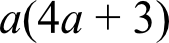
Find the product
a)

4a2+3a4a^2+3a^{ }

b)

77

c)

7a7a

d)

16+3a16+3a

202.
Find the product
a)

2x25x2x^2-5x

b)

25x2-5x

c)

7x7x

d)

3x-3x

203.
Find the product
a)

3n36n2-3n^3-6n^2

b)

3n46n3-3n^4-6n^3

c)

3n36n-3n^3-6n

d)

9n-9n

204.
Find the product
a)

15x33x2+12x15x^3-3x^2+12x

b)

15x23x+1215x^2-3x+12

c)

15x39x15x^3-9x

d)

15x33x15x^3-3x

205.
Find the product
a)

4b+36b2+8b3-4b+36b^2+8b^3

b)

4+36b2+8b3-4+36b^2+8b^3

c)

4+36b+8b2-4+36b+8b^2

d)

4b2+36b3+8b-4b^2+36b^3+8b

206.
Simplify the expression
a)

3w2+7w3w^2+7w

b)

6w2+86w^2+8

c)

3w+93w+9

d)

5w2+2w5w^2+2w

207.
Simplify the expression
a)

2p2+3p-2p^2+3p

b)

2p23p2p^2-3p

c)

2p+3p2-2p+3p^2

d)

2p2+3-2p^2+3

208.
Simplify the expression
a)

3x3+8x3x^3+8x

b)

2x2+7x2x^2+7x

c)

6x210x6x^2-10x

d)

8x3+78x^3+7

209.
Simplify the expression
a)

22b2+2b+8-22b^2+2b+8

b)

2b273b52b^2-73b-5

c)

17b3+8b+10x-17b^3+8b+10x

d)

13b3+12b2+11b-13b^3+12b^2+11b

210.
Simplify the expression
a)

6m2+6m36m^2+6m-3

b)

3m2+2m13m^2+2m-1

c)

6m3+11m25m6m^3+11m^2-5m

d)

18m2+1218m^2+12

211.
Solve the equation
a)

-7.0

b)

7.0

c)

4.0

d)

5.0

212.
Solve the equation
a)

4.0

b)

-4.0

c)

6.0

d)

2.0

213.
Solve the equation
a)

-5.0

b)

5.0

c)

7.0

d)

2.0

214.
Solve the equation
a)

-6.0

b)

6.0

c)

3.0

d)

8.0

215.
Solve the equation
a)

-2.0

b)

2.0

c)

7.0

d)

1.0