
Font size
 Worksheets
A&P 1- Chapters 1&2 Review - Chapter 1
Total questions: 97
Worksheet time: 51mins
A researcher discovered a sensory receptor that detects decreasing oxygen concentrations in the blood. According to the principles of negative feedback, it is likely that stimulation of this sensory receptor will produce which of the following types of responses?
A) A decrease in heart rate
B) An increase in the respiratory rate
C) An increase in physical activity
D) Unconsciousness
E) Both a decrease in heart rate and an increase in the respiratory rate will occur.
Which of the following statements is TRUE?
The coordinated activity of the organ systems is necessary for normal function.
Because organ systems are so interrelated, dysfunction in one organ system can have profound effects on other systems.
An organism is any living thing considered as a whole, whether composed of one cell, such as a bacteria or trillions of cells, such as a human.
Living things are highly organized, and disruption of this organized state can lead to loss of function and death.
All of these statements are true.
Which of the following lists examples of body structures from the simplest to the most complex?
protein, connective tissue, protein, stomach
Protein, adipocyte (fat cell), connective tissue, stomach
connective tissue, stomach, protein, adipocyte (fat cell)
Protein, adipocyte (fat cell), stomach, connective tissue
Protein, stomach, connective tissue, adipocyte (fat cell)
The fact that most of us have five lumbar vertebrae, but some people have six and some have four, is an example of _________ variation among organisms.
cellular
holistic
physiological
anatomical
reductionist
When a woman is giving birth, the head of the baby pushes against her cervix and stimulates the release of the hormone oxytocin. Oxytocin travels in the blood and stimulates the uterus to contract. Labor contractions become more and more intense until the baby is expelled. This is an example of __________.
negative feedback
positive feedback
dynamic equilibrium
integration control
set point adjustment
Which of the following statements provides an accurate description of cellular physiology involving structures of the digestive system?
Hepatocytes (liver cells) produce bile to aid in the breakdown of ingested lipids.
Hemocytoblasts (blood stem cells) are located in the red bone marrow.
Cardiac muscle cells contract to generate pressure that moves the blood through blood vessels.
The epidermis, the superficial layer of the skin, is composed of multiple layers of cells.
If the thoracic cavity was cut along the midsagittal plane, which of the following descriptions of the two halves would be accurate.
The midsagittal cut would create an anterior half that contained portions of the lungs and heart and a posterior half that contained the spinal cord.
The midsagittal plane would produce a medial half and a lateral half, each containing a lung.
The midsagittal plane would produce a right half that contained one lung and a left half that contained a lung and most of the heart.
The midsagittal plane would produce an inferior half that contained portions of the heart and portions of both lungs and a superior half that contained portions of the lungs and the thymus.
Which structure is located inferior and lateral to the heart?
Liver
Brain
Urinary bladder
Lung
Which of the following structures is located in the right-lower quadrant but NOT in the right iliac region?
Which of the following would indicate dysfunction of the respiratory system?
Change in blood pH
Increase in blood glucose levels
Increased blood pressure
All of the choices are correct.
Which of the following lists examples of body structures from the simplest to the most complex?
Protein, connective tissue, stomach, atoms
Protein, epithelial Cell, connective tissue, stomach
Protein, stomach, connective tissue, DNA
Protein, stomach, connective tissue, DNA
The lumbar region is the
lower back
chest area
leg area
forearm
Which of the following describes the position of the nose?
Deep to the guts
Inferior to the mouth
Medial to the ears
Superior to the eyes
Anatomy is...
the branch of physiology
the study of function
the study of bodily systems
study of structures
The anatomical arm refers to the part of the upper limb from the
elbow to the wrist
elbow to the fingers
shoulder to the elbow.
shoulder to the wrist
State the difference between positive and negative feedback and provide an example of each. How do these feedback loops relate to maintaining homeostasis?
Positive feedback amplifies changes and negative feedback counteracts changes; examples include blood clotting (positive) and body temperature regulation (negative); both help maintain homeostasis.
Positive feedback counteracts changes and negative feedback amplifies changes; examples include sweating (positive) and childbirth (negative); both disrupt homeostasis.
Positive feedback and negative feedback both amplify changes; examples include blood pressure regulation (positive) and fever (negative); neither maintains homeostasis.
Positive feedback and negative feedback both counteract changes; examples include digestion (positive) and shivering (negative); both prevent homeostasis.
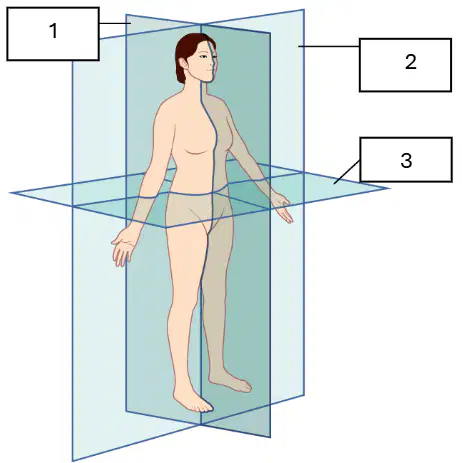
Enter the corresponding planes and their names through the body. Refer to the diagram of the human body with planes labeled 1, 2, and 3. (1) ________________ - divides body into left and right portions.
Sagittal plane
Transverse plane
Coronal plane
Oblique plane
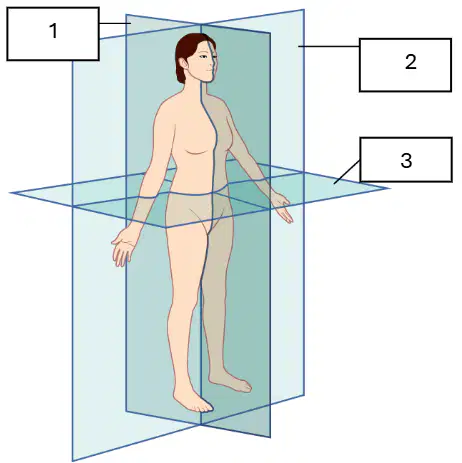
Enter the corresponding planes and their names through the body. Refer to the diagram of the human body with planes labeled 1, 2, and 3. (2) ________________ - divides body into anterior and posterior sections.
Coronal (frontal) plane
Sagittal (lateral) plane
Transverse (horizontal) plane
Oblique plane
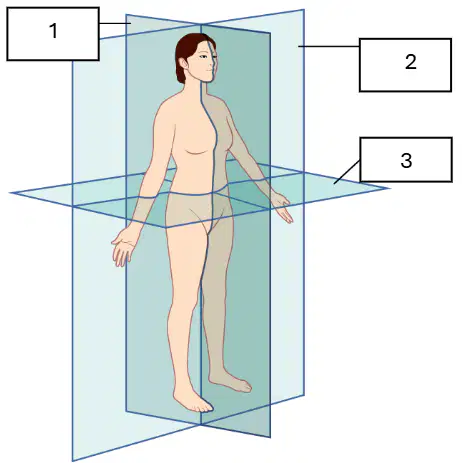
Enter the corresponding planes and their names through the body. Refer to the diagram of the human body with planes labeled 1, 2, and 3. (3) ________________ - divides body into superior and inferior sections.
Transverse (horizontal) plane
Sagittal plane
Coronal (frontal) plane
Oblique plane
Match the organ system to its respective function. ____________________________ - Performs the mechanical and chemical processes of digestion, absorption of nutrients, and elimination of wastes.
Digestive system
Respiratory system
Nervous system
Circulatory system
Match the organ system to its respective function.
Integumentary system
Respiratory system
Digestive system
Circulatory system
Match the organ system to its respective function.
Female reproductive system
Respiratory system
Digestive system
Nervous system
Match the organ system to its respective function. ____________________________ - System detects sensations, and controls movements, physiological processes, and intellectual functions.
Nervous system
Digestive system
Respiratory system
Circulatory system
Transports nutrients, waste products, gases, and hormones throughout the body; plays a role in the immune response and the regulation of body temperature via blood.
Cardiovascular system
Digestive system
Respiratory system
Nervous system
______________________________-Provides protection and support, allows body movements
Skeletal system
Digestive system
Respiratory system
Nervous system
______________________________-Removes foreign substances from the blood and lymph, combats disease, maintains tissue fluid balance, and absorbs fats from the digestive tract.
Lymphatic system
Respiratory system
Digestive system
Nervous system
A hormonal regulatory system that influences metabolism, growth, reproduction, and more.
Endocrine system
Respiratory system
Digestive system
Nervous system
______________________________-Produces and transfers sperm cells to the female and produces hormones that influence sexual functions and behaviors.
Male reproductive system
Female reproductive system
Digestive system
Respiratory system
______________________________-Removes waste products from the blood and regulates blood pH, ion balance, and water balance.
Urinary system
Respiratory system
Digestive system
Nervous system
______________________________-Exchanges oxygen and carbon dioxide between the blood and air and regulates blood ph.
Respiratory system
Digestive system
Nervous system
Skeletal system
Produces body movements, maintains posture, and produces body heat.
Muscular system
Digestive system
Respiratory system
Nervous system
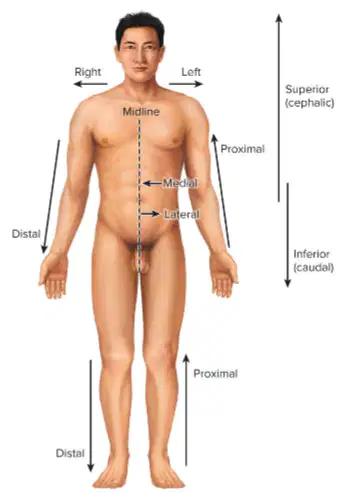
Circle the correct definition of the anatomical term: Superior.
A) AWAY the head.
B) TOWARDS the head.
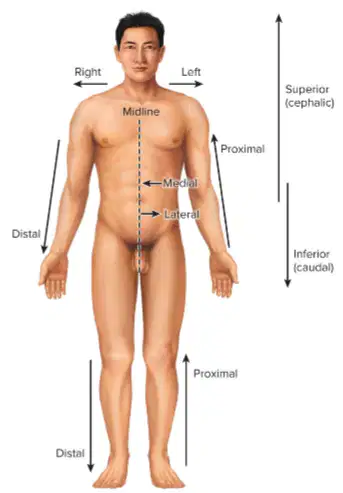
Circle the correct definition of the anatomical term: Distal.
A) AWAY FROM the trunk.
B) TOWARDS the trunk.
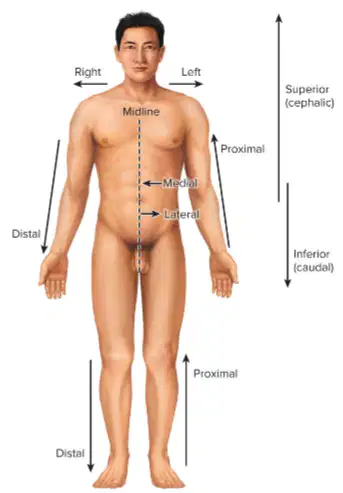
Circle the correct definition of the anatomical term: Lateral.
A) AWAY the midline.
B) TOWARD the midline.
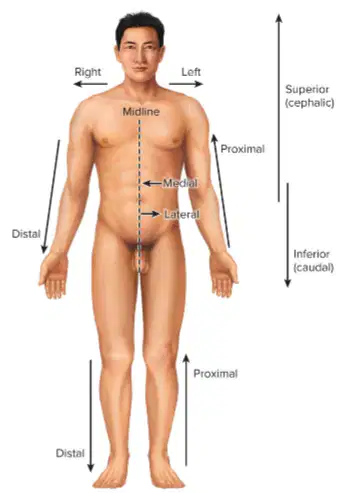
Circle the correct definition of the anatomical term: Proximal.
A) AWAY the trunk.
B) TOWARDS the trunk.
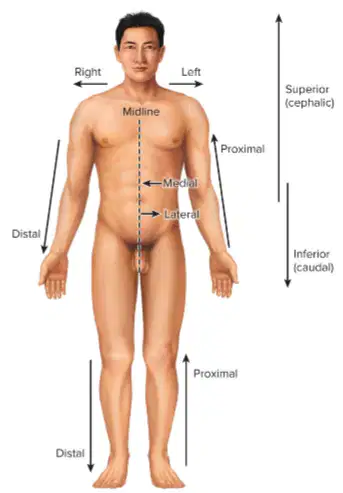
Circle the correct definition of the anatomical term: Inferior.
A) AWAY FROM the head.
B) TOWARDS the head.
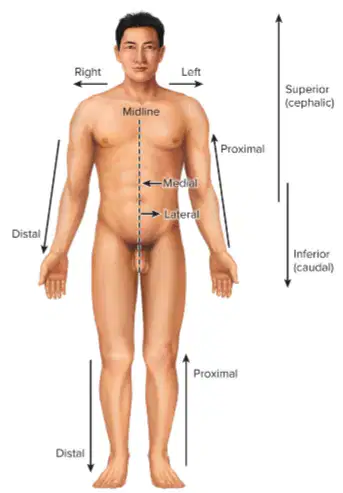
Circle the correct definition of the anatomical term: Medial.
A) AWAY the midline.
B) TOWARD the midline.

Circle the correct definition of the anatomical term 'Anterior'.
Forward
Backward
Ventral
Dorsal
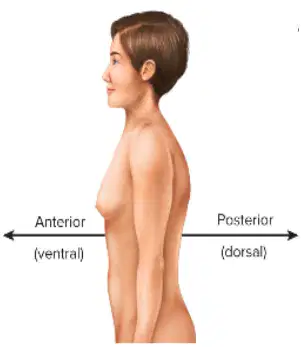
Circle the correct definition of the anatomical term 'Posterior'.
A) Forward
B) Backward
C) Ventral
D) Dorsal
Fill the blank with the appropriate directional terms. a) The toes are ______________ to the ankles.
anterior
posterior
lateral
proximal
Fill the blank with the appropriate directional terms.
b) Your belly button is ______________ to the shoulders.
inferior
superior
lateral
posterior
Fill the blank with the appropriate directional terms. c) The ears are ______________ to the nose.
lateral
medial
superior
inferior
Fill the blank with the appropriate directional terms. d) The guts are ______________ to the skin.
deep
superficial
lateral
anterior
Fill the blank with the appropriate directional terms. e) The thumb is ______________ to the palm.
lateral
medial
proximal
distal
Fill the blank with the appropriate directional terms. f) The eyes are ______________ to the eyebrows.
inferior
superior
lateral
medial
Fill the blank with the appropriate directional terms. g) The scalp is ______________ to the skull.
superficial
deep
inferior
medial
Fill the blank with the appropriate directional terms. h) The heart is ______________ to the ribs.
deep
superficial
lateral
inferior
Fill the blank with the appropriate directional terms. i) Your shoulders are ______________ to your elbows.
proximal
distal
inferior
lateral
The structural and functional organization of the human body can be represented by different levels. Which of the following correctly lists these levels in order from simplest to most complex?
Cell, Tissue, Organ, Organ System, Organism
Organism, Organ System, Organ, Tissue, Cell
Tissue, Cell, Organ, Organ System, Organism
Organ System, Organ, Tissue, Cell, Organism
Which has the highest electronegativity?
non-polar covalent bonds
ionic
polar covalent bonds
Which of these is NOT one of the four MAJOR elements found in the body?
A) Carbon
B) Calcium
C) Nitrogen
D) Hydrogen
E) Oxygen
In a solution of sugar water which of these is true?
Water is the solvent, and sugar is the solute
Water is the solution, and salt is the solvent
Water and sugar are both the solvent
Water is the solute, and sugar is the solvent
5. Solution A has a pH of 10, and solution B has a pH of 2. Which of the following statements about these solutions is true?
Solution B is basic.
Solution A has a higher H+ concentration than solution B.
Solution A is acidic.
Solution B has a higher H+ concentration than solution A.
Solution A and solution B are both basic.
Enzymes are…
Catalysts that slow down the rate of reaction by increasing the activation energy
Speed up the rate of reaction by increasing activation energy
Catalyst that speed up the rate of the reaction by decreasing the activation energy
Slow down the rate of the reaction by increasing activation energy
Anions are…
POSITIVELY CHARGED because they LOST electrons
NEGATIVELY CHARGED because they LOST electrons
POSITIVELY CHARGED because they GAINED electrons
NEGATIVELY CHARGED because they GAINED electrons
Which of the following is the correct complementary strand to CATGTC?
AGCACA
TCGTAT
GTACAG
GUACAG
CATGTC
Sodium has an atomic number of 11 and an atomic mass of 23. Sodium has ________.
12 neutrons and 11 protons
12 protons and 11 neutrons
12 electrons and 11 neutrons
12 protons and 11 electrons
12 electrons and 11 protons
In a polar covalent bond electron are…
NOT shared equally
shared equally
Covalent bonds electrons from one atom to another
In covalent bonding…
atoms share a pair of electrons
atoms fuse into one
electrons are transferred from one atom to another.
Finish the sentence at equilibrium in a reversible reaction…
Which has the Highest OH+ concentration?
Lemon Juice=3.2
Bleach=13.4
Pure water=7.00
Toothpaste=9.16
Which of the following statements correctly describes ATP?
Can be synthesized from ADP
Stores and releases energy in the cell
Is associated with anabolism and catabolism.
Is associated with a reversible reaction.
All of the choices are correct.
Which of the following correctly states the differences between acidic, basic, and neutral solutions in terms of pH, ion concentration, and properties?
Acidic solutions have pH less than 7, high H+ concentration; basic solutions have pH greater than 7, high OH- concentration; neutral solutions have pH 7, equal H+ and OH- concentrations.
Acidic solutions have pH greater than 7, high OH- concentration; basic solutions have pH less than 7, high H+ concentration; neutral solutions have pH 7, equal H+ and OH- concentrations.
Acidic solutions have pH 7, equal H+ and OH- concentrations; basic solutions have pH less than 7, high H+ concentration; neutral solutions have pH greater than 7, high OH- concentration.
Acidic solutions have pH greater than 7, high H+ concentration; basic solutions have pH less than 7, high OH- concentration; neutral solutions have pH 7, high H+ concentration.
Which of the following best describes the difference between saturated, unsaturated, and trans fats?
Saturated fats have no double bonds, unsaturated fats have one or more double bonds, and trans fats are unsaturated fats with trans double bonds.
Saturated fats have many double bonds, unsaturated fats have no double bonds, and trans fats are saturated fats with trans double bonds.
Saturated fats are always liquid at room temperature, unsaturated fats are always solid, and trans fats are always gaseous.
Saturated fats are only found in plants, unsaturated fats are only found in animals, and trans fats are only found in water.
Negative feedback is defined as a process in which a system responds to a change by returning to its original state. Which of the following is an example of negative feedback?
Regulation of body temperature in humans
Blood clotting after an injury
Childbirth contractions
Fruit ripening in response to ethylene
Positive Feedback is best defined as:
A process where the output enhances the original stimulus, such as blood clotting.
A process where the output reduces the original stimulus, such as temperature regulation.
A process that always leads to negative outcomes in biological systems.
A process that maintains a constant internal environment.
Fill in the blank: Negative feedback loops regulate and maintain homeostasis by ______ a certain stimulus and maintaining variables within the body’s set point.
opposing
amplifying
ignoring
initiating
Fill in the blank: Positive feedback loops amplify a stimulus by putting the body ______ out of homeostasis.
further
closer
inside
away
Negative and positive feedback loops relate to maintaining homeostasis by:
regulating internal conditions to keep them stable
causing rapid and uncontrolled changes in the body
preventing any changes in the internal environment
eliminating the need for body regulation
Name the anatomical plane: (1) ________, (2) ________, (3) ________.
(1) Sagittal, (2) Coronal, (3) Transverse
(1) Coronal, (2) Sagittal, (3) Oblique
(1) Transverse, (2) Oblique, (3) Coronal
(1) Oblique, (2) Transverse, (3) Sagittal
List the body systems:
Digestive System, Integumentary System, Female Reproductive System, Nervous System, Cardiovascular System, Skeletal System, Lymphatic System, Endocrine System, Male Reproductive System, Urinary System, Respiratory System, Muscular System
Digestive System, Circulatory System, Plant System, Nervous System, Cardiovascular System, Skeletal System, Lymphatic System, Endocrine System, Male Reproductive System, Urinary System, Respiratory System, Muscular System
Digestive System, Integumentary System, Female Reproductive System, Nervous System, Cardiovascular System, Skeletal System, Lymphatic System, Endocrine System, Male Reproductive System, Urinary System, Respiratory System, Excretory System
Digestive System, Integumentary System, Female Reproductive System, Nervous System, Cardiovascular System, Skeletal System, Lymphatic System, Endocrine System, Male Reproductive System, Urinary System, Respiratory System, Sensory System
Fill in the blank: The direction TOWARDS the midline is called ________.
TOWARDS
AWAY
ABOVE
BELOW
Fill in the blank: The direction AWAY from the midline is called ________.
AWAY
TOWARD
ABOVE
BELOW
Fill in the blank: The direction FORWARD is also known as ________.
VENTRAL
DORSAL
LATERAL
POSTERIOR
Fill in the blank: The direction BACKWARD is also known as ________.
DORSAL
VENTRAL
LATERAL
PROXIMAL
Fill in the blank: The anatomical term for 'farther from the point of attachment' is ________.
Distal
Proximal
Medial
Inferior
Fill in the blank: The anatomical term for 'closer to the feet and towards the midline' is ________.
Inferior AND medial
Superior AND lateral
Anterior AND distal
Posterior AND proximal
Fill in the blank: The anatomical term for 'towards the side' is ________.
Lateral
Medial
Distal
Proximal
Fill in the blank: The anatomical term for 'further from the surface' is ________.
Deep
Superficial
Lateral
Anterior
Fill in the blank: The anatomical term for 'closer to the surface' is ________.
Superficial
Deep
Distal
Medial
Fill in the blank: The anatomical term for 'closer to the head and closer to the point of attachment' is ________.
Superior AND Proximal
Inferior AND Distal
Anterior AND Lateral
Posterior AND Distal
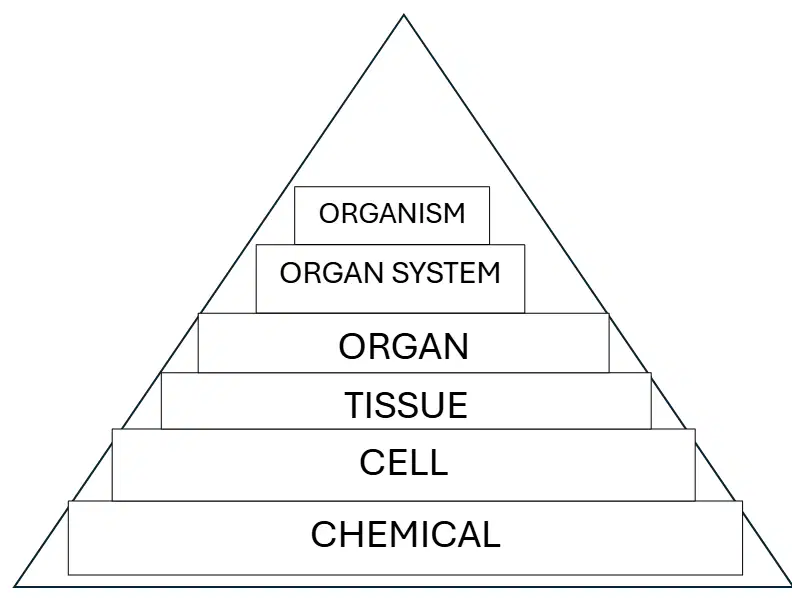
Refer to the pyramid diagram showing levels of biological organization. What is the lowest level of organization in the pyramid?
CHEMICAL
CELLULAR
TISSUE
ORGAN
What level comes directly above CELL in the pyramid?
TISSUE
ORGANELLE
MOLECULE
ORGAN SYSTEM
Refer to the pyramid diagram showing levels of biological organization. Which of the following is the correct order from simplest to most complex?
A) ORGANISM, ORGAN SYSTEM, ORGAN, TISSUE, CELL, CHEMICAL
B) CHEMICAL, CELL, TISSUE, ORGAN, ORGAN SYSTEM, ORGANISM
C) CELL, CHEMICAL, TISSUE, ORGAN, ORGAN SYSTEM, ORGANISM
D) CHEMICAL, TISSUE, CELL, ORGAN, ORGAN SYSTEM, ORGANISM
Refer to the pyramid diagram showing levels of biological organization. What is the highest level of organization in the pyramid?
ORGANISM
CELL
TISSUE
ORGAN
Refer to the pyramid diagram showing levels of biological organization. Which level comes between ORGAN SYSTEM and TISSUE?
ORGAN
CELL
MOLECULE
ECOSYSTEM
Which level is directly below ORGAN SYSTEM in the pyramid?
ORGAN
CELL
TISSUE
MOLECULE
Which statement correctly describes the differences between acidic, basic, and neutral solutions in terms of pH, ion concentration, and properties?
Acidic solutions have pH less than 7, higher H+ concentration; basic solutions have pH greater than 7, higher OH- concentration; neutral solutions have pH 7, equal H+ and OH- concentrations.
Acidic solutions have pH greater than 7, higher OH- concentration; basic solutions have pH less than 7, higher H+ concentration; neutral solutions have pH 7, equal H+ and OH- concentrations.
Acidic solutions have pH 7, equal H+ and OH- concentrations; basic solutions have pH less than 7, higher H+ concentration; neutral solutions have pH greater than 7, higher OH- concentration.
Acidic solutions have pH greater than 7, equal H+ and OH- concentrations; basic solutions have pH less than 7, equal H+ and OH- concentrations; neutral solutions have pH 7, higher H+ concentration.
Saturated, unsaturated, and trans fats differ in their chemical structure and health effects. Which of the following correctly matches each type with an example?
Saturated fat - butter; Unsaturated fat - olive oil; Trans fat - margarine
Saturated fat - olive oil; Unsaturated fat - butter; Trans fat - coconut oil
Saturated fat - margarine; Unsaturated fat - coconut oil; Trans fat - butter
Saturated fat - olive oil; Unsaturated fat - margarine; Trans fat - butter
Which of the following organ systems is primarily responsible for exchanging oxygen and carbon dioxide between the body and the environment?
Digestive system
Endocrine system
Muscular system
Respiratory system
Fill the blank with the appropriate directional terms.
e) The wrist is ______________ to the elbow.
superior
medial
proximal
distal
Circle the correct definition of the anatomical term: Lateral.
B) TOWARD the midline.
A) AWAY from the midline.
Which anatomical term describes a position closer to the surface of the body?
Superficial
Deep
Inferior
Medial
______________________________-Removes waste products from the blood and regulates water and electrolyte balance.
Digestive system
Endocrine system
Respiratory system
Urinary system
Fill the blank with the appropriate directional terms.
f) The heart is ______________ to the sternum.
superior
anterior
posterior
lateral
Fill the blank with the appropriate directional terms.
c) The heart is ______________ to the lungs.
medial
lateral
inferior
superior
Which plane divides the body into right and left portions?
Oblique plane
Transverse (horizontal) plane
Sagittal (lateral) plane
Coronal (frontal) plane
Which organ system is primarily responsible for protecting the body from external harm and regulating body temperature?
Integumentary system
Digestive system
Respiratory system
Endocrine system

