
 Worksheets
Oceans
Total questions: 75
Worksheet time: 38mins
What are the 5 oceans on Earth?
Pacific Ocean, Atlantic Ocean, Indian Ocean, Southern Ocean, Arctic Ocean
Pacific Ocean, Atlantic Ocean, Indian Ocean, Mediterranean Sea, Red Sea
Pacific Ocean, Atlantic Ocean, Indian Ocean, Caribbean Sea, Baltic Sea
Pacific Ocean, Atlantic Ocean, Indian Ocean, Black Sea, Caspian Sea
Oceans are important because they:
Provide oxygen, regulate climate, and support marine life.
Are only used for transportation.
Have no impact on the Earth's climate.
Are not connected to the water cycle.
Oceans are important because they:
Regulate the Earth's climate and support marine life
Are smaller than lakes
Contain only fresh water
Have no effect on weather patterns
Oceans are important features of the Earth because they:
cover most of the Earth's surface and support diverse life forms
are the smallest bodies of water on Earth
do not affect the Earth's climate
exist only at the North and South Poles
The five oceans can be listed based on their size as follows.
Pacific, Atlantic, Indian, Southern, Arctic
Atlantic, Pacific, Indian, Arctic, Southern
Indian, Pacific, Atlantic, Southern, Arctic
Arctic, Southern, Indian, Atlantic, Pacific
The five oceans of the world are:
Pacific, Atlantic, Indian, Southern, Arctic
Pacific, Atlantic, Mediterranean, Indian, Arctic
Atlantic, Indian, Red Sea, Pacific, Arctic
Pacific, Atlantic, Indian, Baltic, Arctic
From largest to smallest, what is the name of the largest ocean?
Pacific Ocean
Atlantic Ocean
Indian Ocean
Arctic Ocean
From largest to smallest, what is the name of the second largest ocean?
Atlantic Ocean
Indian Ocean
Southern Ocean
Arctic Ocean
From largest to smallest, what is the name of the third largest ocean?
Indian Ocean
Atlantic Ocean
Southern Ocean
Arctic Ocean
From largest to smallest, what is the name of the fourth largest ocean?
Southern Ocean
Arctic Ocean
Indian Ocean
Atlantic Ocean
From largest to smallest, what is the name of the smallest ocean?
Arctic Ocean
Atlantic Ocean
Indian Ocean
Pacific Ocean
How many oceans are there in total?
5
4
6
3
Which of the following is the largest ocean?
Atlantic Ocean
Indian Ocean
Pacific Ocean
Arctic Ocean
Oceans are important features of the Earth because they:
regulate climate and support diverse life forms
cover only a small part of the Earth's surface
are not connected to the water cycle
have no impact on weather patterns
List the five oceans based on their size, from largest to smallest.
Pacific Ocean, Atlantic Ocean, Indian Ocean, Southern Ocean, Arctic Ocean.
Atlantic Ocean, Pacific Ocean, Indian Ocean, Arctic Ocean, Southern Ocean.
Indian Ocean, Pacific Ocean, Atlantic Ocean, Southern Ocean, Arctic Ocean.
Arctic Ocean, Southern Ocean, Indian Ocean, Atlantic Ocean, Pacific Ocean.
According to the passage, the Pacific Ocean is located south of which strait?
Gibraltar Strait
Bering Strait
Magellan Strait
Malacca Strait
The Pacific Ocean is west of _________. (Fill in the blank using the passage.)
North and South America
Europe and Asia
Africa and Australia
Antarctica and Greenland
The Pacific Ocean is north of 60°S latitude.
True
False
Based on the passage and the map, which continents are east of the Pacific Ocean?
A) Asia and Australia
B) North and South America
C) Europe and Africa
D) Antarctica
What is the area of the Pacific Ocean?
100 million square miles
165.25 million square miles
200 million square miles
50 million square miles
What is the average depth of the Pacific Ocean?
14,041 feet
5,000 feet
20,000 feet
30,000 feet
What is the deepest point in the Pacific Ocean called?
Mariana Trench
Tonga Trench
Puerto Rico Trench
Java Trench
The Pacific Ocean covers about what percentage of the Earth's total surface area?
10.5%
20.5%
30.5%
40.5%
60% of all the Earth's fish come from the Pacific Ocean.
True
False
By how many centimeters does the Pacific Ocean shrink each year due to tectonic plates?
Two centimeters
Ten centimeters
Half a centimeter
Twenty centimeters
What percentage of the Earth's volcanoes are found in the Pacific Ocean?
75%
25%
50%
90%
Who named the Pacific Ocean 'Mar Pacifico' in 1521?
The Portuguese
The Spanish
The Dutch
The French
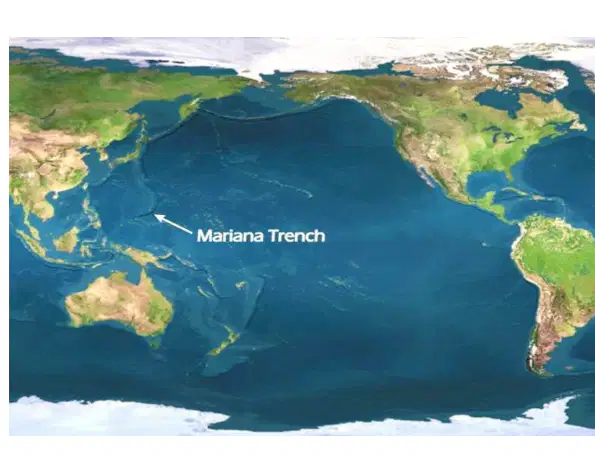
Where is the Mariana Trench located?
Atlantic Ocean
Indian Ocean
Pacific Ocean
Arctic Ocean
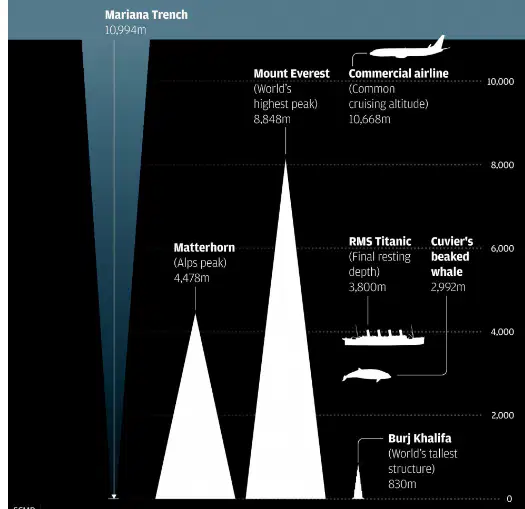
What is the depth of the Mariana Trench?
8,848m
10,994m
4,478m
3,800m
Fill in the blank: The Mariana Trench is the _______ point in the world's oceans.
deepest
highest
coldest
widest
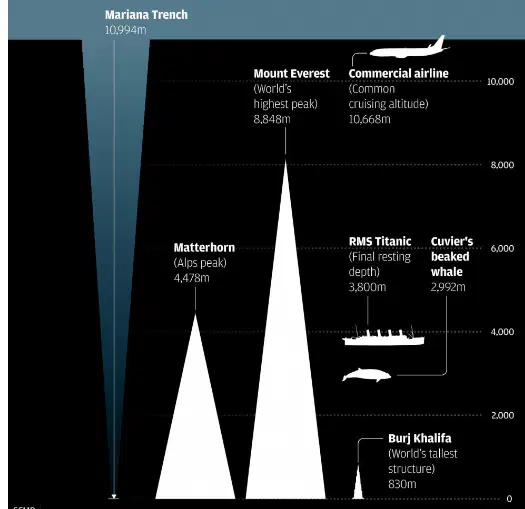
Which of the following is the world's highest peak?
Matterhorn
Mount Everest
Burj Khalifa
Mariana Trench
What is the 'Ring of Fire' known for?
Earthquakes
Volcanoes
Hurricanes
Tornadoes
How many volcanoes are in the Ring of Fire?
452
120
89
300
Which ocean is surrounded by the Ring of Fire?
Pacific Ocean
Atlantic Ocean
Indian Ocean
Arctic Ocean
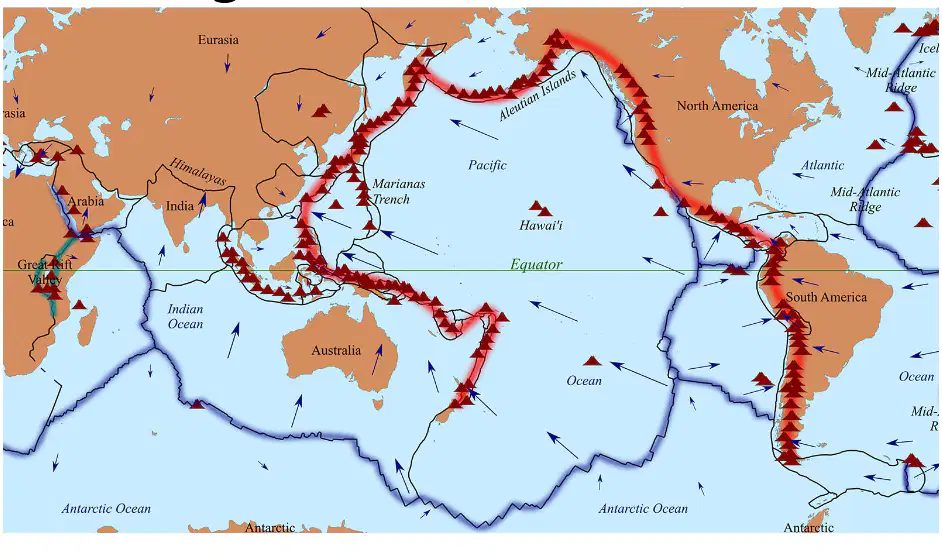
The red line around the Pacific Ocean on the map represents:
The Ring of Fire
The Equator
The International Date Line
The Prime Meridian
What is the average depth of the Pacific Ocean in feet?
14,041 feet
5,280 feet
20,000 feet
35,000 feet
What is the deepest point in the Pacific Ocean and how deep is it?
Mariana Trench, 35,787 feet
Tonga Trench, 25,850 feet
Philippine Trench, 34,580 feet
Kermadec Trench, 32,963 feet
What percentage of Earth's total surface area does the Pacific Ocean cover?
30.5%
15.2%
22.8%
40.1%
60% of the world’s fish come from the Pacific Ocean.
True
False
The Pacific Ocean shrinks in size by just over two centimetres each year.
True
False
The Pacific Ocean Basin is home to 75% of the world’s volcanoes.
True
False
How many islands are there in the Pacific Ocean?
More than 25,000 islands
Less than 1,000 islands
About 5,000 islands
Exactly 10,000 islands
In what year was the Pacific Ocean declared “Mar Pacifico” and what does it mean in Portuguese?
1521; Peaceful Sea
1492; Great Ocean
1600; Calm Waters
1550; Blue Expanse
According to the passage, what is a unique characteristic of the Atlantic Ocean compared to other oceans?
It has many islands
It is a relatively narrow body of water
It is the largest ocean
It is surrounded only by Europe and Africa
The Atlantic Ocean is located between which continental masses?
The Americas, Europe, and Africa
Asia and Australia
Antarctica and Asia
Australia and Africa
Based on the passage and the map, which ocean is to the north of the Atlantic Ocean?
The Arctic Ocean
The Indian Ocean
The Pacific Ocean
The Southern Ocean
The Atlantic Ocean has North and South America to the west, and ______ and Africa to the east.
Europe
Asia
Australia
Antarctica
The Atlantic Ocean contains most of our planet's shallow seas but has relatively few islands.
True
False
According to the passage, what is the area of the Atlantic Ocean?
51.175 million square miles
20.8 million square miles
10,954 million square miles
28,231 million square miles
According to the passage, what is the average depth of the Atlantic Ocean?
10,954 feet
5,000 feet
20,000 feet
15,500 feet
According to the passage, what is the deepest point in the Atlantic Ocean?
Mariana Trench
Puerto Rico Trench
Mid Atlantic Ridge
Sea of Atlas
According to the passage, the Atlantic Ocean covers about ____% of the total surface area of the Earth.
20.8
35.4
12.6
28.1
According to the passage, the name Atlantic comes from the Greek word ________.
Atlantikos
Okeanos
Poseidon
Aegean
According to the passage, the Atlantic Ocean is the world's ______ sea.
saltiest
deepest
largest
coldest
According to the passage, which is the world's youngest ocean?
Pacific Ocean
Indian Ocean
Atlantic Ocean
Arctic Ocean
According to the passage, what is the name of the earth's largest mountain range found in the Atlantic Ocean?
Andes
Himalayas
Mid Atlantic Ridge
Rockies
What is the size of the Atlantic Ocean in million square miles?
51.17 million square miles
32.45 million square miles
21.94 million square miles
65.23 million square miles
What is the average depth of the Atlantic Ocean in feet?
10,954 feet
5,000 feet
20,000 feet
15,000 feet
What is the deepest point in the Atlantic Ocean?
Puerto Rico Trench, 28,231 feet
Milwaukee Deep, 20,000 feet
Romanche Trench, 25,000 feet
South Sandwich Trench, 27,000 feet
What percentage of Earth's total surface area does the Atlantic Ocean cover?
20.8%
14.5%
32.1%
25.3%
Where does the name 'Atlantic' come from?
The Greek word Atlantikos, known in English as the Sea of Atlas
The Latin word Atlanticus, meaning 'great ocean'
The name of an ancient Roman city
A mythological sea monster
What is the water salinity level of the Atlantic Ocean in parts per thousand?
Between 33 – 37 parts per thousand
Between 20 – 25 parts per thousand
Between 10 – 15 parts per thousand
Between 40 – 45 parts per thousand
Which is the world's youngest ocean, formed long after the Pacific, Indian, and Arctic Oceans of the Triassic Period?
The Atlantic Ocean
The Southern Ocean
The Mediterranean Sea
The Red Sea
What is the name of the earth's largest mountain range located in the Atlantic Ocean?
The Mid Atlantic Ridge
The Andes
The Himalayas
The Rocky Mountains
According to the passage, which continents enclose the Indian Ocean on three sides?
A) Africa, Asia, and Australia
B) Europe, North America, and South America
C) Africa, Europe, and Australia
D) Asia, Antarctica, and Africa
Fill in the blank: The southern border of the Indian Ocean is wide open and exchanges with the much colder ________ Ocean.
Southern
Atlantic
Pacific
Arctic
True or False: The Indian Ocean is completely enclosed by landmasses on all sides.
True
False
Which ocean does the Indian Ocean exchange with at its southern border?
Atlantic Ocean
Pacific Ocean
Southern Ocean
Arctic Ocean
According to the passage, what is the area of the Indian Ocean in square miles?
45.7 million square miles
12.3 million square miles
28.5 million square miles
60.2 million square miles
What is the average depth of the Indian Ocean?
12,992 feet
5,000 feet
20,000 feet
8,500 feet
What is the deepest point in the Indian Ocean called?
Sunda Deep Trench
Mariana Trench
Puerto Rico Trench
Tonga Trench
The Indian Ocean covers what percentage of Earth's total surface area?
14.4%
9.2%
21.3%
6.8%
Which ocean is the warmest in the world?
Indian Ocean
Atlantic Ocean
Arctic Ocean
Pacific Ocean
Approximately what percentage of the world's oil comes from the Indian Ocean?
40%
10%
25%
60%
The Indian Ocean becomes approximately 8 inches wider each year.
True
False

