
 Worksheets
Reporting Category 1 Assessment - Matter and Energy
Total questions: 21
Worksheet time: 21mins
An igloo is made of ice and snow. Which state of matter is used to make an igloo?
Liquid
Solid
Water
Gas
The substance being dissolved in a solution is called the —
solute
solvent
variable
not here
On a hot, sunny day, which playground equipment will probably be too hot to touch?
Metal climbing tower
Plastic slide
Wooden bridge
Rubber bounce house
Which process occurs when dew forms on grass in the morning?
Condensing
Melting
Freezing
None of these
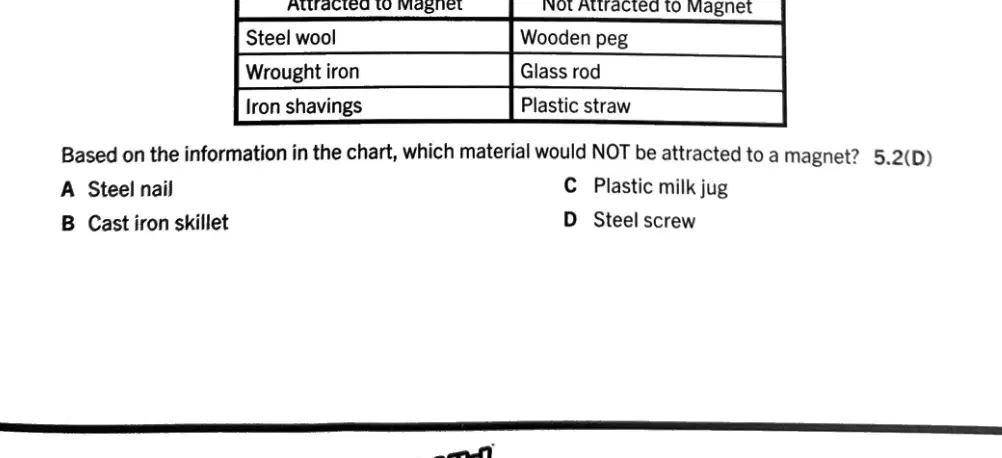
The chart shows items classified using the property of magnetism. | Attracted to Magnet | Not Attracted to Magnet | |--------------------|------------------------| | Steel wool | Wooden peg | | Wrought iron | Glass rod | | Iron shavings | Plastic straw | Based on the information in the chart, which material would NOT be attracted to a magnet?
Steel nail
Cast iron skillet
Plastic milk jug
Steel screw
Students are combining ingredients to make solutions. Which of the following is a way they could speed up the process of combining sugar and water?
Allow the solution to sit undisturbed
Heat the water
Add more sugar to the solution
All of the above
Students combine sand, water, and iron filings in paper cups to learn about separating mixtures. After the investigation, how should the students properly dispose of the materials?
Pour the sand, water, and iron filings down the drain, rinse the sink, and throw the paper cup in the trash.
Remove the iron filings, saving them for future use. Drain the water from the sand, saving it for future use, and throw the paper cup in the trash.
Throw the sand, water, and iron filings in the trash. Wash hands.
Empty the mixture of sand, water, and iron filings on the playground beside the school.
A student leaves snow-covered boots in front of the fire for many hours. When the student comes to get them, the snow is gone and puddles of water surround the boots. Which statement correctly describes the boots after they warm by the fire?
The snow on the boots remains solid and unchanged.
The snow on the boots changes from a solid to a liquid.
The snow on the boots changes from a liquid to a gas.
The snow on the boots became a solid form of water.
Which equipment is necessary when mixing sand and water?
Fire blanket and fire extinguisher
Chemical splash goggles and gloves
Fire blanket and safety goggles
Gloves and fire extinguisher

Which tool is necessary when using evaporation to separate a solution?
F (image of a strainer)
G (image of a compass)
H (image of a dropper)
J (image of a hot plate)
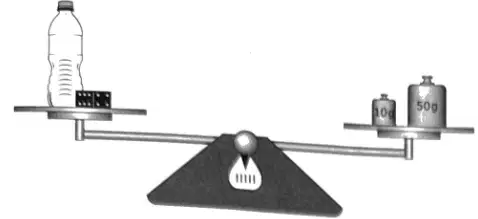
The objects on the left of the pan have a mass that is —
more than 60 grams
less than 60 grams
equal to 60 grams
less than 15 grams
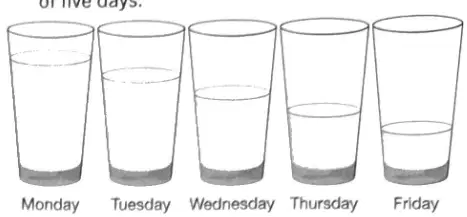
A glass of water was left outside over a period of five days. What caused the level of water in the glass to decrease each day?
Heat over time caused the water to evaporate.
Colder temperatures changed the water from liquid to solid.
Melting caused less liquid to appear in the glass.
Heat caused the water to boil.
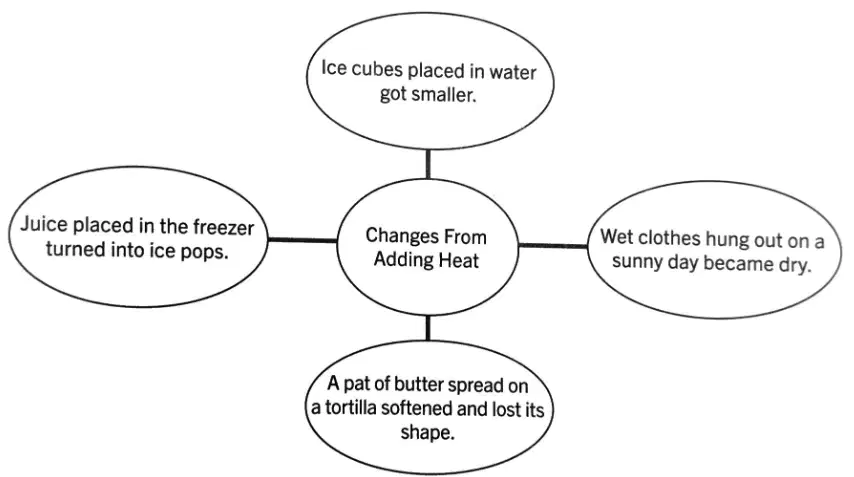
A student makes a graphic organizer to brainstorm changes that occur when heat is added. Which change did the student list incorrectly?
Ice cubes placed in water got smaller.
Wet clothes hung out on a sunny day became dry.
A pat of butter spread on a tortilla softened and lost its shape.
Juice placed in the freezer turned into ice pops.
A student is investigating mixtures. Which of the following is the best way to separate a mixture of gravel and sand?
Separate the mixture using a coffee filter
Separate the mixture by evaporation
Separate the mixture using a magnet
Separate the mixture using a sieve
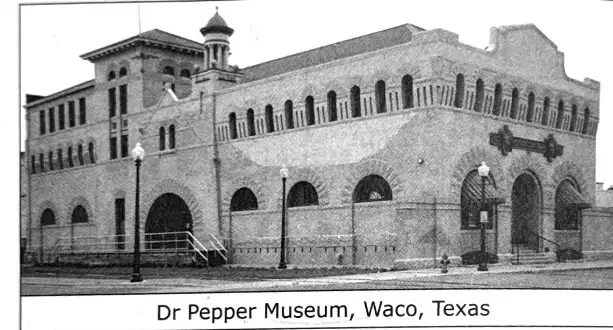
What inventor is credited with developing the mixture, Dr Pepper?
Robert Lazenby
Charles Alderton
Mr. Morrison
Charles Pepper
What characteristic of Dr Pepper makes it a solution?
It contains more than one ingredient.
It was developed using a recipe.
It contains dissolved fruit syrups and carbonated gas.
It can be separated using a filter.

States of matter such as solids, liquids, and gases
physical property
matter
physical state
mixture

A student places an ice cube into a cup. The student moves the cup into the sun and records observations. The student's observations are shown below.
Which statement is NOT supported by the data?
Water is always a liquid
Ice is the solid form of water
Ice melts when heat is added
Water can become a liquid when heated.

Student measured 100ml of water and poured it inside a beaker. The teacher then asked the students to place 50 ml of water in the freezer and 50 ml of water in a hotplate for 20 minutes. What did the students most likely observe after 20 minutes
The water in the freezer became a solid while the water on the hotplate evaporated
The water in the freezer stayed a liquid, while the water on the hotplate was boiling
The water in the freezer "disappeared: while the water in the hotplate stayed a liquid
Both the water in the freezer and the hotplate keep the same state of matter
Which of the following is an example of a solid changing to a liquid?
water boiling in a tea kettle
snow melting when the sun is shining
rain freezing when it falls on a cold surface
clouds forming from water vapor
What is the effect of temperature on the state of matter?
Increasing temperature can turn a solid into a liquid.
Increasing temperature can turn a gas into a liquid.
Decreasing temperature can turn a liquid into a gas.
Decreasing temperature can turn a gas into a solid.

