wayground logo

Free Printable Worksheets

Font size

S
M
L
XL
Worksheets

Harnessing Human Energy Retake Assessment

Total questions: 22

Worksheet time: 11mins
Name
Class
Date
1.
A student walking is an example of which type of energy?
a)
Potential Energy
b)
Thermal Energy
c)
Kinetic Energy
d)
Situational Energy
2.
A stretched balloon or rubber band has which type of energy?
a)
Potential Energy
b)
Thermal Energy
c)
Kinetic Energy
d)
Situational Energy
3.
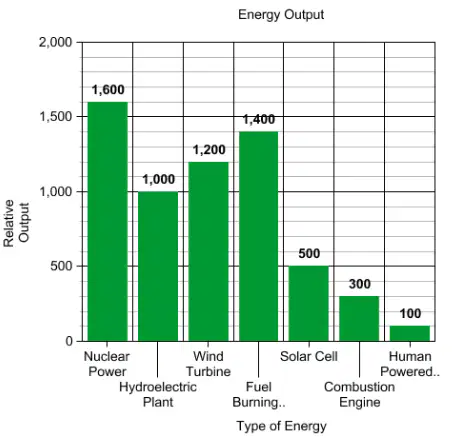
Look at this graph, which has the most energy output, and how do you know?
a)
Nuclear Power- it is created by energy from uranium.
b)
Wind Turbines- it is natural energy that is around us all the time.
c)
Nuclear Power- it has the tallest bar on the graph.
d)
Human Powered Energy- it has the shortest bar on the graph.
4.
How are potential energy and kinetic energy related in a system?
a)
Energy can't be created or destroyed, they are not related.
b)
One is chemical and one is physical.
c)
As potential energy decreases, kinetic energy increases.
d)
As potential energy increases, kinetic energy also increases.
5.
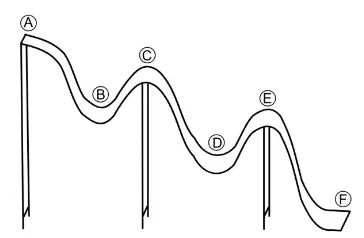
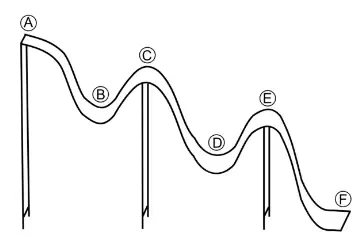
Out of the choices given, where does the roller coaster most likely have the most Potential Energy?
a)
Point C
b)
Point D
c)
Point E
d)
Point F
6.
Out of the choices given, where does the roller coaster most likely have the most increase of Kinetic Energy?
a)
From B to C
b)
From C to D
c)
Point E
d)
Point F
7.
Choose the answer that best describes the diagram.
a)
The flywheel creates energy, transferring to the generator, which transfers energy to the battery, and that energy makes the light shine.
b)
The crank creates energy that moves the flywheel, transferring to the generator, which transfers energy to the battery, and that energy makes the light shine.
c)
Potential energy from the flywheel moving is being transferred to the generator, which creates energy in the battery, and that energy makes the light shine.
d)
Kinetic energy from the flywheel moving is being transferred to the generator, which transfers energy to the battery, and that energy makes the light shine.
8.
Which statement is most correct about energy?
a)
Energy can be transferred, but never converted.
b)
Potential Energy is created and Kinetic Energy is the energy of movement.
c)
Energy cannot be created or destroyed.
d)
Kinetic Energy is created when it is transferred from Potential Energy.
9.
`A rescue worker wants to have an emergency back up system, in case he runs out of electricity. Which answer best describes what can happen?
a)
They can use a hand crank, kinetic energy from turning the crank will be converted to electrical energy which can power lights.
b)
They can use a hand crank to create potential energy, which powers lights.
c)
There is no way to have power without electricity.
d)
They can use a hand crank to create thermal energy, which will power lights.
10.
Which pieces of Evidence support Claim 2?
a)
Evidence 2, 4, 6
b)
Evidence 1, 3
c)
All the evidence supports Claim 1.
d)
There is no way to tell if these pieces of evidence support or refute the claim.
11.
In lab, we connected a battery to a fan. What was our evidence that there was energy in the system?
a)
The fan moved.
b)
The battery worked.
c)
We connected cables to the fan.
d)
There was no energy in the system.
12.
Why did the fan moving support the claim that the system had energy?
a)
We saw movement.
b)
There was a battery involved.
c)
The cables made the system.
d)
Energy is the ability to make things move or change.
13.
Using the data table in the passage above, determine the claim that answers the question: How does the mass of an object affect the kinetic energy it has?
a)
The more mass an object has, the less kinetic energy it has.
b)
The more mass an object has, the more kinetic energy it has.
c)
Mass and kinetic energy are not realated.
d)
Energy cannot be created or destroyed.
14.

What is the evidence that supports the claim that, "The more mass an object has, the more kinetic energy it has."?

a)
A 4 kg bowling ball is exactly double the mass of a 2 kg bowling ball. It also has exactly double the kinetic energy.
b)
There is no evidence to support the claim- it's common sense.
c)
The velocity remained the same as the mass increased. So speed is not affected by mass.
d)
The article states: "When a bowler releases the ball, it starts moving and gains mechanical kinetic energy."
15.

Which statement is the reasoning that connects the claim, "The more mass an object has, the more kinetic energy it has". and the evidence?

a)
There is no possible reasoning.
b)

As the mass increases, the velocity stayed the same. All the balls traveled at the same speed.

c)

As the mass increases, the kinetic energy decreases, thus if an object has more mass, there will be less kinetic energy and less power.

d)

As the mass increases, the kinetic energy increases, thus if an object has more mass, like the bowling ball then it has the power to knock down more pins.

16.

Thomas, Marcus, and Jesus are at a bowling alley, each choosing their favorite bowling ball. The balls come in different masses and are rolled at the same velocity. The table below shows the kinetic energy of different bowling balls rolled at the same speed. Use the information in the table to answer the question. Thomas used the plastic ball. Marcus used the resin ball the same size as Thomas's, but Jesus grabbed the heaviest ball he could carry. (Bowling Ball Mass, Velocity, and Kinetic Energy table). Take a closer look at these numbers: ✓ A 4 kg ball has exactly double the mass of a 2 kg ball. It also has exactly double the kinetic energy. ✓ A 6 kg ball has exactly double the mass of a 3 kg ball. It also has exactly double the kinetic energy. Who is most likely to knock down all the pins if they each roll the ball straight down the middle of the lane?

a)

Thomas

b)

Marcus

c)

Jesus

d)

Ms. Gutierrez

17.

Richard is conducting a controlled experiment with toy cars of different masses speeding down a ramp. He makes sure to keep the speed the same. He observes how the kinetic energy changes as he increases the mass of the cars. Which statement is the reasoning that connects Richard's claim and the evidence?

a)

There is no possible reasoning.

b)

As the mass increases, the velocity stayed the same.

c)

As the mass increases, the kinetic energy decreases, thus if an object has more mass, there will be less kinetic energy.

d)

As the mass increases, the kinetic energy increases, thus if an object has more mass, there will be more kinetic energy.
18.

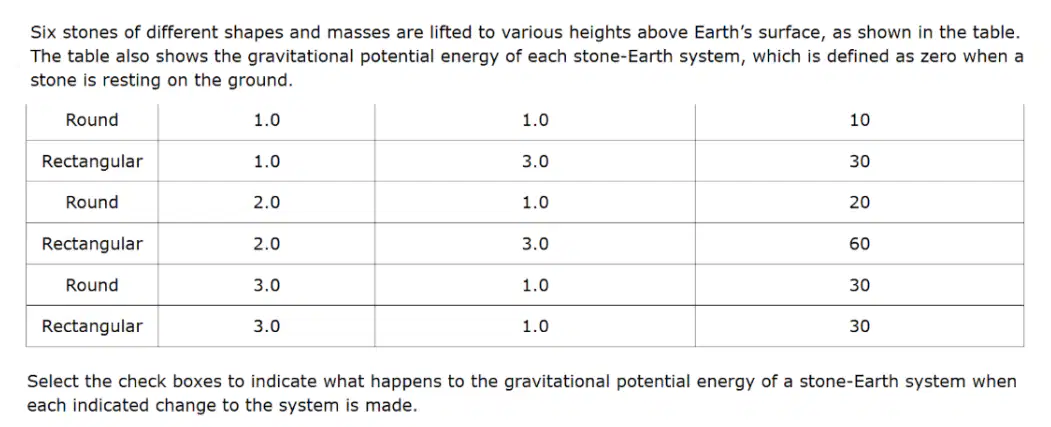
Read the data table, then select the boxes to indicate what type of change, if any occurs.  1st column is the mass, 2nd is the height lifted, 3rd is the gravitational potential energy.

A round stone is replaced with a rectangular stone.

a)

The potentional energy will increase.

b)

The potentional energy will decrease.

c)

The potentional energy will remain the same.

19.

Read the data table, then select the boxes to indicate what type of change, if any, occurs.  1st column is the mass, 2nd is the height lifted, 3rd is the gravitational potential energy.

A stone is replaced with another stone that is half the mass.

a)

The potentional energy will increase.

b)

The potentional energy will decrease.

c)

The potentional energy will remain the same.

20.

Read the data table, then select the boxes to indicate what type of change, if any, occurs.  1st column is the mass, 2nd is the height lifted, 3rd is the gravitational potential energy.

A stone is lifted to a height that is 2.0 meters higher than before.

a)

The potentional energy will increase.

b)

The potentional energy will decrease.

c)

The potentional energy will remain the same.

21.

Look at the diagram and the corresponding graph. What happens to the speed and the kinetic energy as the skater moves from Position A to Position B? The speed ______

a)

Approximately Halved

b)

Approximately Doubled

c)

Approximately Quadrupled

d)

Stays the Same

22.

Look at the diagram and the corresponding graph. What happens to the speed and the kinetic energy as the skater moves from Position A to Position B? The kinetic energy ______

a)

Approximately Halved

b)

Approximately Doubled

c)

Approximately Quadrupled

d)

Stays the Same