
Font size
 Worksheets
Properties of Different Substances
Total questions: 27
Worksheet time: 17mins
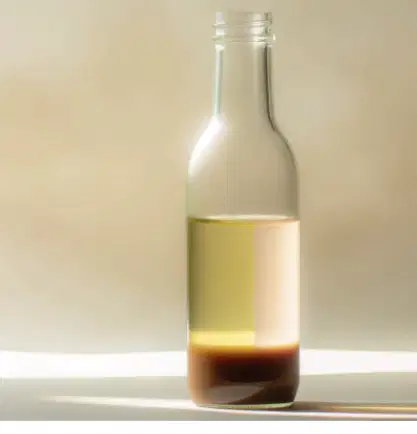
What type of mixture is the salad dressing?
Element
Compound
Homogeneous mixture
Heterogeneous mixture
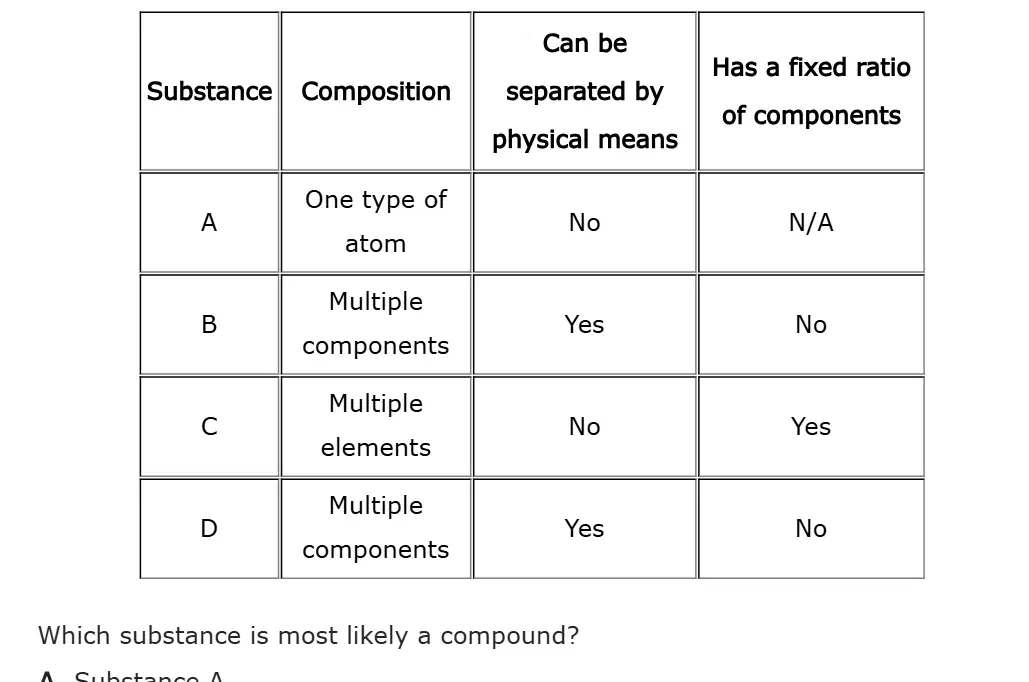
Which substance is most likely a compound?
Substance A because is made of one type of atom
Substance B because is made of multiple components not chemically combined
Substance C because its made of multiple elements
Substance D because is made of multiple components not chemically combined
Which of the following best describes the difference between an element and a compound?
An element is a pure substance that cannot be separated into simpler substances, while a compound is a mixture that can be separated into simpler substances by chemical means.
An element is always a gas at room temperature, while a compound can be a solid, liquid, or gas.
An element is made up of only one type of atom, while a compound is made up of two or more types of atoms.
An element has a uniform composition, while a compound has a non-uniform composition.
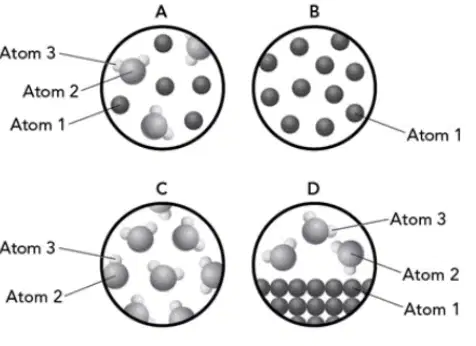
Which mixture is classified as a homogeneous mixture?
A, because not chemically combined, and the substances are uniformly mixed.
B, because it contains only one type of atom
C, because it contains two or more types of atoms that are all chemically combined.
D, because not chemically combined, and the substances are not uniformly mixed.
Which of these mixtures are heterogeneous?
Sand and water
Sugar and water
Oil and vinegar
Sand and water
Iron filings and sulfur powder
Oil and vinegar
Sugar and water
Iron filings and sulfur powder
Oil and vinegar
Sand and water
Iron filings and sulfur powder
Sugar and water
In the context of water transport in plants, which of the following statements best describes the relationship between cohesion and adhesion?
Cohesion and adhesion work together to move water upward through the xylem in the plant.
Cohesion pulls the water upward, while adhesion pulls the water downward.
Adhesion pulls the water upward, while cohesion does not affect the water's movement.
Neither cohesion nor adhesion plays a role in capillary action.
A student dips one end of a paper towel into a glass of water and observes that the water travels up the towel, eventually reaching the other end. Which of the following best explains how cohesion and adhesion contribute to this phenomenon?
Cohesion and adhesion do not affect the movement of water through the paper towel.
Cohesion causes water to evaporate from the paper towel, while adhesion causes the water to condense on its surface.
Cohesion pulls the water molecules upward through the spaces between the paper towel fibers, while adhesion keeps the water attached to the fibers.
Adhesion pulls the water molecules upward through the spaces between the paper towel fibers while cohesion keeps them together.
Le is learning how plants move water upward from their roots. She knows that water molecules attract each other and also cling to the inside of narrow tubes in plants. Which of the following best explains how these forces allow water to move upward against gravity?
Cohesion forces water to sink to the bottom, while adhesion keeps it from flowing out.
Gravity pushes water through the tubes while surface tension holds it together.
Only adhesion moves water upward, because cohesion has no effect on this process.
Adhesion helps water stick to the tubes, and cohesion pulls other molecules upward with it.
Isabel is exploring different natural phenomena related to water. Which of these scenarios is most directly influenced by water's cohesion AND adhesion properties?
A paperclip floating on the surface of water.
Water climbing up the stem of a plant.
Raindrops forming puddles on the sidewalk.
Ice melting into liquid water in a glass.
Roger is observing water droplets on the surface of a leaf after a rainstorm. She notices that the droplets are rounded (sphere) and do not spread out.
Surface tension
Adhesion
Capillary action
Cohesion
At a welding workshop, students observe iron welding and learn the equation: 4Fe + 3O₂ → 2Fe₂O₃. Which elements are involved in this reaction, and how can the periodic table help identify them?
Oxygen and carbon are involved
Only iron is involved
Iron and hydrogen are involved
Iron and oxygen are involved
Pb(NO3)2 + 2KI → PbI2 (yellow precipitate) + 2KNO3 Which of the following atoms is part of the yellow precipitate?
Lead
Nitrogen
Oxygen
Potassium
2C8H18 + 25O2 → 16CO2 + 18H2O How many hydrogen atoms are involved in this combustion reaction?
(a)

How many different elements are present in the chemical equation?
(a)
Which elements are present in the following chemical equation?
SnO2 + 2H2 → Sn + 2H2O
(a)

The ocean has become more acidic over time. Which of the following pH value would best describe this acidic ocean water?
pH 2.1 very acidic
pH 5.9 acidic
pH 7.0 neutral
pH 9.3 basic
Toothpaste A (pH 7.5), Toothpaste B (pH 10), and Toothpaste C (pH 6.5). The students were asked to use pH paper to measure the pH of each toothpaste and record the results. A slightly basic toothpaste is preferred for maintaining a healthy oral environment. Based on the pH values, which toothpaste is the most suitable for maintaining a healthy oral environment?
Toothpaste A
Toothpaste B
Toothpaste C
All toothpastes are not suitable

Ray sets up a circuit with a light bulb and places the wires into a beaker containing a solution of hydrochloric acid (HCl) which releases a lot of electrolytes. He notices that the bulb lights up brightly and the pH of the solution is measured at 2. Which conclusion can Ray draw about the solution?
It is a strong acid and a strong electrolyte.
It is a weak base and a weak electrolyte.
It is a strong base and a strong electrolyte.
It is a weak acid and a weak electrolyte.

Max accidentally gets a few drops of window cleaner on her hand. She notices the cleaner feels slippery and has a soapy texture. Based on these observations, how would the cleaner likely be classified?
None of the answers
Basic, with a pH greater than 7.
Acidic, with a pH less than 7.
Neutral
Henry is preparing a lab to test the properties of acids and bases. He uses red litmus paper and places it in two solutions. In the first solution, the paper turns blue. In the second solution, the paper remains red. Which conclusion can be drawn from these observations?
both are neutral
The first solution is acidic, and the second solution is basic.
The first solution is basic, and the second solution is acidic.
Both solutions are acidic
( HINT: Count the atoms) -The reaction H₂ + Cl₂ → 2HCl follows the law of conservation of mass because:
The mass of the reactants is less than the mass of the products.
The number of hydrogen and chlorine atoms are equal in the reactants and products.
The mass of the reactants is greater than the mass of the products.
The number of molecules in the reactants is equal to the number of molecules in the products.
Given the equation:
C₂H₆O + 3 O₂ → 2 CO₂ + 3 H₂O
What is the total number of hydrogen atoms before and after the reaction?
(a)
When arsenic reacts with sodium hydroxide, sodium arsenite and hydrogen gas are produced. A student produces 68 grams of sodium arsenite and 2 grams of hydrogen gas. The reaction is represented by the equation: 2 As + 6 NaOH → 2 Na₃AsO₃ + 3 H₂ If the mass of arsenic used in the reaction was 27 grams. How will you calculate to find the mass of sodium hydroxide (NaOH)?
Add the mass from sodium arsenite and hydrogen, then subtract the mass of arsenic from the total mass of sodium arsenite and hydrogen.
Add the mass from sodium arsenite and hydrogen, then add the mass of arsenic from the total mass of sodium arsenite and hydrogen.
Subtract the mass from sodium arsenite and hydrogen, then subtract the mass of arsenic from the total mass of sodium arsenite and hydrogen.
Subtract the mass from sodium arsenite and hydrogen, then add the mass of arsenic from the total mass of sodium arsenite and hydrogen.

If 21 grams of sodium (Na) reacts with 83 grams of chlorine (Cl₂), how much sodium chloride (NaCl) is formed?
(a)
Examine the reaction: 2 AgI + Na₂S → Ag₂S + 2 NaI
Look at the chemical reaction, do the atoms on the reactants equal to the atoms of the products?
No, there's more atoms in the products side.
Yes, the number of atoms in the reactants equal to the number of atoms in the products.
Yes, the number of atoms in the reactants are less to the number of atoms in the products.
The atoms are destroyed when new substances are form.
Which substance is a strong acid?
HCl has a pH of 1, NaOH has a pH of 13, Vinegar has a pH of 2-3.
None
HCl
NaOH
Vinegar
What is an example of a heterogenous mixture?
salad dressing
sand and water
Oil and vinegar
Iron filings and sulfur powder

