
 Worksheets
5 U1C3 The Black Death and The Hundred Years' War
Total questions: 23
Worksheet time: 12mins
What was the Black Death?
The pandemic that swept across Europe in the mid-1300s.
A famous battle in the Hundred Years' War.
A type of medieval festival.
A popular book from the 14th century.
What is the disease called the Black Death known as today?
The Bubonic Plague
The Spanish Flu
The Great Famine
The Renaissance
What caused the Black Death?
A bacterium in rodents
A virus in birds
A fungus in crops
A chemical spill
Where did the Black Death originate?
Central Asia
South America
North America
Australia
How did the Black Death spread to the Middle East and Europe?
Trade routes
Air travel
Space exploration
Television broadcasts
Where did the Black Death first arrive in Europe?
Italy
France
Germany
Spain
How did Europeans who were not sick with the Black Death respond to the arrival of the disease in Europe?
They fled their responsibilities in fear for their lives.
They celebrated the arrival of the disease.
They ignored the disease completely.
They welcomed the disease as a new beginning.
How did the Black Death result in Anti-Semitism?
Some Christians began killing Jewish people, believing they had poisoned the wells.
Jewish people were praised for their medical knowledge.
Some Jewish began killing Christian people, believing they had poisoned the wells.
Christians and Jewish people united to fight the disease.
How did the Black Death affect the global population?
It killed approximately 40 percent of Europe’s population.
It had no significant impact on the global population.
It increased the global population by 40 percent.
It only affected the population in Asia.
25 million people died in Africa, Asia, and Europe.
What was one economic effect of the Black Death related to the growth of towns?
There was a shortage of labor, allowing workers to demand higher wages.
Towns became deserted and abandoned.
Townspeople refused to work, leading to economic collapse.
There was an abundance of labor, reducing wages.
After the plague, Europe saw the rise of what powerful new class?
a merchant class
a landowning class
a working class
What was two technological improvements that resulted from the Black Death?
Improvement of the plow
A 365- day calendar
Development of the internet.
Creation of the printing press.
Management of farms more efficiently.
What were the two disputes between King Edward III and Philip VI that led to the Hundred Years’ War?
They both wanted to control Spain and Portugal.
They both wanted to be king of France and control of Aquitaine.
They both wanted to control the Mediterranean Sea.
They both wanted to be king of England and control of Normandy.
In the Hundred Years’ War, what would victory have meant for England and France?
England could expand its trade and control in the English Channel.
England would gain control of the Mediterranean Sea.
France would lose all its territories in Europe.
France would gain control of the English Channel and expand into Spain.
Who was King Henry V?
The king of France who led the French Revolution.
The king of England who became heir to the throne of France during the Hundred Years War.
A famous explorer who discovered new trade routes.
The king of France who became heir to the throne of England during the Hundred Years War.
What were two effects of Henry V’s success in the Hundred Years’ War?
It led to a decline in England's power and influence.
It caused a major economic recession in England.
It led to a strong sense of nationalism among the people of England.
It resulted in the unification of England and Scotland.
It helped set the stage for England’s growth as a global power.
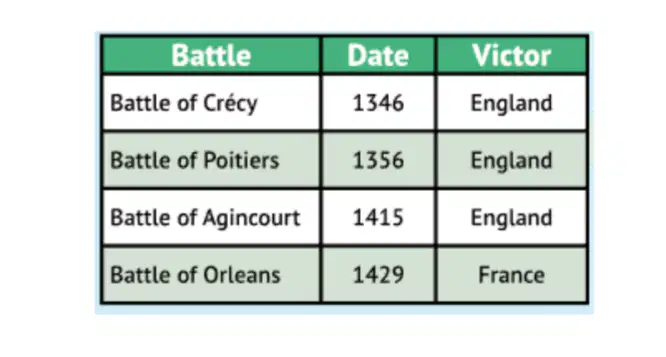
Who was victorious in the Hundred Years’ War?
England
Spain
France
Germany
Which battle did England win during the Hundred Years' War?
Agincourt
Orleans
Which battle did France win during the Hundred Years' War?
Agincourt
Orleans
What did Joan of Arc believe her role was meant to be in the Hundred Years’ War?
To help retake the throne of France
To become the queen of France
To negotiate peace with England
To lead the English army
What are two things Joan of Arc promoted?
French victory and a peaceful end to the war
English victory and a long-lasting war
Peace with England and a new French king
A new French government and a stronger army
How is Joan of Arc remembered today?
A French patriot, warrior, and advisor
A famous English queen
A legendary artist and musician
A renowned scientist and inventor
Which statement explains how labor shortages affected society?
Towns and cities ceased to exist.
Workers began to form labor union.
Landowners imported enslaved people to replace farm workers.
Landowners produced crops that required less labor.

