
 Worksheets
Middle East Review
Total questions: 56
Worksheet time: 32mins

On the map, which number identifies the Gaza Strip?
1
2
3
4
On the map, which number identifies the West Bank?
1
2
3
4
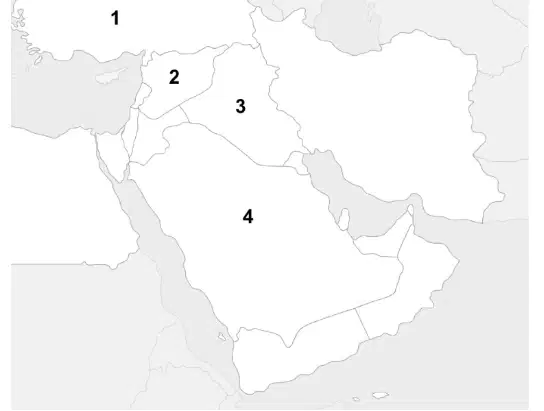
Look at the map of the Middle East. What country is labeled with number 1?
Turkey
Iran
Egypt
Saudi Arabia
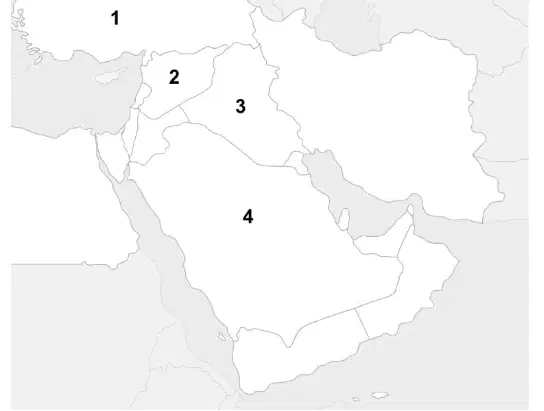
Look at the map of the Middle East. What country is labeled with number 2?
Syria
Jordan
Iraq
Lebanon
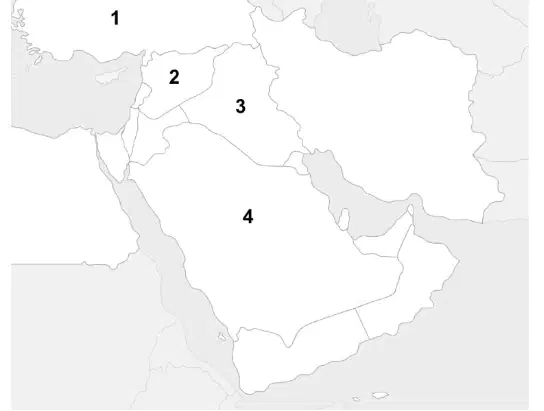
Look at the map of the Middle East. What country is labeled with number 3?
Iraq
Saudi Arabia
Jordan
Syria
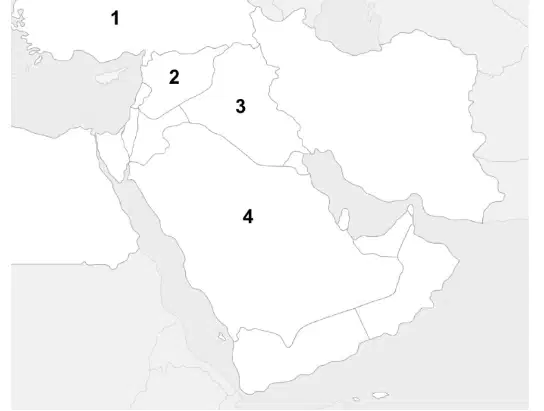
Look at the map of the Middle East. What country is labeled with number 4?
Saudi Arabia
Iran
Turkey
Jordan
What important trade route connects the Red Sea and the Mediterranean Sea in the Middle East?
The Suez Canal
The Panama Canal
The Strait of Gibraltar
The Bosporus Strait
Which statement BEST describes how over-irrigation in Syria leads to ____?
Over-irrigation in Syria would cause Iraq to build bigger dams and reservoirs to redirect water to Iraqi soil.
Over-irrigation in Syria would prevent crops from growing. This would create a dependence on foreign crops from Iraq to feed people in Syria.
Over-irrigation in Syria would lead to a shortage of water in Iraq. This might lead to other problems such as food shortages and access to clean drinking water.
Over-irrigation in Syria would create an abundance of crops to export, leading to an increase in trade goods by Syria, putting Iraq at an economic disadvantage.
Vast areas of the Middle East are deserts. This has impacted the use of water by:
People need to use irrigation from the region's rivers and lakes.
Many people use large quantities of water from the many dams in Saudi Arabia
People in this region have little conflict because there is a lot of fresh water in Southwest Asia.
All of the drinking water is piped in from the Arabian Sea to supply the region's needs.
The Tigris and Euphrates Rivers begin in Turkey. Over the years, Turkey has built dams along the river to produce _____.
hydroelectric power (or electricity)
drinking water for cities
irrigation canals for farming only
tourist attractions
How have dams impacted water availability in countries like Syria and Iraq?
The dams have increased water availability in Syria and Iraq.
Turkey has built dams that reduce the flow of water to Syria and Iraq.
The dams have no impact on water availability in Syria and Iraq.
Turkey has removed dams to increase water flow to Syria and Iraq.
How have the major rivers of Southwest Asia become part of political conflicts?
Countries build dams along their portion of rivers which decreases water availability downstream.
Most countries do not allow water to be taken out of the rivers for irrigation.
Many rivers dry up during the hot summer months.
Rivers do not cause political conflicts between nations.
What natural resource is in high demand for the Southwest Asia region?
Fresh water sources
Tropical grasslands
Clear land for agriculture
Areas of evergreen forests with heavy canopies
Which of the following is a major environmental issue facing the (Middle East) region?
Fresh water scarcity
Tropical rainforests
Clear lakes
Areas of high rainfall
The location of rivers impacts the population in Southwest Asia (Middle East) by:
Providing water sources that support larger populations near rivers.
Causing people to avoid settling near rivers due to flooding.
Making the region less suitable for agriculture and settlement.
Encouraging populations to settle far from water sources.
What statement is TRUE of deserts in Southwest Asia (Middle East)?
Agriculture is widespread and plentiful.
The lack of water limits farming and doesn't support a population.
They are densely populated because of the abundance of water.
Water is plentiful and shared peacefully.
How have the rivers in the Middle East historically influenced trade in the region?
Rivers have served as trade routes.
Rivers have hindered trade.
Rivers stopped trade.
Rivers are for irrigation and not used for trade.
What is the MAIN reason why the desert regions in the Middle East do not have a lot of large cities?
Harsh climate
Abundance of natural resources
Cultural traditions to live near the sea
_______________ is the process of removing salt from saltwater to produce freshwater.
Desalination
Hydropolitics
Cuniform
Fossil Water

What feature is represented by the letter E?

What feature is represented by the letter F?
Which of these Southwest Asian nations has the MOST secure and reliable access to water?
Iraq
Kuwait
Israel
Turkey
Pollution from various sources contaminates the drinking water in Southwest Asia. Why is this problem so difficult to fix?
Contaminated drinking water is difficult to fix because of political disputes; each country blames one another for the problems.
Contaminated drinking water is difficult to fix because fewer people are living in the region than there were fifty years ago.
Contaminated drinking water is difficult to fix because the area has a lot of rainfall, so they don't worry about the rivers and lakes.
Contaminated drinking water is difficult to fix because people in Southwest Asia use too much water for things like washing clothes.
The Tigris and Euphrates Rivers begin in Turkey. Over the years, Turkey has built dams along the river to produce hydroelectricity. How have dams impacted water availability in countries like Syria and Iraq?
The dams have increased the amount of water available to Syria and Iraq.
Turkey is now selling water to Syria and Iraq for a very high price.
The dams have drastically reduced the water supply to Syria and Iraq.
Turkey is now providing water to many Southwest Asian nations.
How does the location of rivers impact the population in Southwest Asia (Middle East)?
Over 62% of the population lives in poverty.
The population near the water is more dense.
It is a middle-income emerging market with lots of natural resources.
Most of the population depends on herding animals to make a living.
How do the deserts in the Middle East impact trade?
Deserts in the Middle East make trade easy.
Deserts in the Middle East have no impact on trade.
Deserts often lack the necessary water to supply and support settled agriculture and large human populations.
You hear a student say, "Arabs, Persians, and Kurds all live in the same region of the world and have the same cultural characteristics. The only difference is the country in which they live."
Why is this student incorrect?
The student is incorrect because the groups have many differences in their cultures and religious beliefs.
The student is incorrect because Arabs and Persians are the same group of people, but the Kurds are not.
The student is incorrect because all three groups are only found in Iran.
A group of people who share a common ancestry and, as a result, other common characteristics
Nationalist Group
Religious Group
Ethnic Group
What is a religious group?
A group of people who share a common ancestry and, as a result, other common characteristics
A group of poeple who follow a common set of values and have shared spiritual beliefs
A group of citizens who live in the same country
What ethnic group does not have their own country?
Christianity
Persians
Kurds
Arabs
All of the following are religious groups EXCEPT
Judaism
Christianity
Persian
Islam
Which is TRUE of the difference between an ethnic and religious group?
All members if a religious group worship the same god; members of an ethnic group may have different religions.
Members of religious groups may have different religious beliefs; ethnic group members have the same religious beliefs.
An ethnic group has a common race or culture, but not a common religion; religious groups have a common race or culture and religion.
A man wakes up early every morning and reads the Quran. He thinks upon Muhammad’s teachings and visits the holy city of Mecca every year. He prays many times during the day to one god, and spends his nights reflecting on the prophets Abraham and Moses. This man is part of which religion?
Judaism
Christianity
Islam
A woman in Israel prays to God and the Messiah, Jesus Christ. She reads both the Old Testament and the New Testament of the Bible. She tries to follow the teachings of the prophets, and she often visits places in the Holy City that were important in the life of Jesus Christ. This woman is part of which religion?
Judaism
Christianity
Islam
Identify the ethnic group being described here:
- Largest ethnic group in Iran
- Unified by their language, Farsi
- Originally practiced Zoroastrianism
- Today most are Muslims
Arabs
Persians
Kurds
Muslims
Identify the ethnic group being described here:
- Have no official homeland, but would like one
- Speak both Kurdish and Arabic
- Forced to abandon nomadic lifestyle post-WWI
Arabs
Kurds
Persians
Muslims
Natural resources are not overly evenly distributed among countries.
Which of the following correctly show how the Middle Wast is an example of uneven distribution?
abundance of oil, but a scarcity of water
abundance of coal, but scarcity of copper
abundance of natural gas, but a scarcity of oil
abundance of water, but a scarcity of phosphates
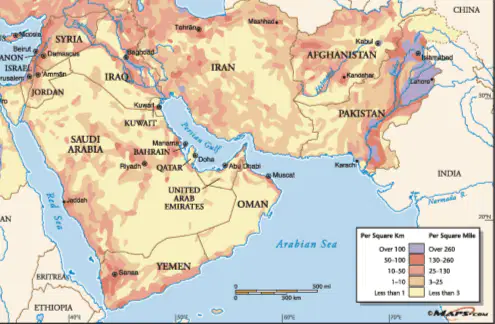
What conclusion can be drawn based on the information presented in the map?
The northern region of SW Asia is home only to nomads and small groups.
Most of the people in SW Asia live near rivers, coastlines, or water sources.
The harsh climate in the northern region of SW Asia keeps people from settling there.
The large, flat plains in the southern region of SW Asia can support large populations.
How have the citizens of oil-rich countries benefitted from their oil supplies?
Citizens of oil rich countries no longer have to work to earn a living
Having oil has made very little difference in the lives of citizens in oil-rich countries
Oil wealth has improved their standard of living, leading to better education, housing, and health
They no longer have to be a member of OPEC
How has the discovery of oil in some Southwest Asian countries affected the economic development of this area?
The discovery of oil has meant that no other industries have developed in the region
Those countries with oil reserves are much richer than those countries that have not found oil in their territory
Having oil has made very little difference in the economy of this region
Those with oil need less water than the other countries around them

Israel
Syria


What conclusion be drawn based on the information presented in the maps?
The northern region of Southwest Asia is home only to nomads and small groups.
Most of the people in Southwest Asia live near rivers, coastlines, or other water sources.
The harsh climate in the northern region of Southwest Asia keeps people from settling there.
The large, flat plains in the southern region of Southwest Asia can support large populations.

According to this chart, which country would be MOST likely to export water?
Jordan
Lebanon
Syria
Turkey

According to this chart, which country would be MOST likely to face a water crisis?
Jordan
Lebanon
Syria
Turkey
Jacob's family is planning a trip to the holiest site in their religion, the Temple Mount (Western Wall/Wailing Wall) in the Old City of Jerusalem. To prepare for the trip, Jacob has been reading the history and teachings of his people in the Torah. He is very excited to see such a historically important place.
Which religion does Jacob and his family MOST LIKELY follow?
Judaism
Christianity
Islam
What can be inferred about the Middle East's Empty Quarter?
It includes a large oasis that is home to nomadic tribes.
It's used for industry, so very few people live there.
It has lush soil that attracts local farmers.
It's a desert, so it is not densely populated.
Which of these is the best example of an identity that you can change over the course of your life?
ethnic group
religious group
cultural group
What would be an appropriate title for terms listed?
Belief in god (s)
Holy text
Prophets
Rituals
Sacred Places
Ethnic Group
Religious Group
Political Group

