
 Worksheets
Biomechanics - Day 01
Total questions: 98
Worksheet time: 49mins
Biomechanics is the study of how the body moves and functions, and it relates to you now and in the future by helping you understand movement and prevent injuries.
Biomechanics is the study of how the body moves and functions, and it relates to you now and in the future by helping you understand movement and prevent injuries.
Biomechanics is only about studying animal movement and has no relevance to humans.
Biomechanics is a branch of chemistry that deals with body fluids.
Biomechanics is the study of weather patterns and their effect on sports.
Fill in the blank: Biomechanics is the science of movement in a living body, focusing on how _______, bones, tendons, and ligaments work together to facilitate movement.
muscles
nerves
organs
cells
Which of the following is NOT a plane of motion?
Sagittal
Frontal
Transverse
Circular
Which plane of motion divides the body into left and right halves?
Sagittal
Frontal
Transverse
Oblique
Which type of muscle contraction involves the muscle lengthening under tension?
Concentric
Eccentric
Isometric
Static
What is the term for a muscle contraction where the muscle does not change length?
Isometric
Isotonic
Eccentric
Concentric
Which muscle action refers to increasing the angle between two body parts?
Flexion
Extension
Abduction
Adduction
What is the muscle action called when a limb moves away from the midline of the body?
Abduction
Adduction
Flexion
Extension
Which muscle role is responsible for producing the main force during a movement?
Agonist
Antagonist
Synergist
Fixator
What is the role of a muscle that opposes the main movement?
Antagonist
Agonist
Synergist
Fixator
At the end of this module, students will be able to: Define biomechanics and use movement concepts to analyze exercises and sport skills. Explain what biomechanics is and how movement concepts can be used to analyze exercises and sport skills.
Students will be able to define biomechanics and use movement concepts to analyze exercises and sport skills.
Students will be able to memorize sports rules only.
Students will be able to list famous athletes.
Students will be able to design sports equipment.
At the end of this module, students will be able to: Identify planes of motion, contraction types, muscle actions, and muscle roles within a movement. Describe the different planes of motion, types of muscle contractions, muscle actions, and the roles muscles play within a movement. This module primarily focuses on:
Planes of motion, muscle contractions, muscle actions, and muscle roles
Nutrition and dietary planning
Cardiovascular endurance training
Sports equipment maintenance
Analyzing a basic gait, jump, or throw involves identifying movement patterns to suggest ways to improve performance and safety.
True
False
Only for professional athletes
Only for injury prevention
Communicating findings from a movement analysis should be done using which type of vocabulary?
Correct anatomical and biomechanical vocabulary
Colloquial and informal vocabulary
Slang and non-technical terms
Only visual demonstrations without terminology
What is the plane of movement that divides the body into right and left halves?
Sagittal Plane (R/L)
Frontal Plane (Front/Back)
Transverse Plane (Top/Bottom)
Oblique Plane (Diagonal)
Which plane of movement divides the body into front and back portions?
Frontal Plane (F/B)
Sagittal Plane (L/R)
Transverse Plane (T/B)
Oblique Plane
Which plane of movement divides the body into upper and lower parts?
Transverse Plane
Sagittal Plane
Frontal Plane
Oblique Plane
Which type of muscle contraction involves the muscle lengthening under tension?
Eccentric
Concentric
Isometric
Isokinetic
Which type of muscle contraction involves the muscle shortening under tension?
Concentric
Eccentric
Isometric
Isokinetic
Which type of muscle contraction involves no change in muscle length?
Isometric
Isotonic
Concentric
Eccentric
What is the muscle action called when a limb moves toward the midline of the body?
Adduction
Abduction
Flexion
Extension
What is the muscle action called when a limb moves away from the midline of the body?
Abduction
Adduction
Flexion
Extension
What is the muscle action called when a body part turns around its own axis?
Rotation
Flexion
Extension
Abduction
What is the muscle action called when the angle between two body parts decreases?
Flexion
Extension
Abduction
Rotation
What is the muscle action called when the angle between two body parts increases?
Extension
Flexion
Rotation
Abduction
Which muscle function describes a muscle that is primarily responsible for movement?
Agonist
Antagonist
Synergist
Fixator
Which muscle function describes a muscle that opposes the action of another muscle?
Antagonist
Agonist
Synergist
Fixator
Which muscle function describes a muscle that assists another muscle in movement?
Synergist
Antagonist
Fixator
Prime mover
Which plane divides the body into left and right halves and is responsible for movements that occur forward and backward?
Sagittal
Frontal
Transverse
Which plane divides the body into front and back?
Sagittal
Frontal
Transverse
Which plane divides the body into top (superior) and bottom (inferior) halves?
Sagittal
Frontal
Transverse
Fill in the blank: The _______ plane divides the body into left and right halves. It is responsible for movements that occur forward and backward.
Sagittal
Transverse
Frontal
Oblique
Fill in the blank: The _______ plane divides the body into front and back.
Frontal
Sagittal
Transverse
Oblique
Fill in the blank: The _______ plane divides the body into top (superior) and bottom (inferior) halves.
Transverse
Sagittal
Coronal
Oblique
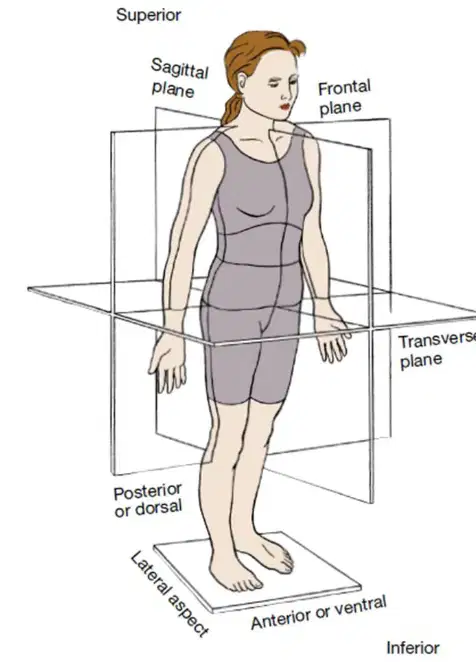
Which plane divides the body into left and right halves?
Frontal plane
Sagittal plane
Transverse plane
Lateral aspect

Which plane divides the body into anterior (front) and posterior (back) sections?
Frontal plane
Sagittal plane
Transverse plane
Superior

Which plane divides the body into superior (upper) and inferior (lower) parts?
Sagittal plane
Frontal plane
Transverse plane
Dorsal

Refer to the diagram of the anatomical position and planes of motion. The term 'anterior or ventral' refers to which part of the body?
Back
Side
Front
Top

Refer to the diagram of the anatomical position and planes of motion. The term 'posterior or dorsal' refers to which part of the body?
Front
Back
Side
Bottom

Refer to the diagram of the anatomical position and planes of motion. The term 'superior' refers to the ______ part of the body.
upper
lower
lateral
posterior

Refer to the diagram of the anatomical position and planes of motion. The term 'inferior' refers to the ______ part of the body.
lower
upper
lateral
anterior

Refer to the diagram of the anatomical position and planes of motion. The 'lateral aspect' refers to the ______ of the body.
side
front
back
middle

Select the movements that occur in the sagittal plane.
Flexion and extension
Abduction and adduction
Rotation and circumduction
Elevation and depression

Select the movements that occur in the frontal plane.
Abduction and adduction
Flexion and extension
Rotation and circumduction
Pronation and supination

Select the movement that occurs in the transverse plane.
Rotation of the trunk
Flexion of the elbow
Abduction of the arm
Extension of the knee
Which plane of movement does the activity 'BB Back Squat' belong to?
Sagittal
Frontal
Transverse
Which plane of movement does the activity 'DB Lateral Raise' belong to?
Sagittal
Frontal
Transverse
Which plane of movement does the activity 'Med Ball Rotational Throw' belong to?
Sagittal
Frontal
Transverse
Which plane of movement does the activity 'Cycling' belong to?
Sagittal
Frontal
Transverse
Which plane of movement does the activity 'Speed Skating' belong to?
Sagittal
Frontal
Transverse
Which plane of movement does the activity 'Swimming Flip Turn' belong to?
Sagittal
Frontal
Transverse
Which plane of movement does the activity 'Volleyball Serve' belong to?
Sagittal
Frontal
Transverse
Which plane of movement does the activity 'Tennis Side Shuffle' belong to?
Sagittal
Frontal
Transverse
Which plane of movement does the activity 'Football' belong to?
Sagittal
Frontal
Transverse

Which type of muscle contraction occurs when the muscle lengthens while contracting (lowering or controlling a load)?
Eccentric
Isometric
Concentric

Which type of muscle contraction occurs when the muscle length stays the same while contracting (no movement)?
Eccentric
Isometric
Concentric

Which type of muscle contraction occurs when the muscle shortens while contracting (lifting or moving a load)?
Eccentric
Isometric
Concentric
Which type of muscle contraction is involved in 'Jumping Up for a block'?
Eccentric
Isometric
Concentric
Which type of muscle contraction is involved in 'Landing from a jump'?
Eccentric
Isometric
Concentric
Which type of muscle contraction is involved in 'Running - Push Off Phase'?
Eccentric
Isometric
Concentric
Which type of muscle contraction is involved in 'Running - Landing Phase'?
Eccentric
Isometric
Concentric
Which type of muscle contraction is involved in 'Tennis Serve - Racket Acceleration'?
Eccentric
Isometric
Concentric
Which type of muscle contraction is involved in 'Tennis Serve - follow through'?
Eccentric
Isometric
Concentric
Which type of muscle contraction is involved in 'Bench Press'?
Eccentric
Isometric
Concentric
Which type of muscle contraction is involved in 'Back Squat'?
Eccentric
Isometric
Concentric
Which type of muscle contraction is involved in 'Pull Up'?
Eccentric
Isometric
Concentric
Which type of muscle contraction is involved in 'RDL' (Romanian Deadlift)?
Eccentric
Isometric
Concentric
Which type of muscle contraction is involved in 'Tricep Pushdown'?
Eccentric
Isometric
Concentric

The different planes of motion are called sagittal, frontal, and transverse. Which of the following correctly lists 2-3 movements for each plane?
Sagittal: flexion, extension; Frontal: abduction, adduction; Transverse: rotation, horizontal abduction
Sagittal: abduction, adduction; Frontal: flexion, extension; Transverse: plantarflexion, dorsiflexion
Sagittal: rotation, circumduction; Frontal: flexion, extension; Transverse: abduction, adduction
Sagittal: inversion, eversion; Frontal: rotation, circumduction; Transverse: flexion, extension
Movements that can be found in the 3 movement planes include which of the following?
Flexion, abduction, and rotation
Only flexion and extension
Only abduction and adduction
Only rotation and circumduction
Which of the following is an example of a muscle action exercise?
Bicep curl
Reading a book
Watching TV
Typing on a keyboard
Biomechanics Analysis: The barbell back squat primarily involves which type of biomechanical movement?
Hip and knee extension
Shoulder abduction
Ankle inversion
Elbow flexion
Biomechanical Analysis: The process involves creating a video recording of a movement or skill to analyze the movement in detail by identifying which of the following?
Key anatomical biomechanical components
Nutritional intake before the movement
The color of the athlete's clothing
The type of camera used for recording
Which plane divides the body into left and right halves and is responsible for movements that occur forward and backward?
Sagittal
Frontal
Transverse
Which plane divides the body into front and back?
Sagittal
Frontal
Transverse
Which plane divides the body into top (superior) and bottom (inferior) halves?
Sagittal
Frontal
Transverse
The plane responsible for movements that occur forward and backward is called the _______ plane.
Sagittal
Frontal
Transverse
Oblique

Look at the image of two people running. Which plane of movement does this activity best represent?
Sagittal
Frontal
Transverse

Look at the image of two people ice skating side by side. Which plane of movement does this activity best represent?
Sagittal
Frontal
Transverse

Look at the image of a person swinging a golf club. Which plane of movement does this activity best represent?
Sagittal
Frontal
Transverse

What happens to the muscle during an eccentric contraction?
Muscle shortens while contracting (lifting or moving a load).
Muscle length stays the same while contracting (no movement).
Muscle lengthens while contracting (lowering or controlling a load).

What is the characteristic of an isometric contraction?
Muscle length stays the same while contracting (no movement).
Muscle shortens while contracting (lifting or moving a load).
Muscle lengthens while contracting (lowering or controlling a load).

During a concentric contraction, the muscle:
Shortens while contracting (lifting or moving a load).
Lengthens while contracting (lowering or controlling a load).
Stays the same length while contracting (no movement).
What is the movement of a limb toward the body's midline called?
Abduction
Adduction
Flexion
Extension
What is the movement of a limb away from the body's midline called?
Abduction
Adduction
Flexion
Extension
What is the term for turning a body part around its own axis?
Flexion
Extension
Rotation
Adduction
What is the term for decreasing the angle between two bones at a joint (e.g., bending your elbow or knee)?
Flexion
Extension
Rotation
Abduction
What is the term for increasing the angle between two bones at a joint (e.g., straightening your elbow or knee)?
Flexion
Extension
Rotation
Adduction

What is the movement of a limb toward the body’s midline called? (e.g., bringing your arms down to your sides)
Abduction
Adduction
Rotation

What is the movement of a limb away from the body’s midline called? (e.g., lifting your arms out to the side)
Adduction
Abduction
Rotation

What is the term for turning a body part around its own axis? (e.g., shaking your head “no” or twisting your torso)
Adduction
Abduction
Rotation
What is flexion?
Increasing the angle between two bones at a joint (e.g., straightening your elbow or knee).
Decreasing the angle between two bones at a joint (e.g., bending your elbow or knee).
Rotating a bone around its axis.
Moving a limb away from the body.
What is extension?
Increasing the angle between two bones at a joint (e.g., straightening your elbow or knee).
Decreasing the angle between two bones at a joint (e.g., bending your elbow or knee).
Rotating a bone around its axis.
Moving a limb away from the body.

Refer to the image showing a person lying on their back with legs on an exercise ball. Which action is being demonstrated in the top image: flexion or extension?
Extension
Flexion
Rotation
Abduction

Refer to the diagram showing the arm muscles. Which muscle is contracted during flexion of the arm?
Biceps
Triceps
Deltoid
Brachioradialis

In the image showing a person standing, what is the action called when the knee is lifted towards the chest?
Hip Flexion
Hip Extension
Knee Extension
Ankle Dorsiflexion
What is the meaning of 'Adduction' in muscle action?
Movement of a body part toward the midline of the body.
Movement of a body part away from the midline of the body.
Rotation of a body part around its axis.
Bending a joint to decrease the angle between two bones.
What is the meaning of 'Abduction' in muscle action?
Movement of a body part away from the midline of the body.
Movement of a body part towards the midline of the body.
Rotation of a body part around its axis.
Decrease in the angle between two body parts.

