wayground logo

Free Printable Worksheets

Font size

S
M
L
XL
Worksheets

test ch 2 review

Total questions: 20

Worksheet time: 10mins

Name
Class
Date
1.
Atoms in molecules share pairs of electrons when they make
a)
polymers
b)
covalent bonds.
c)
ionic bonds.
d)
hydrogen bonds.
2.
What gives water many properties that are important to living things?
a)
specific heat
b)
temperature
c)
hydrogen bonds
d)
density
3.
Which of the following solutions has the highest H+ ion concentration?
a)
a solution with a pH of 10
b)
a solution with a pH of 7
c)
a solution with a pH of 4
d)
a solution with a pH of 1
4.

Which of the following solutions has the lowest H+ ion concentration?
a)
a solution with a pH of 10
b)
a solution with a pH of 7
c)
a solution with a pH of 4
d)
a solution with a pH of 1
5.
Both animal fats and plant oils are made up of glycerol and
a)
saturated fats.
b)
phospholipids.
c)
fatty acids.
d)
polar molecules.
6.
How do ions form?
a)
Atoms gain or lose electrons.
b)
Atoms combine to make a larger atom.
c)
Two atoms share electrons.
d)
Atoms form covalent bonds.
7.
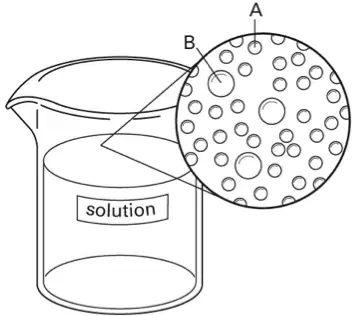
Which substance represented in the figure (A or B) is the solute?
a)
substance A
b)
substance B
c)
both A and B
d)
neither A nor B
8.
Identify the reactants in this reaction: 6H2O + 6CO2 → C6H12O6+ 6O2.
a)
6H2O and 6CO2
b)
6CO2 and C6H12O6
c)
6H2O, C6H12O6, and 6O2
d)
C6H12O6 and 6O2
9.
The activation energy needed for a chemical reaction is decreased by a
a)
substrate.
b)
catalyst.
c)
reactant.
d)
product.
10.
Which property of carbon makes it the “building block of life”?
a)
its hydrogen bonding
b)
its covalent bonding
c)
its ability to dissolve substances
d)
its specific heat
11.
What are the four main groups of carbon-based molecules?
a)
starches, cholesterol, fatty acids, and amino acids
b)
sugars, cellulose, triglycerides, and monosaccharides
c)
carbohydrates, lipids, proteins, and nucleic acids
d)
polysaccharides, sugars, oils, and polymers
12.
Chemical reactions change substances into different substances by
a)
maintaining constant energy.
b)
reaching chemical equilibrium.
c)
breaking and forming bonds.
d)
changing the substance’s properties.
13.
What is the term for the substances that are changed during a chemical reaction?
a)
reactants
b)
products
c)
catalysts
d)
enzymes
14.
What is the result of an endothermic chemical reaction?
a)
no energy absorbed or released
b)
hydrogen bonds are broken down
c)
products have lower bond energy than reactants
d)
more energy absorbed than released
15.
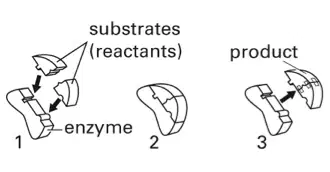
The lock-and-key model of enzyme function shown in the figure illustrates which important characteristic of enzymes?
a)
ability to bond with a product
b)
ability to bind with many reactants
c)
ever-changing structure
d)
precise fit with particular substrates
16.
What kind of bonds link the monomers in a protein?
a)
peptide bonds
b)
protein bonds
c)
hydrogen bonds
d)
ionic bonds
17.

Which type of macromolecule is primarily responsible for storing genetic information?

a)

Lipids

b)

Proteins

c)

Carbohydrates

d)

Nucleic acids

18.

Which property of water allows it to dissolve many substances important for life?

a)

Its nonpolar nature

b)

Its polarity

c)

Its high density

d)

Its low specific heat

19.

What is the primary function of carbohydrates in living organisms?

a)

Forming cell membranes

b)

Speeding up chemical reactions

c)

Providing energy

d)

Storing genetic information

20.

Which of the following best describes a catalyst?

a)

A substance that speeds up a chemical reaction without being consumed

b)

A substance that is used up during a chemical reaction

c)

A substance that changes the products of a reaction

d)

A substance that increases the activation energy of a reaction