
NEW
Font size
 Worksheets
Ch. 2 Review Game
Total questions: 20
Worksheet time: 10mins
The three particles that make up atoms are
protons, neutrons and isotopes
neutrons, isotopes and electrons
positives, negatives and neutrals
protons, neutrons and electrons
What are found in space surrounding the nucleus of an atom?
protons
electrons
neutrons
ions
Isotopes are atoms of the same element with the same number of protons and different number of
electrons
molecules
neutrons
ions
A substance formed by the chemical joining of 2 or more elements in definite proportions
compound
isotope
nucleus
enzyme
An atom that loses electrons forms which type of ion?
Cation
Anion
Isotope
Radical
Water molecule: shared electrons spend more time by the O atom than the H's, the O atom is
slightly negative
very negative
slightly positive
very positive
When sugar is dissolved in water, water is the
reactant
solution
solute
solvent
A scientist places a colony of bacteria into distilled water and stirs it.
a solution
a suspension
a buffer
an adhesion
Rainfall in NY varies from a pH of 4.22 to 4.40. The most acidic rainfall is ________
4.22
4.30
4.35
4.40
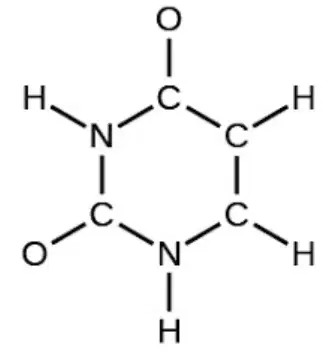
What kinds of atoms are bonded to the carbon atoms in the molecule shown?
helium, oxygen and nitrogen
calcium, hydrogen and oxygen
hydrogen, oxygen and nitrogen
helium, carbon and sodium
Which of the following is NOT a function of proteins?
store and transmit genetic information
help fight disease
control the rate of reactions
move substances into or out of cells
Identify the reactant(s) shown here: CO₂ + H₂O ---> H₂CO₃
CO₂, H₂O and H₂CO₃
CO₂ and H₂O
H₂CO₃
What is the process that changes one set of chemicals into another set of chemicals?
cohesion
hydrogen bonding
chemical reaction
dissolving
The energy needed to get a reaction started is the
adhesion energy
activation energy
cohesion energy
chemical energy
Which of the following statements is true about catalysts?
Catalysts slow down the rate of chemical reactions
All catalysts are enzymes
Catalysts are use up during a chemical reaction
Catalysts lower the activation energy of a chemical reaction
Scientists show the composition of compounds by a kind of shorthand known as the
chemical structure
atoms
chemical formula
scientific notation
The attraction between water molecules and the glass sides of the graduated cylinder
heat capacity
adhesion
cohesion
polar bonds
The molecules of life all contain
sulfur
potassium
nitrogen
carbon
All isotopes of an element have the same
physical properties
neutrons
chemical properties
atoms
A chemical bond formed by the transfer of electrons is a(n)
ionic bond
hydrogen bond
covalent bond
Van der waals forces

