wayground logo

Free Printable Worksheets

Font size

S
M
L
XL
Worksheets

Accel Algebra Chapter 1 Review

Total questions: 104

Worksheet time: 6hrs 19mins

Name
Class
Date
1.

Which statement is false?

a)

No integers are irrational numbers.

b)

All whole numbers are integers.

c)

No real numbers are irrational numbers.

d)

All integers greater than 0 are whole numbers.

2.

The value  36\sqrt{36}   is an integer.

a)

No, b/c a square root is always irrational.

b)

No, b/c it's root is a decimal.

c)

Yes, b/c it simplifies to -6 and 6

d)

Yes, b/c it can be rounded.

3.

Choose the categories that apply to the value

164\sqrt{\frac{16}{4}}

a)

natural number

b)

whole number

c)

integer

d)

rational number

e)

irrational number

4.

Choose the categories that apply to -7.5.

a)

natural number

b)

whole number

c)

integer

d)

rational number

e)

real number

5.

T/F the value π\pi  is a rational number.

a)

True because all Greek symbols are rational.

b)

True because it can be expressed as a ratio of two integers.

c)

False because it cannot be expressed as a ratio of two integers.

d)

False because it's a confusing value.

6.

5.4545454545454545... is a

a)

natural number

b)

whole number

c)

integer

d)

rational number

e)

real number

7.

The number 0 is a

a)

natural number

b)

whole number

c)

integer

d)

rational number

e)

irrational number

8.

The value   121-\sqrt{121}  is a(n)

a)

natural number

b)

whole number

c)

integer

d)

rational number

e)

irrational number

9.

The value -18/6 is a(n)

a)

natural number

b)

whole number

c)

integer

d)

rational number

e)

irrational number

10.
Classify this number:  6.7
a)
real
b)
real      rational
c)
real      rational        integer
d)

real   rational   integer   whole natural

11.
Classify this number:  2
a)
real
b)
real      rational
c)
real      rational        integer
d)

real   rational   integer   whole natural

12.
Classify this number:  √10
a)
real
b)
real      rational
c)
real       irrational
d)
real         rational        integer
13.
Classify this number:  ⅚
a)
real
b)
real      rational
c)
real      rational        integer
d)
real   rational   integer   whole
14.
Classify this number: √25
a)
real
b)
real      rational
c)
real      rational        integer
d)

real   rational   integer   whole natural

15.
Classify this number:  -12
a)
real
b)
real      rational
c)
real       irrational
d)
real         rational        integer
16.
a)
Rational, Integer
b)
Whole, Integer, Rational 
c)
Irrational, Integer
d)
Irrational
17.
Determine if it is a rational or irrational number:
√20
a)
Rational
b)
Irrational
18.
8 is a part of the following sets: 
a)
Whole Number
b)
Integer
c)
Rational
d)
All of the above
19.
Classify the Number: -23
a)
Rational
b)
Real, rational, integer
c)
integer
d)
Real, irrational, integer, whole
20.
Classify the number: 0
a)
Real Number
b)
Irrational Number
c)
Imaginary
d)
Natural Number
21.
An example of an integer is...
a)
9.1
b)
8/9
c)
-9
d)
-2.3
22.
An example of a whole number is:
a)
4/9
b)
-9
c)
5.2
d)
17
23.
The number -8 belongs to what number set(s)?
a)
Whole
b)
Integer
c)
Rational
d)
Integer and Rational
24.

Which of the following is rational?

a)

.211232112421125. . . .

b)

π

c)

√25

d)

√12

25.
A fraction is which type of number?
a)
Rational
b)
Irrational
c)
Integer
d)
Whole
26.
Is 8.27 rational or irrational?
a)
Rational
b)
Irrational
c)
Both
d)
None of the above
27.

Classify √100

a)

Rational, Integer, Whole, Natural

b)

Whole, Integer, Rational

c)

Irrational, Integer

d)

Irrational

28.

Repeating decimals are _____ numbers.

a)

irrational

b)

rational

29.

16\sqrt{16}  is included in the set of _______ because it simplifies to 4.

a)

irrational numbers

b)

whole number

30.

-1.4 is not included in the set of ______ because it has a decimal (or fractional) part.

a)

rational numbers

b)

integers

c)

real numbers

31.
the product of x and sixteen
a)
x + 16
b)
x - 16
c)
16x
d)
x/16
32.
Pat worked 4 hours on Monday and 3 hours on Friday.
If he earned the same hourly rate each day, which expression best represents the situation?
a)
7x
b)
4x + 3x
c)
4 + 3x
d)
3 + 4
33.
Translate this phrase into an Algebraic expression.
57 more than 3 times Kate's score
Use the variable g to represent Kate's score.
a)
57g + 3
b)
3g - 57
c)
3g + 57
d)
57 + 3g
34.
Translate this phrase into an algebraic expression.
8 less than the product of 4 and a number
Use the variable m to represent the unknown number.
a)
8 - 4m
b)
8m - 4
c)
8m + 4
d)
4m - 8
35.
Translate this phrase into an algebraic expression.
8 less than the product of 4 and a number
Use the variable m to represent the unknown number.
a)
8 - 4m
b)
8m - 4
c)
8m + 4
d)
4m - 8
36.
Translate this phrase into an algebraic expression.
the difference if 3 times a number and 7
a)
3(7 - n)
b)
3n - 7
c)
3n + 7 
d)
3 / 7n
37.
Translate this phrase into an algebraic expression.
the quotient of 4 and a number increased by 10.
a)
4 - n + 10
b)
4n - 10
c)
4/(n + 10)
d)
4 / n + 10
38.
Translate this phrase into an algebraic expression.
14 subtracted from the quantity 6 times k 
a)
6 - 14k
b)
6k - 14
c)
14k - 6
d)
14 - 6k
39.
Translate this phrase into an algebraic expression.
the difference of 100 and the sum of 6 and w 
a)
100 - 6 + w 
b)
100 / (6 + w)
c)
100  - (6 + w)
d)
100 / 6 + w 
40.
Translate this phrase into an algebraic expression.
4 divided by the sum of a number and 12
a)
4 / n + 12
b)
4 / 12n
c)
4 / (n + 12) 
d)
(4 / n) + 12
41.
Translate this phrase into an algebraic expression.
2 times the difference of t and 11
a)
2t - 11
b)
2(t - 11) 
c)
2(t / 11)
d)
2 x t - 11
42.
Translate this phrase into an algebraic expression.
35 multiplied by the quantity r less than 45 
a)
35(r - 45) 
b)
35r - 45
c)
35(45 - r)
d)
45 - 35r
43.
Write a verbal expression for:
2a+6
a)
6 more than the product of 2 times a
b)
6 less than the product of 2 times a
c)
6 more than the quotient of 2 and a
d)
twice the sum of a and 6
44.
What word phrase can you use to represent "5x + 2"?
a)
five times the sum of a number x and two
b)
two times the sum of a number x and five
c)
a number x times the sum of five and two
d)
the sum of five times a number x and two
45.
Which algebraic expression represents
 "six less than a number"?
a)
6/k
b)
k/6
c)
6 - k
d)
k - 6
46.
Ten decreased by four times a number.  
a)
10 - 4x
b)
4x - 10 
c)
10 - x
d)
10/4x
47.
Seven less than the difference of five times a number and two.  
a)
7 - (5x - 2)
b)
(x - 2) - 7
c)
5(x - 2) - 7
d)
(5x - 2) - 7
48.
Write a verbal expression for:
2a+6
a)
6 more than the twice a number
b)
6 less than the product of 2 times a
c)
6 more than the quotient of 2 and a
d)
twice the sum of a and 6
49.
Which algebraic expression best represents the following verbal expression?
 
half a number x plus 4
a)
2x + 4
b)
x + 4(½)
c)
½x + 4 
d)
x + ½ + 4
50.
Which algebraic expression best represents the following verbal expression?
 
four less than the product of b and three
a)
4 - 3b
b)
4 - (3 + b)
c)
(4 + b) - 4
d)
3b - 4
51.
12 - 4 x 2 = 
a)
16
b)
4
c)
8
d)
18
52.
(7 + 41) ÷ 2 – 15 =
a)
19
b)
9
c)
25
d)
3
53.
What would be my first step? 3 + 4 x 6 - 4 =
a)
addition
b)
multiplication
c)
subtraction
d)
exponents
54.
(9 + 23) ÷ (5 - 3) = 
a)
16
b)
32
c)
15
d)
12
55.
16÷2x4-3
a)
5
b)
-1
c)
25
d)
29
56.
Solve the following:
-2 x (3 + 8 ÷ 4)2
a)
-16
b)
1.375
c)
4
d)
-50
57.
Solve the following:
(2 + 7 - 1) ÷ 22
a)
16
b)
2
c)
72.25
d)
8.75
58.
Solve the following:
5 - 62 ÷ 4 - 3
a)
1
b)
-10.75
c)
-31
d)
-7
59.
True or False?
2 + (4 x 5 - 2) + 8 = 28
a)
True
b)
False
60.
Simplify the following:
-2 ⋅ (3 + 8 ÷ 4)2
a)
-16
b)
1.375
c)
4
d)
-50
61.

(24-16)÷8

a)

8

b)

1

c)

2

d)

7

62.
(4x8)-(9+7)
a)
16
b)
25
c)
41
d)
32
63.
(6 + 2) x (3 + 2)
a)
18
b)
26
c)
16
d)
40
64.
(7 x 5) + 5
a)
40
b)
70
c)
17
d)
755
65.
5 x 4 + 6
a)
50
b)
34
c)
26
d)
29
66.
What would be my first step to simplify?
3 + 4 x 6 - 4 
a)
addition
b)
multiplication
c)
subtraction
d)
exponents
67.
4 + 9 + 8 ÷ 4
a)
5.25
b)
5
c)
25
d)
15
68.
What does the ( E )in PEMDAS mean?
a)
experience
b)
exponents
c)
examples
d)
evidence
69.
82-72
a)
5
b)
2
c)
15
d)
1
70.
32+42-(4x2)
a)
14
b)
9
c)
9
d)
17
71.
True or False?
2 x 3 + 10 ÷ 2 = 8
a)
True
b)
False
72.
Which step would come first in the following problem:
6x7+(9-3)+2
a)
6x7
b)
7+9
c)
9-3
d)
3+2
73.
All of the x values or inputs are called what?
a)
Domain
b)
Range
c)
Relation
d)
Function
74.
All of the y values or outputs are called what?
a)
Domain
b)
Range
c)
Relation
d)
Function
75.
In the given relation, what domain value corresponds to the range value -2?
{(-1,2), (-2,4), (2,5), (0,-2), (2,0)}
a)
-2
b)
0
c)
2
d)
4
76.
What is the range of the following graph?
a)
-5, -1,  0 , 1, 5
b)
-4, -2, 0, 3, 6
c)
(-4, 1)  ( 6, 0)
d)
(6, 0)
77.
Identify the domain of the following relation:
a)
{-6, 14, 2, 28}
b)
{(-6,14), (0,32), (2,38), (4,44)}
c)
{-6, 0, 2, 4}
d)
{14, 32, 38, 44}
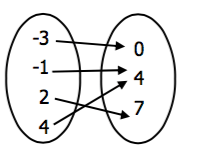
78.
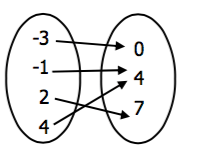
What is the range?
a)
{-3, -1, 2, 4}
b)
{0, 4, 7} 
c)
{0, 4, 4, 7}
d)
{7, 4, 0}
79.
What is the range?
a)
{-2, -1, 0, 3}
b)
{3, 0, -1, 0, -2}
c)
{-4, -2, 1, 2, 5}
d)
{-4, -2, -1, 0, 1, 2, 3, 5}
80.

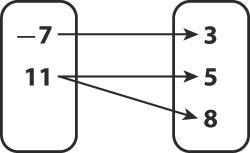
Is the relation a function? Why?

a)

Yes, because the x-value 11 has two y-values paired with it.
b)
Yes, because each x-value has only one y-value paired with it.
c)

No, because the x-value 11 has two y-values paired with it.

d)
No, because each x-value has only one y-value paired with it.
81.
Is this mapping a function or not a function? 
a)
Function
b)
Not a Function 
82.
Is this table a function or not a function? 
a)
Function
b)
Not a Function
83.
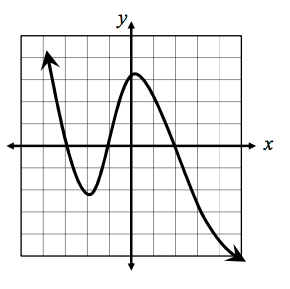
Is this graph a function or not a function? 
a)
Function 
b)
Not a Function
84.
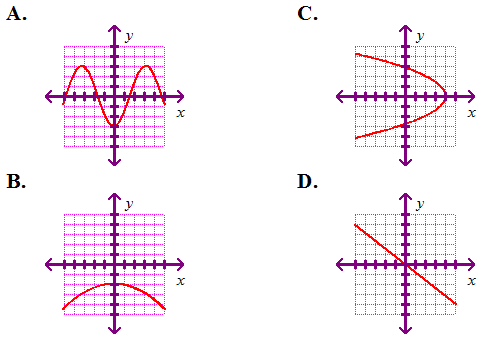
Which graph does NOT pass the vertical line test?
a)
Graph 1
b)
Graph 2
c)
Graph 3
d)
Graph 4
85.
Is this graph a function or not a function? 
a)
Function
b)
Not a Function
86.

Select ALL of the functions.

a)

{ (a,z) , (b,z) , (c,z) }

b)

c)

d)

87.

What is  f(0)f\left(0\right)   for the function f(x)=2x+3f\left(x\right)=2x+3  

a)

2x

b)

-3

c)

3

d)

10

88.

Given the function f(x) = 3x + 8 find the output when x = 2

a)

13

b)

14

c)

15

d)

16

89.
Evaluate 2r + 1      if   r = 3
a)
6
b)
5
c)
7
d)
8
90.

Find f(6)

a)

1

b)

2

c)

3

d)

4

91.
f(x)=x2-5x
f(4)=
a)
-4
b)
126
c)
24
d)
84
92.
f(x)=x2-5x
f(4)=
a)
-4
b)
126
c)
24
d)
84
93.

Given f(x)=3x+9f\left(x\right)=3x+9  , find f(4)f\left(-4\right)  .

a)

3-3  

b)

2121  

c)

88  

d)

12-12  

94.
Which graph is linear?
a)
Graph A
b)
Graph B
c)
Graph C
d)
Graph D
95.

Is the following an increasing or decreasing function?

a)

increasing

b)

decreasing

96.
Which statement is true about this graph?
a)
This function is always constant
b)
This function is always increasing
c)
This function is never increasing
d)
This function is both increasing and decreasing
97.
Determine if the graph is linear or nonlinear. Increasing,decreasing, both or neither? 
a)
Linear; increasing 
b)
Nonlinear; increasing 
c)
Linear; both increasing and decreasing 
d)
Nonlinear; both increasing and decreasing
98.
Where is the function increasing?
a)
y≤1
b)
y≥1
c)
y≥-2
d)
y≤-2
99.
Where is the function decreasing?
a)
y≤1
b)
y≥1
c)
y≤2
d)
y≥2
100.

What is the decreasing interval on the function shown?

a)

(, 1)\left(-\infty,\ 1\right)

b)

(, 2)\left(-\infty,\ 2\right)

c)

(2, )\left(2,\ \infty\right)

d)

(1, )\left(1,\ \infty\right)

101.

What is the increasing interval on the function shown?

a)

(, 1)\left(-\infty,\ 1\right)

b)

(, 2)\left(-\infty,\ 2\right)

c)

(2, )\left(2,\ \infty\right)

d)

(1, )\left(1,\ \infty\right)

102.

Where is the function decreasing?

a)

(,1)\left(-\infty,-1\right)

b)

(1,)\left(-1,\infty\right)

c)

(,3)\left(-\infty,3\right)

d)

(3,)\left(3,\infty\right)

103.

Where is the function decreasing?

a)

(,1)\left(-\infty,-1\right)

b)

(1,)\left(-1,\infty\right)

c)

(,3)\left(-\infty,3\right)

d)

(3,)\left(3,\infty\right)

104.

Where is the function increasing?

a)


(1,)\left(1,\infty\right)

b)

(2,)\left(2,\infty\right)

c)

(,1)\left(-\infty,1\right)

d)

(,2)\left(-\infty,2\right)