
Font size
 Worksheets
Eduqas Hinduism Relationships
Total questions: 72
Worksheet time: 12mins
What is dharma in Hinduism, especially in relation to family life?
A type of worship
A religious and moral duty
A festival
A sacred text

What are the four stages (ashramas) of a Hindu person's life related to?
Different jobs they must do
Different geographical places
Different spiritual and social responsibilities
Different food rituals
Why is marriage important in Hindu life?
It is optional and not very important
It marks the transition from the student stage to the householder stage
It is only for social status
It is only to obey parents

Name two responsibilities of good Hindu parents towards their children.
Provide for their children, perform puja, teach their children about Hinduism and right and wrong (any two)
Ignore their children's education and beliefs
Discourage their children from learning about Hinduism
Teach their children to disrespect other religions

What is the purpose of the sacred thread ceremony for boys?
To celebrate a birthday
To mark taking on religious responsibilities
To start work
To leave the family

Hindu beliefs, attitudes and teachings about the family: How do Hindu children show respect for their parents?
By following their guidance
By caring for them
Both a and b
Children do not have duties towards parents
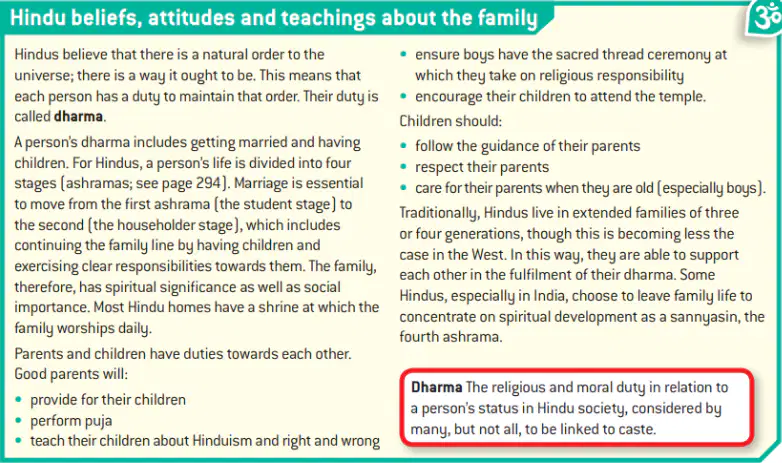
What type of family structure is traditional in Hinduism?
Nuclear family only
Extended family of three or four generations
What is a sannyasin?
A temple priest
Someone who leaves family life to focus on spiritual development
A child in the student stage
A type of festival
The family has spiritual significance in Hinduism because:
it is considered a sacred unit that upholds dharma and traditions.
it is only important for economic reasons.
it is not mentioned in Hindu scriptures.
it is seen as a barrier to spiritual growth.
One spiritual responsibility associated with the sacred thread ceremony in Hinduism is to study the Vedas. One way the role of women differs from boys regarding this ceremony is that women traditionally do not participate in the sacred thread ceremony. Which of the following statements is correct?
Women traditionally do not participate in the sacred thread ceremony.
Women are required to perform the ceremony before marriage.
Boys are not allowed to study the Vedas after the ceremony.
The ceremony is only for married women.
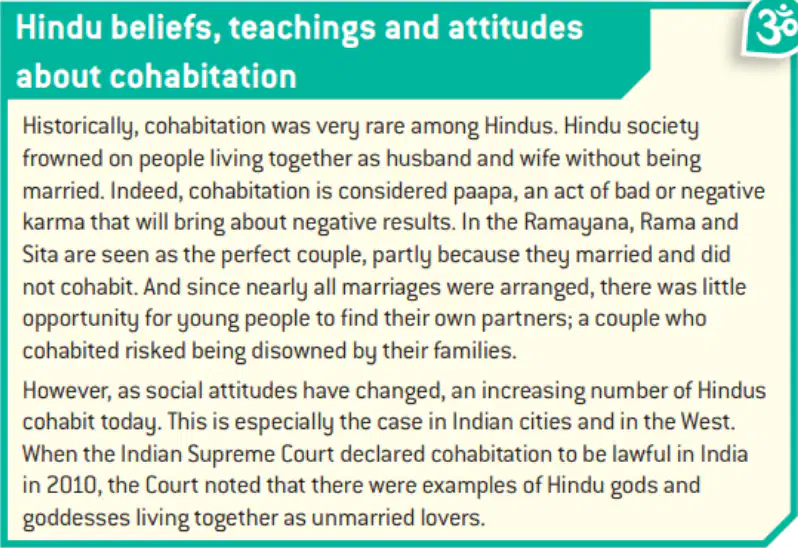
How was cohabitation traditionally viewed in Hindu society?
As a normal and accepted practice
As an act of bad karma (paapa)
As a religious duty
As a modern invention
The Hindu epic that features the perfect couple Rama and Sita, known for their marriage and not cohabiting, is:
Mahabharata
Ramayana
Bhagavad Gita
Rigveda
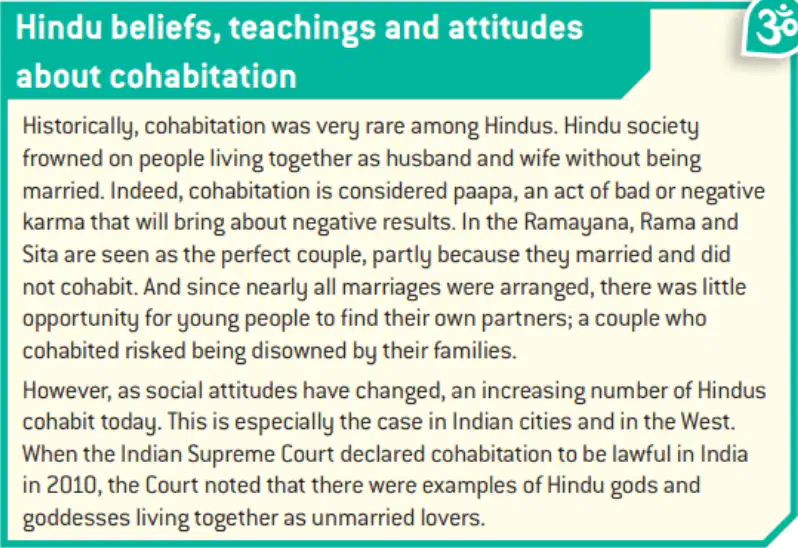
Cohabitation was historically rare among Hindus because:
traditional values emphasised marriage before living together
it was legally prohibited by ancient laws
economic reasons made cohabitation difficult
cohabitation was encouraged only among royalty
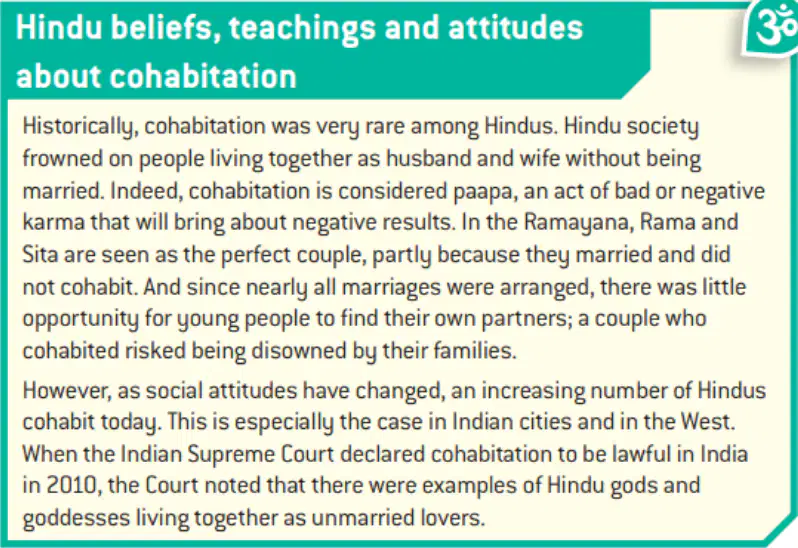
Social attitudes towards cohabitation have changed in recent years in which of the following ways?
They have become more accepting.
They have become less accepting.
They have remained completely unchanged.
They have become illegal in most places.
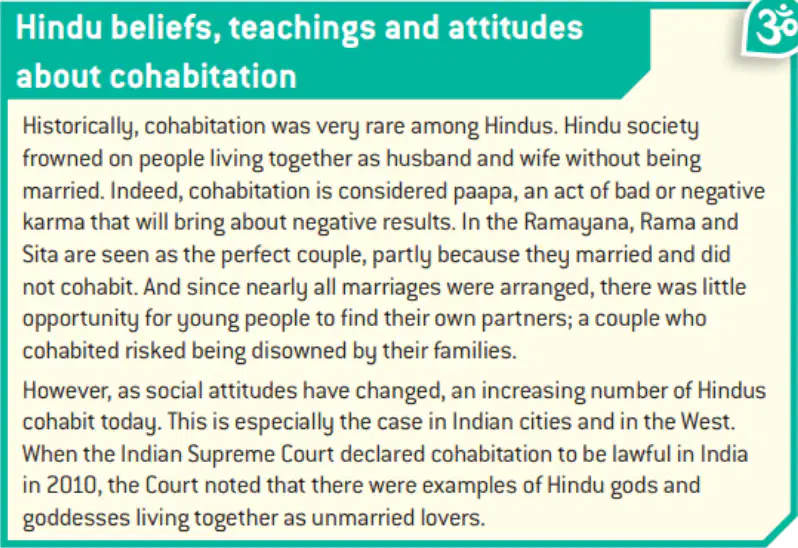
In 2010, what did the Indian Supreme Court declare about cohabitation?
That cohabitation between adults is not an offence
That cohabitation is illegal in India
That cohabitation requires government approval
That cohabitation is punishable by law
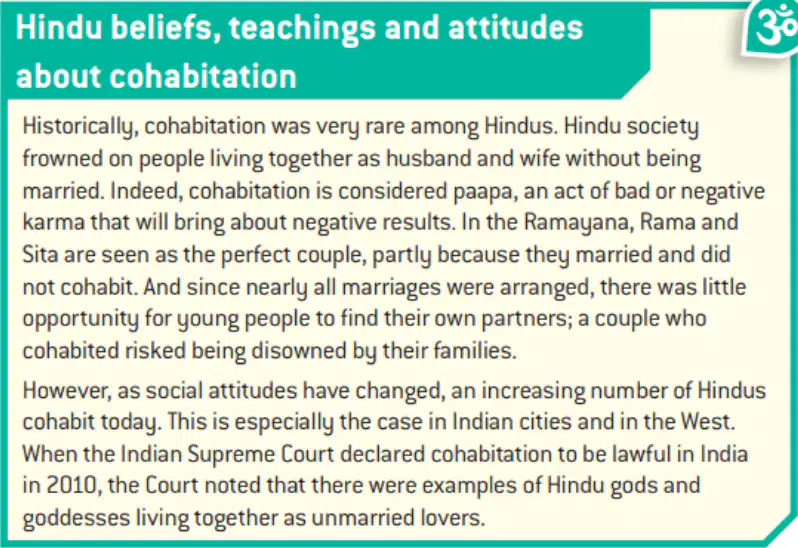
One example showing Hindu gods or goddesses living as unmarried lovers is:
Krishna and Radha
Shiva and Parvati
Rama and Sita
Vishnu and Lakshmi
Many Hindu couples consider Rama and Sita to be the ideal married couple because:
they are seen as symbols of love, loyalty, and devotion to each other.
they were the first married couple in Hindu mythology.
they never faced any challenges in their marriage.
they ruled their kingdom without any help from others.
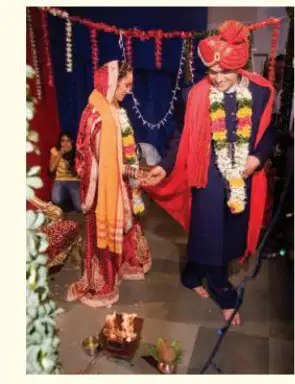
As the Hindu couple walk around the sacred fire, their clothes are ______ together.
tied
folded
washed
burned
Write a short definition for the term 'Ashrama'.
Ashrama refers to one of the four stages of life in Hindu tradition: Brahmacharya (student), Grihastha (householder), Vanaprastha (hermit), and Sannyasa (renunciate).
Ashrama is a sacred river mentioned in Hindu scriptures.
Ashrama is a type of traditional Indian clothing.
Ashrama refers to a festival celebrated in southern India.
Write a short definition for the term 'Vivaha Sanskar'.
Vivaha Sanskar is the Hindu marriage ceremony, considered one of the important sacraments (sanskars) in Hinduism.
Vivaha Sanskar is a Hindu festival celebrating the harvest season.
Vivaha Sanskar is a ritual performed for the naming of a child in Hinduism.
Vivaha Sanskar is a ceremony for the initiation of students into formal education in Hinduism.
Write a short definition for the term 'Mandap'.
Mandap is a temporary platform or canopy set up for Hindu wedding ceremonies.
Mandap is a traditional Indian sweet served at festivals.
Mandap is a type of musical instrument used in Hindu rituals.
Mandap is a sacred river mentioned in Hindu scriptures.
Write a short definition for the term 'Kanyadaan'.
Kanyadaan is the ritual of giving away the bride by her parents during a Hindu wedding ceremony.
Kanyadaan is a traditional Indian dance performed at weddings.
Kanyadaan refers to the exchange of garlands between the bride and groom.
Kanyadaan is the ritual of lighting the sacred fire during a Hindu wedding.
Write a short definition for the term 'Panigrahana'.
Panigrahana is a ritual in Hindu weddings where the groom takes the bride's hand, symbolising their union.
Panigrahana is a traditional Indian dance performed during festivals.
Panigrahana refers to a type of Indian sweet served at weddings.
Panigrahana is a prayer recited at the beginning of Hindu ceremonies.
Write a short definition for the term 'Saptapadi'.
Saptapadi is the ritual of taking seven steps around the sacred fire, signifying the vows taken by the couple in a Hindu wedding.
Saptapadi is a traditional Indian dance performed during festivals.
Saptapadi refers to the seven sacred rivers of India.
Saptapadi is a type of sweet distributed during Hindu ceremonies.
Rama and Sita are considered ideal role models for Hindu married couples because they demonstrate which of the following qualities?
Loyalty, devotion, and mutual respect
Wealth and power
Strictness and discipline
Independence and solitude
What type of relationship is marriage considered in Hinduism?
A social contract
A holy relationship
A legal obligation
A casual agreement
Why is adultery considered wrong according to Hinduism?
It breaks the sacred vows made in marriage
It results in social disgrace
It strengthens family bonds
It creates bad karma
What is paapa?
An act of good karma
An act of bad karma
A religious holiday
A sacred vow
According to the Vishnu Purana, what happens to a man who lusts after another’s wife?
He is rewarded in the afterlife
He is reborn as a creeping insect
He becomes a god
He lives a long life
What was the fate of Ahalya in Hindu mythology for committing adultery?
She was forgiven immediately
She was imprisoned inside a stone for centuries
She became a goddess
She was banished from her village
Divorce is uncommon in Hindu communities for which of the following reasons?
Strong religious and cultural values discourage divorce.
Divorce is legally impossible in Hindu law.
Hindu marriages are not recognised by the government.
There is no social stigma attached to divorce in Hindu communities.
Divorce is uncommon in Hindu communities for which of the following reasons?
Strong social and religious values discourage divorce
Divorce is legally impossible in Hindu law
Hindu communities do not believe in marriage
Divorce is encouraged in Hindu scriptures
What is kama in Hinduism?
Duty to family
Desire for pleasure
Spiritual enlightenment
Religious ritual
According to Hindu dharma, when should sex take place?
Only within marriage
Only during festivals
Anytime, without restrictions
Only after meditation
What is the main purpose of sex in Hinduism as related to dharma?
To experience pleasure
To procreate and continue the family line
To gain wealth
To achieve spiritual enlightenment
What warning does the Bhagavat Purana give about pursuing sexual pleasure?
It is the most important part of life
It can distract people from their ambitions and spiritual goals
In traditional Hindu families in the UK, attitudes to sex tend to be:
Very liberal
Fairly conservative
Not discussed at all
Encouraged outside marriage
What challenge may arise between younger British Hindus and their elders regarding attitudes to sex?
Disagreement about dietary laws
Conflict over traditional vs. modern values
Disagreement about dress codes
Conflict over language use
What does the quote from Bhagavat Purana 5.5.8 suggest about relationships?
Relationships help people focus on spiritual matters
Relationships may increase attachment to worldly things and “I and mine” thinking
Relationships are unimportant
Relationships always lead to enlightenment
The Hindu concept of dharma suggests which of the following about family and procreation?
It emphasizes the importance of fulfilling family duties and procreation as part of one's moral responsibilities.
It discourages family life and procreation in favor of asceticism.
It considers family and procreation irrelevant to spiritual progress.
It promotes celibacy as the highest form of dharma.
Having children, especially a son, is important in Hindu beliefs related to karma because:
It is believed that a son can perform rituals for the ancestors, helping them attain moksha.
It is necessary for inheriting property.
It brings good luck and wealth to the family.
It is required for social status in the community.
Contemporary Hindus in India and the UK generally approach the issue of family size and contraception in which of the following ways?
They often accept smaller family sizes and the use of contraception.
They strictly oppose any form of contraception.
They believe in having large families without contraception.
They are indifferent to family size and contraception.
Some Hindus might object to certain methods of contraception, such as the morning-after pill, because:
they believe it interferes with the natural process of conception and life.
it is considered a form of dietary restriction.
it is required by Hindu law to use all forms of contraception.
they believe it increases fertility.
The principle of ahimsa (non-harm) relates to Hindu views on contraception in which of the following ways?
It encourages Hindus to consider whether contraception causes harm to living beings.
It requires Hindus to use contraception at all times.
It forbids all forms of contraception without exception.
It has no influence on Hindu views about contraception.
The use of contraception is considered controversial in Hindu communities because:
Some believe it interferes with religious teachings, while others accept it for family planning.
It is universally accepted without any controversy.
It is completely forbidden in all Hindu scriptures.
There is no discussion about contraception in Hindu communities.
Hinduism teaches that the dharma of men and women is to marry and have children.
True
False
Homosexuality is described explicitly as sinful in the Vedas, the most authoritative Hindu texts.
True
False
Some ancient Hindu temple carvings depict sexual activity between same-sex couples.
True
False
Homosexuality was made legal in India in 2018.
True
False
All Hindu families and communities fully accept same-sex relationships today.
True
False
Many Hindus in the UK have adopted more open-minded views about same-sex relationships compared to traditional views.
True
False
Hinduism considers homosexuality to be in harmony with the natural order of the universe, called rta.
True
False
The Mahanirvana Tantra states: "A girl should be brought up and educated with great effort and care." What does this quote suggest about Hindu attitudes to the roles of women and men in worship and authority?
It suggests that women should be given importance in education and upbringing, reflecting respect for their roles in worship and authority.
It suggests that only men should be educated and given authority in worship.
It suggests that girls should not participate in religious activities.
It suggests that women have no significant role in Hindu society.
According to Manusmriti 2:67, what is said about a woman’s household duties and religious rituals?
A woman should perform household duties and religious rituals with her husband.
A woman is exempt from all household duties and rituals.
A woman should only perform religious rituals, not household duties.
A woman should perform household duties but not participate in religious rituals.
According to Manusmriti 5:154, a wife should treat her husband in which of the following ways?
With the same respect as a deity
With indifference
With hostility
With superiority
Hinduism presents both supporting and opposing arguments regarding whether men and women are thought of and treated equally, based on attitudes to their roles in worship and authority. Which of the following best summarizes these two opposing arguments?
Some believe men and women are treated equally in worship and authority, while others argue there are differences in their roles and status.
All Hindus agree that men and women are always treated equally in every aspect of worship and authority.
Hinduism teaches that women have more authority than men in all religious matters.
There is no discussion or debate about gender roles in Hinduism.
Manusmriti 9:72–81 allows some equality for women but also gives husbands certain rights. What is one right mentioned?
The right to discipline their wives under certain circumstances
The right to inherit property from their wives
The right to vote on behalf of their wives
The right to annul their daughters' marriages
God is described in Hinduism in relation to gender as:
Beyond gender distinctions
Strictly male
Strictly female
Both male and female at the same time
Shakti is important in Hindu beliefs about gender because:
it represents the divine feminine energy and power essential to creation and balance.
it is a festival celebrated only by men.
it refers to a specific male deity in Hinduism.
it is a ritual performed for wealth.
Some people oppose women holding positions of religious authority for which of the following reasons?
Traditional beliefs and interpretations of religious texts
Desire to increase gender equality
Support for modern reforms
Belief in the superiority of women in leadership
What evidence from the text shows that gender is considered temporary in Hinduism?
Hinduism teaches that the soul can be reborn in any gender, showing gender is temporary.
Hinduism states that gender is fixed for all lifetimes.
Hinduism believes only men can achieve enlightenment.
Hinduism does not mention gender in its teachings.
Men and women are thought of and treated equally in Hinduism. Choose the correct answer based on the evidence from the quotes above.
Men and women are always treated equally in Hinduism.
Men and women are never treated equally in Hinduism.
There are both arguments for and against the idea that men and women are treated equally in Hinduism.
Hinduism only values men.
Hindu attitudes to adultery are typically found in relation to dharma and marriage duties. Which of the following best describes these attitudes?
Adultery is generally condemned as it goes against dharma and marriage duties.
Adultery is encouraged as a way to test marital bonds.
Adultery is considered acceptable if both partners agree.
Adultery is ignored in Hindu teachings.
Hindu attitudes towards marriage and family life are often linked to which concepts?
Ashramas and dharma
Karma and moksha
Yoga and meditation
Puja and festivals
Hindu attitudes to the roles of men and women in worship and authority can be described as:
Varied, with some traditions allowing equal roles and others maintaining traditional gender roles.
Uniformly supportive of complete gender equality in all aspects.
Strictly prohibitive of women in any religious authority.
Unchanging and identical across all Hindu communities.
Hindu attitudes to contraception can be explained as:
Generally accepting, with emphasis on responsible family planning.
Strictly forbidden under all circumstances.
Only allowed for men, not women.
Encouraged as a religious duty.
Hindu attitudes to same-sex relationships can be described as:
Varied, with some acceptance and some disapproval depending on interpretation and tradition.
Uniformly supportive across all sects and traditions.
Strictly opposed in all Hindu scriptures and practices.
Completely ignored and never discussed in Hinduism.
Hindu attitudes to sex can be described as:
Generally accepting within marriage, but emphasizing self-control and responsibility.
Completely prohibitive and viewing sex as sinful in all circumstances.
Encouraging promiscuity and lack of restraint in sexual matters.
Indifferent and having no particular views on sex.
Hindu views on the nature and purpose of marriage include which of the following?
Marriage is a sacred duty and a spiritual union.
Marriage is only a legal contract with no spiritual significance.
Marriage is discouraged in Hinduism.
Marriage is solely for economic benefits.
Hindu marriage ceremonies express the nature and purpose of marriage by:
emphasizing sacred rituals and lifelong commitment
focusing solely on legal documentation
prioritizing individual wealth accumulation
encouraging temporary partnerships
Hindu beliefs about the duties of husbands and wives in marriage include which of the following?
Husbands and wives are expected to support and respect each other, fulfilling their roles with love and duty.
Husbands are expected to do all household chores while wives only pray.
Wives are expected to work outside while husbands stay at home.
There are no specific duties for husbands and wives in Hindu marriage.
Hindu attitudes towards the family emphasize its role as a social and spiritual unit.
They see the family as both a social and spiritual unit.
They view the family only as a social unit.
They consider the family unimportant in spiritual matters.
They believe the family is only for economic support.

