
Font size
 Worksheets
MT Ch. 2 Test Review
Total questions: 40
Worksheet time: 25mins
Match the following:
population
dem
head
cephal/o
lower part of the body (feet)
caud/o
disease
path/o
before, front
anter/o
Circle True (T) or False (F): The umbilicus is also known as the belly button or navel.
True
False
Circle True (T) or False (F): The diaphragm is a muscle that separates the thoracic and abdominal cavities.
True
False
Circle True (T) or False (F): The transverse plane divides the body into equal left and right halves.
True
False
Circle True (T) or False (F): The thoracic cavity is also known as the chest cavity.
True
False
Circle True (T) or False (F): The pelvic cavity contains primarily the organs of the reproductive system and the bladder.
True
False
Match the following:
progressive weakness of skeletal muscles
Muscular Dystrophy
associated with characteristic facial appearance, heart valve problems
Down Syndrome
fatal disease; fatty substance in the brain
Tay-Sachs Disease
bleeding disorder
Hemophilia
affects respiratory & digestive systems
Cystic Fibrosis
The body cavity that contains most of the intestines is called the _________________ cavity.
thoracic
pelvic
abdominal
spinal
Which term would be appropriate to describe an area on the backside of the body?
superior
inferior
ventral
dorsal
A ____________________ specializes analysis of tissues samples to confirm or establish a diagnosis.
histologist
geneticist
cytologist
pathologist
Which term would be appropriate to describe an area nearest the midline of the body?
proximal
distal
medial
lateral
A specialist that studies disease outbreaks is called a ____________________.
geneticist
pathologist
etiologist
epidemiologist
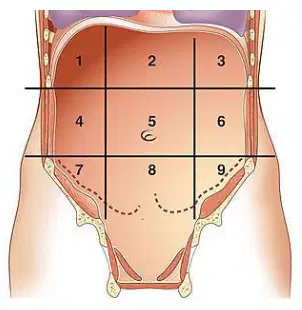
Match the abdominal region number to the correct name:
right hypochondriac
1
hypogastric
8
left iliac
9
epigastric
2
left lumbar
6
Which cavity contains the brain?
thoracic
cranial
spinal
pelvic
_______________________ means uppermost or above.
inferior
lateral
medial
superior
The _______________________ position describes a body standing in the standard position.
ventral
right hypochondriac
anatomical
transverse
This type of disease is also known as a contagious disease.
airborne transmission
communicable disease
vector-borne transmission
epidemic
What is another name for the umbilical region?
diaphragm
belly button
hypogastric
anatomical
Match the following:
cough or sneeze
Airborne
flies, ticks, mites, fleas, rats
Vector-borne
HIV/Hepatitis B
Bloodborne
fecal-oral
Foodborne
contaminated surface
Indirect Contact
Match the following:
Acquired in a hospital
nosocomial infection
spreads over several countries or continents
pandemics
outbreak
epidemic
Produces symptoms caused by detectable physical changes in the body
organic disorder
Produces symptoms for which no physiological or anatomical cause can be identified
functional disorder
The study of the cause of disease is called ________________________________.
histology
etiology
pandemic
epidemic
The dog's tail is (a) on the body.
dorsal
ventral
anterior
posterior
A directional term for caudal can also be referred to as:
posterior
superior
anterior
inferior
hardening
-tocia
-phoresis
-sclerosis
-rrhexis
stomy
inflammation of scar
tore structure
surgical opening
An example of a communicable disease is..
measles
coronavirus
chicken pox
all of the above
Circle True (T) or False (F): The cranial cavity contains the brain.
False
True
Which term describes a position farther from the origin of a body part or the point of attachment?
medial
distal
proximal
superior
A person who studies the microscopic structure of tissues is called a ____________________.
pathologist
epidemiologist
geneticist
histologist
Match the following terms with their definitions
Proximal
Closer to the trunk of the body
Distal
Further from the trunk of the body
Superior
Above
Inferior
Below
Lateral
Away from the midline of the body
The heel is (a) to the toes.
The shoulders are (a) to the midline.
The neck is (a) to the arms.
Match the term with the correct definition
Superior
towards the head or above
Inferior
towards the feet or below
Anterior
front, or in front of
Posterior
back, or the back of

midsagittal/median


Which TWO terms mean towards the feet. (based on the photo)
Lateral, Posterior
Dorsal, Posterior
Inferior, Caudal
Cephalic, Superior

