
 Worksheets
Business Economics Unit IIII
Total questions: 20
Worksheet time: 10mins
Find out the equal term of Diminishing Marginal Returns.
Decreasing average variable costs
Decreasing marginal costs
Increasing marginal costs
Decreasing average fixed costs
Define Production in Economics
Utility creation
Providing services
Agricultural activity
Industrial production
In which stage of production, a rational producer likes to operate in short-run production.
First Stage
Second Stage
Third Stage
No Stage
Find out the main objective of production activity.
To create employment
To improve standard of living
To earn Profit
Raise national income
Identify the two kinds of economies of scale.
Temporary and Permanent
Natural and Artificial
Managerial and Industrial
Internal and External
Which of the following are the primary factors of production?
Labour and Organisation
Labour and Capital
Land and Capital
Land and Labour
Why firms making similar products, often located near each other?
Competition may be reduced
External economies may be possible
Land may be cheaper
Overheads may be increased
When is the “Law of Diminishing Returns” applied in Production Function?
Long run, but not short run
Short run, but not the long run
Short run and long run
Neither long run and short run
WHICH IS FREE GIFT OF NATURE
(a)
Indicate the term applicable in Law of Diminishing Returns.
Average Product
Average Total Cost
Marginal Product
Marginal rate of technical substitution
The law of variable proportions is also known as
Law of Increasing Costs
Law of Returns to Scale
Law of Diminishing Returns
Law of Supply
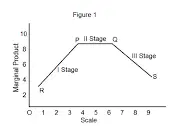
Find out the above diagram?
Law of Variable Proportion
Law of Return to Scale
Long Run
Short Run
Identify the shape of the supply curve.
Downward sloping
Vertical line
Horizontal line
Upward Sloping
What is the effect of increasing variable inputs on total output in the short run?
Total output increases at a decreasing rate
Total output remains constant
Total output increases at an increasing rate
Total output decreases
Which of the following best describes the concept of economies of scale?
Fixed costs that remain constant regardless of output
Variable costs that increase with output
Cost disadvantages due to increased production
Cost advantages due to increased production
What happens to marginal returns when a firm operates beyond the optimal level of production?
Marginal returns begin to decline
Marginal returns remain constant
Marginal returns increase
Marginal returns become negative
What is the primary purpose of the production function in economics?
To determine the optimal level of output
To analyze consumer behavior
To measure economic growth
To evaluate market competition
From the following best describes the concept of diminishing returns?
Increased output leads to higher costs
Adding more inputs results in smaller increases in output
Output decreases as inputs are increased
Output increases at a constant rate
Identify the term that describes the relationship between input and output in production.
Production Function
Cost Function
Supply Function
Demand Function
If a company’s long-run average cost (LRAC) curve is falling, it indicates:
Diseconomies of scale
Constant returns to scale
Economies of scale
None of the above

