
 Worksheets
Industrialization and Gilded Age Review
Total questions: 26
Worksheet time: 14mins
What is a primary goal of antitrust laws?
Reduce government regulation
Promote business competition
Limit consumer rights
Support large corporations
Which was a result of industrialization in the United States during the late 1800s?
a decline in factory production
increased urbanization
reduced use of machines
decrease in transportation networks
Which group found increased employment opportunities in offices and factories due to inventions like the typewriter and sewing machine?
women
immigrants
farmers
children
Why were industrialists like Rockefeller, Carnegie, and Morgan often criticized during the Gilded Age?
They donated all their wealth to charity
They supported labor unions
They were accused of exploiting workers and eliminating competition
They refused to invest in new technology
Which statement best reflects the principle of laissez-faire economics?
The government should provide financial aid to struggling industries
The government should set strict rules for all businesses
The government should allow businesses to operate with minimal regulation
The government should nationalize major companies
Who was the founder of Standard Oil Company?
J.P. Morgan
John D. Rockefeller
Andrew Carnegie
Jay Gould
What was the primary purpose of the Sherman Antitrust Act?
To prevent monopolies and promote competition
To support the growth of industrial trusts
To provide tax breaks for large corporations
To encourage mergers between major companies
Which goal was shared by labor leaders such as Samuel Gompers, Terence Powderly, and Eugene Debs in the late 1800s?
End discrimination against immigrants
Promote the assimilation of Native Americans
Reduce the power of big business
Secure better wages and hours for workers
Which idea is most closely associated with the theory of Social Darwinism in the 19th century?
The government should regulate business to protect workers
Only the fittest individuals will achieve wealth and power
Society should strive for complete equality among all citizens
Charity and social welfare are necessary for progress
What did the term "Gilded Age," as used by Mark Twain, suggest about American society in the late 19th century?
It was a time of widespread equality
It was a period of peace and stability
It was marked by significant social and economic disparities
It was known for the decline of industrialization
What term did opponents use to describe wealthy business leaders who were seen as exploiting workers and resources?
tycoons
robber barons
philanthropists
muckrakers
The Bessemer Process was used in (a) .
Knights of Labor is an example of a (a) that existed in the late 1800s
Which of the following contributed significantly to the growth of industry in the United States during the Industrial Revolution?
Strict government regulations on business
Innovative machinery and technological advances
Limited access to raw materials
Shortage of available workers
Who was the industrialist known for his success in the steel business and for donating much of his wealth to educational and cultural causes?
John D. Rockefeller
J.P. Morgan
Andrew Carnegie
Cornelius Vanderbilt
How did the expansion of railroads impact the distribution of goods in the United States?
It limited access to distant markets
It increased the time needed for delivery
It allowed businesses to reach customers across the country
It reduced the variety of products available
Which time zone does the city of Baton Rouge, LA fall under?
Pacific
Mountain
Central
Eastern
The system in which the government owns and controls major industries and aims to distribute resources and wealth equally among the population is known as (a) .
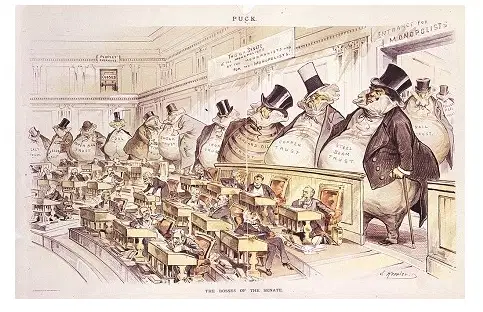
Analyze the political cartoon "The Bosses of the Senate" by Joseph Keppler. What message does the cartoon convey about the influence of big business during the Gilded Age?
The cartoon suggests that big business leaders had little impact on government decisions
The cartoon portrays business leaders as controlling and manipulating the Senate
The cartoon shows business leaders as supporters of democratic reforms
The cartoon depicts business leaders as powerless and ignored by politicians
Many (a) workers in the 1800s were immigrants from China and Ireland.
During the late 1800s, many American workers faced long hours and unsafe workplaces. Which government approach contributed most to these conditions and eventually prompted the rise of organized labor movements?
Laissez-faire attitude toward industrial regulation
Progressive reforms for worker safety
Expansionist foreign policies
Protective tariffs on imported goods
Which factor contributed most to the rapid urbanization of the United States in the late 1800s?
the expansion of rural farming communities
the rise of industrial jobs in cities
the decline in immigration rates
the reduction of technological innovation
Who was the first president of the American Federation of Labor (AFL)?
Samuel Gompers
John L. Lewis
Eugene Debs
Terence Powderly
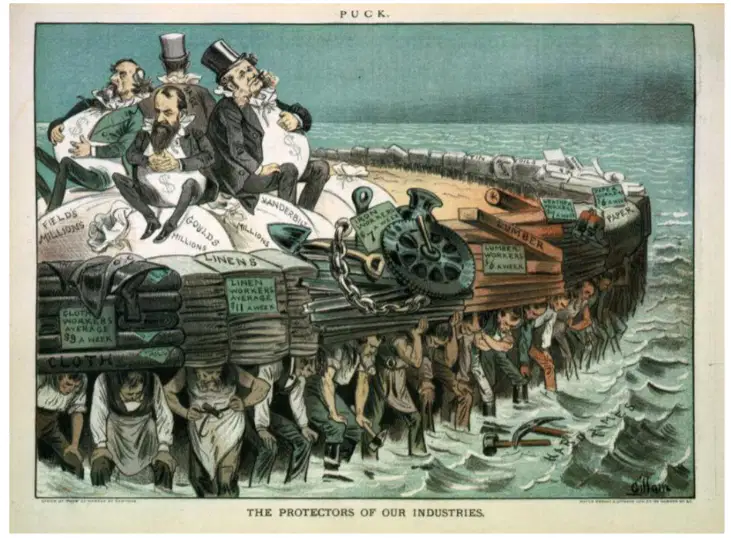
According to the cartoon, how are Gould and Vanderbilt portrayed in relation to the workers?
They are helping the workers improve their lives
They are struggling alongside the workers
They are profiting while the workers do all the labor
The workers are ignoring their presence
According to Andrew Carnegie's "The Gospel of Wealth," how did he view the economic differences between the rich and the poor?
He saw them as a threat to society
He believed they were necessary for progress
He thought they should be eliminated by the government
He felt they were temporary and unimportant
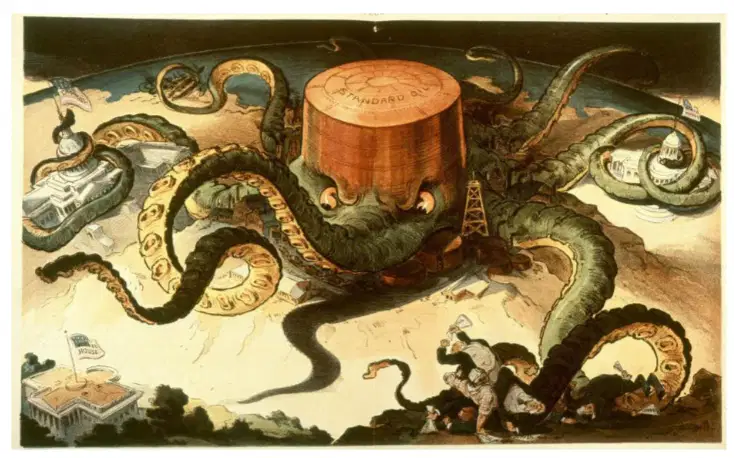
Which of the following best explains the economic environment that allowed the situation shown in the cartoon to develop during the Gilded Age?
Laissez-faire economic policies that limited government regulation of business
Progressive Era reforms aimed at breaking up monopolies
The shift from an agricultural to an industrial economy
Frequent financial panics and unstable markets in the late 1800s

