
 Worksheets
Princ of Mech Eng Mechatronics (Oscillatory Motion)
Total questions: 15
Worksheet time: 8mins
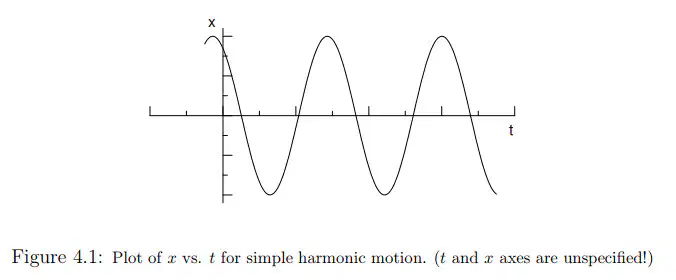
Referring to Figure 4.1, how many full cycles are shown in the plot?
one
two
three
four
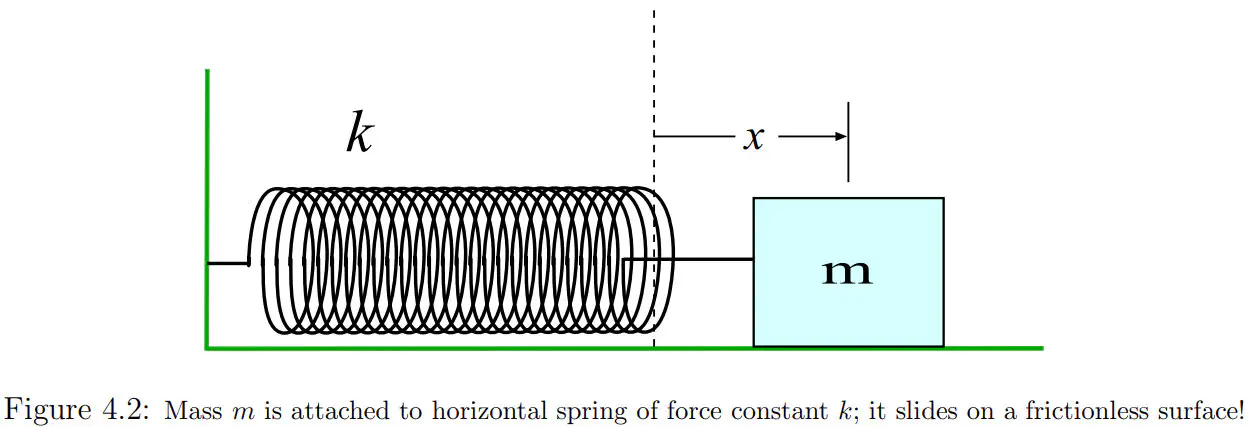
Based on Figure 4.2, what force is responsible for the simple harmonic motion of the mass (m) attached to the spring?
Gravitational force
Frictional force
Restoring force of the spring
Normal force
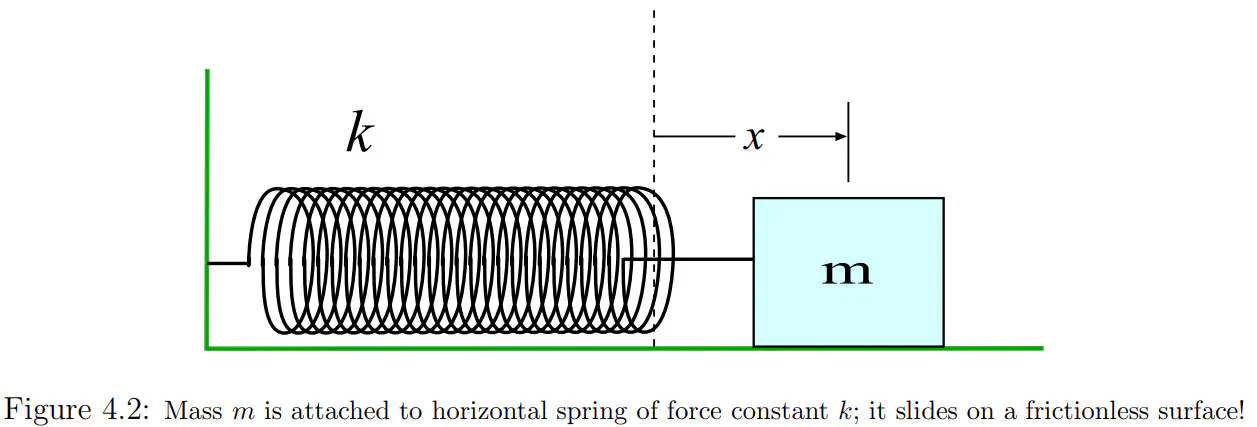
In the system shown in Figure 4.2, what is the expression for the angular frequency (ω) of the oscillating mass?
ω= km
ω=2πkm
ω=mk
ω=2π1mk
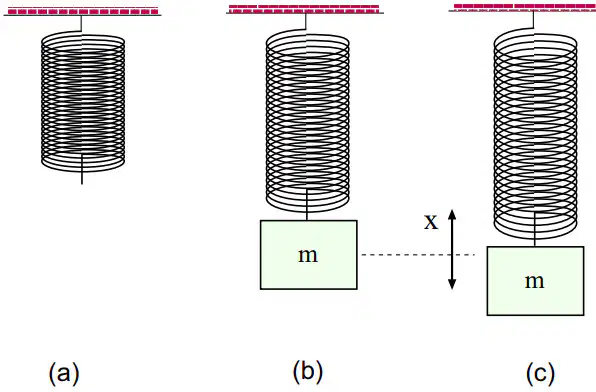
According to Figure 4.3 (a), (b), and (c), what is the purpose of the initial static extension of the vertical spring when a mass is attached to it?
It increases the period of oscillation.
It establishes a new equilibrium position for the oscillations.
It changes the angular frequency of the motion.
It prevents the mass from oscillating.
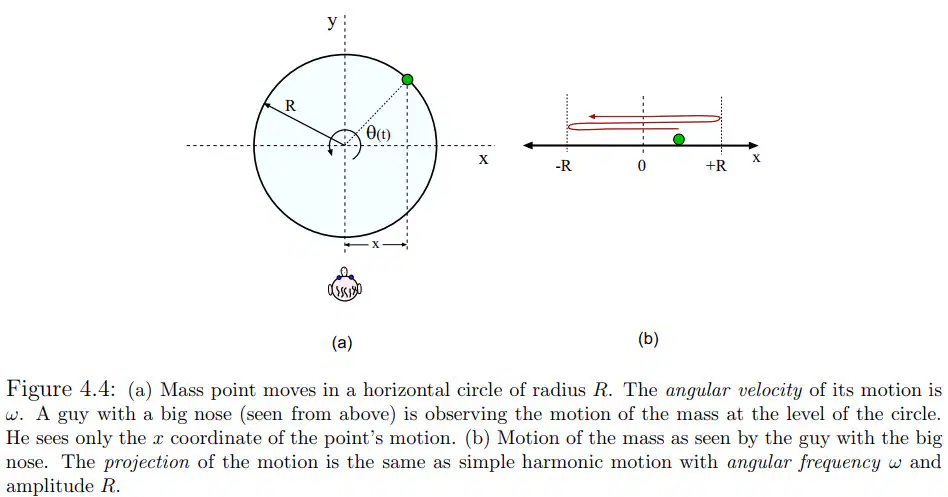
Based on the relationship between uniform circular motion and simple harmonic motion illustrated in Figure 4.4, what does the radius (R) of the circular motion correspond to in the simple harmonic motion?
Amplitude
Angular frequency
Frequency
Period
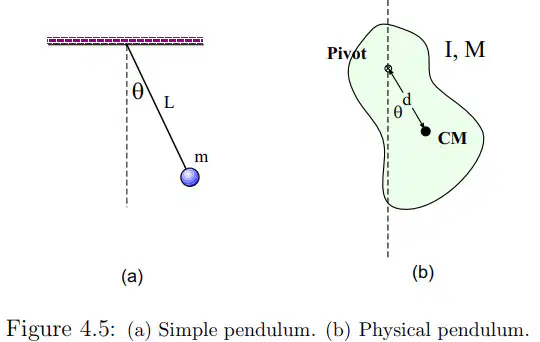
According to Figure 4.5 (a), what parameters determine the period of a simple pendulum, assuming small angle oscillations?
Mass (m) and length (L)
Mass (m) and gravity (g)
Angle of displacement (θ) and length (L)
Length (L) and gravity (g)
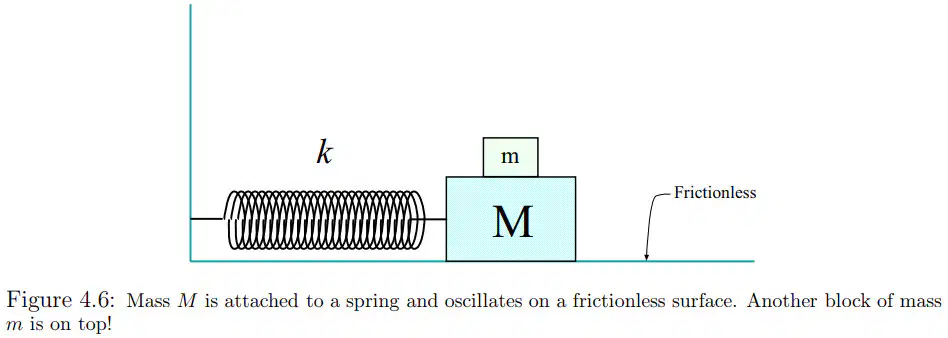
In the scenario depicted in Figure 4.6, if no slippage is to occur between the two blocks (m and M), what is the force that causes the smaller block (m) to accelerate?
The spring force
The gravitational force
The normal force
The static friction force
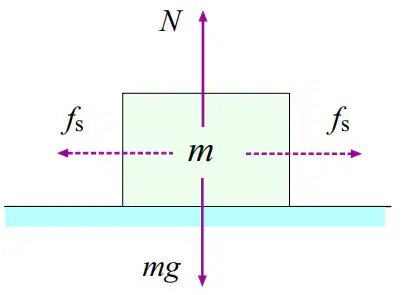
Based on the text and Figure 4.7, which shows a free-body diagram of block m, what is the expression for the maximum possible acceleration of mass m if no slippage occurs?
amax=μsg
amax=kAmaxm
amax=ωAmax
amax=mFspring
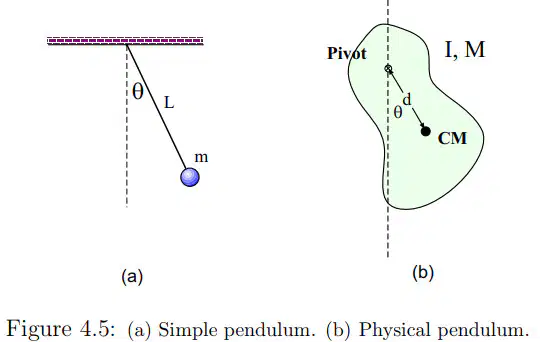
Based on the physical pendulum shown in Figure 4.5 (b), what quantity is used to calculate the period of oscillation that is not needed for a simple pendulum?
Mass (M)
Moment of inertia (I)
Distance from pivot to center of mass (d)
Both B and C
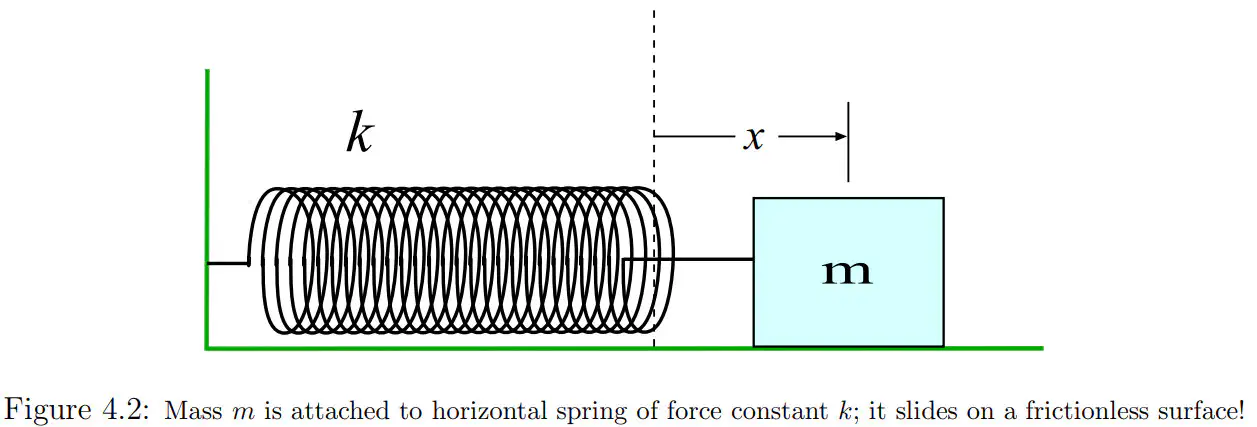
A mass is attached to a horizontal spring and oscillates on a frictionless surface, as shown in Figure 4.2. If the spring constant (k) is 200 N/m and the mass (m) is 0.5 kg, what is the angular frequency (ω) of the motion?
20 rad/s
10 rad/s
400 rad/s
100 rad/s

Based on the relationship shown in Figure 4.4, if a particle in uniform circular motion has a radius (R) of 0.5 m and an angular velocity (ω) of 10 rad/s, what is the maximum speed (vmax) of the corresponding simple harmonic motion?
5 m/s
10 m/s
20 m/s
0.5 m/s
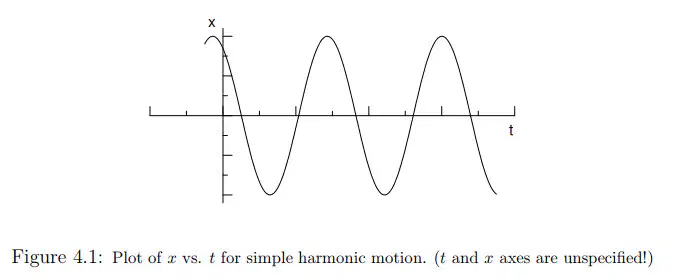
As shown in Figure 4.1, at what point in the oscillation is the kinetic energy of the particle at its maximum?
At x=+A
At x=−A
At x=0
Kinetic energy is constant throughout the motion.
Referring to the energy analysis of a simple harmonic oscillator, what is the potential energy (U) of a mass-spring system when the displacement (x) is equal to half the amplitude (A/2)?
21kA2
41kA2
81kA2
161kA2
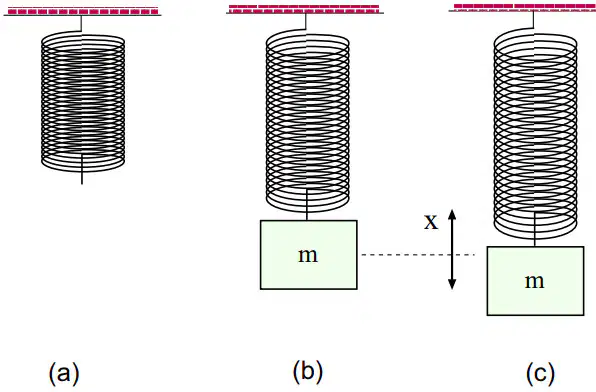
Based on Figure 4.3, a 5.0 kg mass is attached to a vertical spring. If the spring constant is 490 N/m, by how much does the spring stretch to reach its new equilibrium position? (Assume g=9.8 m/s2).
0.05 m
0.1 m
0.15 m
0.2 m
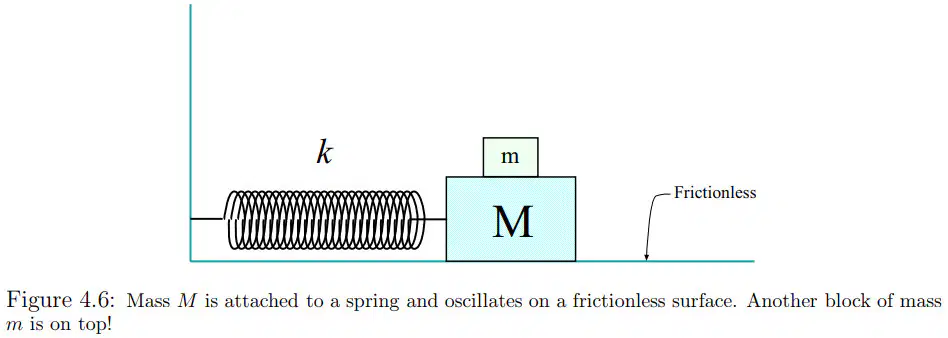
As shown in Figure 4.6, a spring with constant k=200 N/m is attached to a large mass (M=10 kg), with a smaller mass (m=1.0 kg) on top. What is the total mass (M) of the system that determines the angular frequency of the oscillation?
1.0 kg
10 kg
11 kg
200 kg

