
 Worksheets
Events Prior to U.S. entry
Total questions: 65
Worksheet time: 33mins
What was the official position of the U.S. prior to its entry into the conflict?
Aggression
Neutrality
Alliance
Isolationism
Who encouraged U.S. neutrality in 'thought and action'?
President Roosevelt
President Wilson
President Taft
President Harding
The U.S. traded with ______ sides, but ties with Great Britain were strongest.
both
neither
only one
no
Which country did the U.S. have the strongest ties with prior to entering the conflict?
France
Germany
Great Britain
Russia
Name one of the commonalities that strengthened U.S. ties with Great Britain:
language, customs, or government
different religions
opposing political systems
isolationist policies
By 1917, U.S. loans to the Allies reached how much?
$1 billion
$2.3 billion
$5 billion
$10 billion
Events Prior to U.S. entry: Great Britain spread anti-German _______ to the U.S. (Fill in the blank)
propaganda
currency
weapons
medicine
Events Prior to U.S. entry: G. Britain blockaded Europe, stopping our trade with _______ (famine).
Germany
France
Italy
Russia
Events Prior to U.S. entry: Germany began _______ warfare, violating 'freedom of seas.'
submarine
aerial
chemical
guerrilla
Events Prior to U.S. entry: Germany attacked ships in _______ ports. (Fill in the blank)
Allied
Neutral
Pacific
American
Events Prior to U.S. entry: Germany declared a '_______' around the British Isles.
war zone
neutral zone
safe zone
trade zone
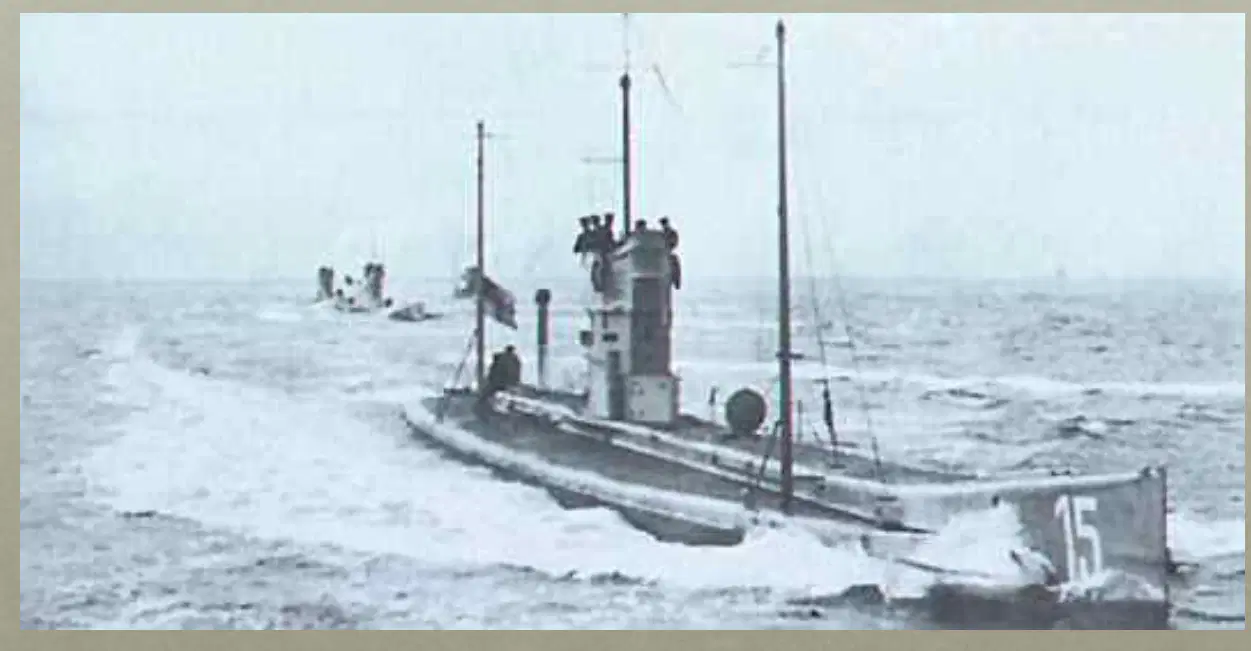
What type of vessel is shown in the image above?
Battleship
Aircraft carrier
Submarine (German u-boat)
Destroyer

What is the name of the ship shown in the image?
Titanic
Lusitania
Britannic
Queen Mary
What was the name of the ship whose sinking on May 7, 1915, was a significant event prior to U.S. entry into World War I?
Titanic
Lusitania
Britannic
Arizona
Germany questioned U.S. ________ and the ship’s cargo after the sinking of the Lusitania.
neutrality
alliance
territory
leadership
The ship was loaded with ________ purchased from the U.S.
contraband
furniture
passengers
machinery
Who demanded in a letter of protest that Germany end submarine warfare and pay reparations to the families?
Churchill
Wilson
Roosevelt
Lloyd George
Wilson demanded that Germany end sub ________ after the sinking of the Lusitania.
warfare
negotiations
alliances
trade
The Lusitania was loaded with contraband purchased from the U.S.
True
False
What did Wilson demand Germany pay to the families affected by the sinking of the Lusitania?
Taxes
Reparations
Fines
Loans
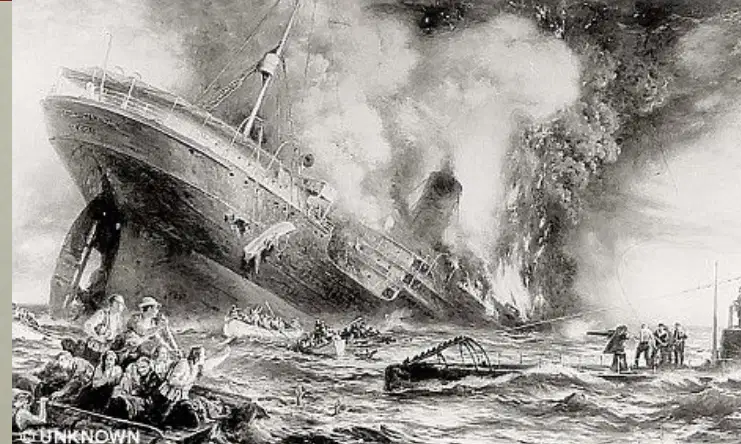
Observe the images of the sinking ships. What event do these images most likely depict?
The sinking of the Titanic
The sinking of the Lusitania
The Battle of Trafalgar
The launching of a new ship
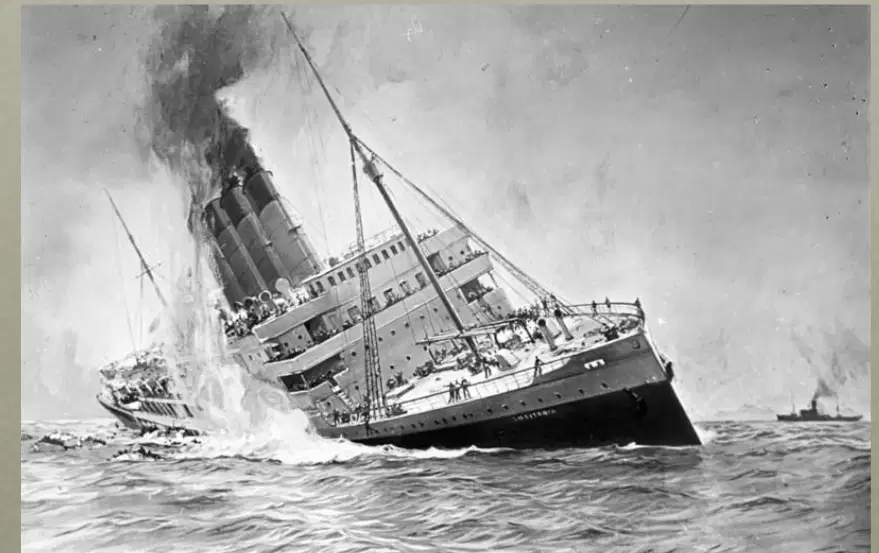
Based on the images, the ships are:
being attacked and sinking.
being loaded with cargo.
sailing peacefully.
being built in a shipyard.
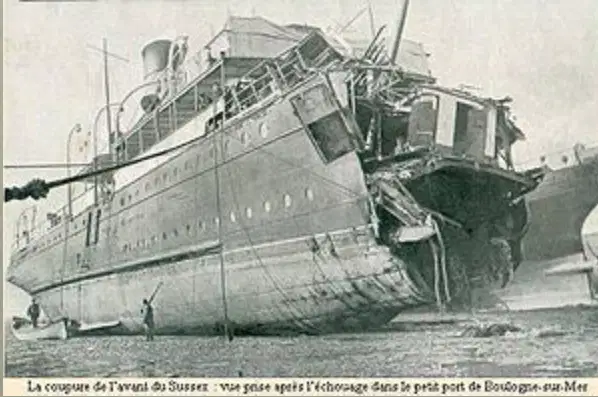
March 1916: The French ship Sussex was sunk with Americans on board. What was the name of the pledge Germany agreed to after this event?
The Sussex Pledge
The Paris Agreement
The Treaty of Versailles
The Berlin Accord
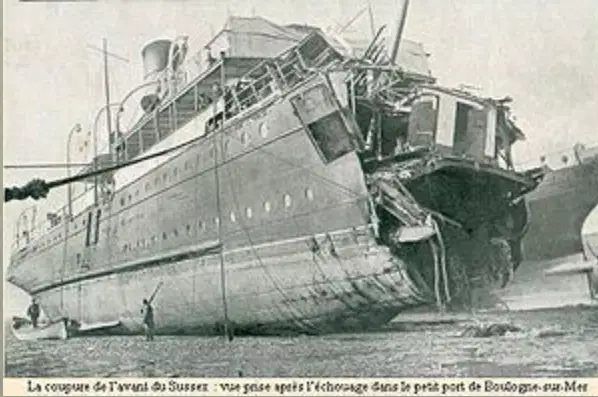
March 1916: The French ship Sussex was sunk with Americans on board. Germany agreed to the “Sussex Pledge,” a promise to ______ ships before sinking them.
warn
ignore
attack
board
March 1916: The French ship Sussex was sunk with Americans on board. The significance of the Sussex Pledge was:
Germany promised to stop unrestricted submarine warfare.
The United States declared war on Germany.
France joined the Central Powers.
The Sussex was a British ship.
Who were the main candidates in the Election of 1916?
Wilson and Charles E. Hughes
Roosevelt and Taft
Lincoln and Douglas
Adams and Jefferson
In the Election of 1916, both candidates campaigned for ______ and ______.
peace and neutrality
war and expansion
industrialization and reform
prohibition and suffrage
TR may have hurt Republican chances for victory with pro-war speeches.
True
False
How many electoral votes did Wilson win by in the Election of 1916?
20
10
35
50
The citizens of the US wanted to go to war despite Wilson.
True
False
Only some citizens wanted to go to war
Wilson wanted to go to war more than the citizens
By 1916, the War in Europe became ________ on both fronts.
stalemated
victorious
peaceful
decisive
The Western Front was defended by which two countries?
France and Great Britain
Russia and Germany
Italy and Austria-Hungary
United States and Canada
The Western Front consisted of ______ miles of trenches extending from the English Channel to the Adriatic Sea.
500
100
2000
50
The Eastern Front was defended by which country?
France
Russia
Great Britain
Germany
Little progress and high ______ led to frustration on both sides.
casualties
profits
hopes
rewards

According to the map, which alliance did France belong to during World War I?
Triple Entente
Central Powers
Neutral
None of the above

According to the map, which country was neutral during World War I?
Germany
Switzerland
United Kingdom
Austria-Hungary

Italy joined the ______ in 1915, according to the map.
Triple Entente
Triple Alliance
Central Powers
League of Nations

According to the map, Bulgaria was a member of the Central Powers during World War I.
True
False
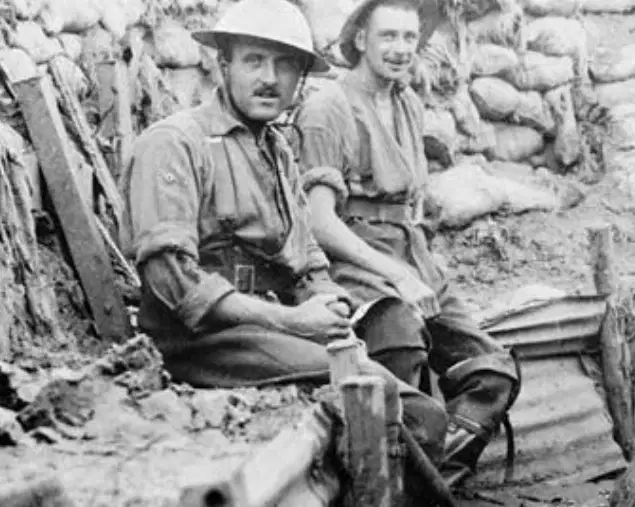
Look at the image of soldiers sitting in a trench. What historical event is most likely depicted in this photograph?
The American Civil War
World War I
The Vietnam War
The Korean War
Germany resumed _______ submarine warfare to break the deadlock. (Fill in the blank with the correct term from the passage.)
unrestricted
limited
defensive
commercial
How did Germany try to break the deadlock before U.S. entry into the war?
By resuming unrestricted submarine warfare
By sending peace treaties
By withdrawing from the war
By increasing trade with the U.S.
The U.S. responded to Germany's actions by ending _______ relations with Germany. (Fill in the blank with the correct term from the passage.)
diplomatic
economic
military
cultural
What happened after Germany stopped issuing warnings?
3 U.S. ships were sunk in one day
The U.S. declared war immediately
Germany surrendered
The Kaiser fled the country
The Kaiser felt confident the _______ would not enter the war.
U.S.
France
Russia
Italy
What was the Zimmerman Note?
A letter from Germany to Mexico asking for an alliance against the U.S.
A peace treaty between Germany and the U.S.
A declaration of war by Mexico
A letter from Britain to the U.S.
Who intercepted and decoded the Zimmerman Note?
Mexico
Great Britain
Russia
United States
In March 1917, which country surrendered to Germany?
Mexico
Great Britain
Russia
United States
The Zimmerman Note was published on _________
March 1, 1917
April 6, 1917
January 16, 1917
June 28, 1914
After the Zimmerman Note, how many more unarmed U.S. ships were sunk?
4
2
6
1
Wilson asked ______ for a Declaration of War on April 2, 1917.
Congress
the Supreme Court
the United Nations
the Cabinet
Who did Wilson identify as the enemy?
German government
German people
Wilson said: “America must go to war to make the world safe for ______.”
democracy
capitalism
monarchy
imperialism
On what date did Congress declare war?
April 6, 1917
May 1, 1915
June 28, 1914
November 11, 1918
The Allies were _______ in 1917.
weakened
strengthened
victorious
neutral
In March, 1917, a Russian peoples’ _______ overthrew Czar Nicholas II and a provisional government was set up.
revolt
festival
treaty
election
Who was overthrown in March 1917 during the Russian Revolution?
Vladimir Lenin
Nicholas II
Joseph Stalin
Leon Trotsky
In November 1917, the weak government was overthrown by the _______ led by Nikolai Lenin. (Fill in the blank)
Bolsheviks
Mensheviks
Provisional Government
Duma
The Bolshevik Revolution eventually resulted in a _______ government.
communist
monarchist
democratic
theocratic
In December 1917, Russia agreed to an _______ on the Eastern Front and withdrew from the war.
armistice
offensive
treaty
blockade
After Russia withdrew from the war, Germany could now send all its forces to which front?
Eastern Front
Western Front
Southern Front
Northern Front
A.E.F. stands for ________ and was led by General John Pershing. (Events Prior to U.S. entry)
American Expeditionary Forces
Allied European Forces
Army of Eastern Front
American Elite Fighters
By 1918, how many U.S. 'Doughboys' were in France? (Events Prior to U.S. entry)
1 million
2 million
3 million
4 million
Wilson began plans for ________ based on his 14 Points. (Events Prior to U.S. entry)
permanent peace
military expansion
economic sanctions
territorial conquest
Who led the American Expeditionary Forces (A.E.F.) during World War I? (Events Prior to U.S. entry)
Woodrow Wilson
John Pershing
Theodore Roosevelt
George Patton

