
 Worksheets
Banking, Friction, and Energy Concepts
Total questions: 28
Worksheet time: 17mins
What is the formula for torque in terms of force and radius?
τ = r - F
τ = r + F
τ = r × F
τ = F / r
How does friction affect the banking of a rod in motion?
Friction causes the rod to slide off the bank.
Friction reduces the speed of the rod in motion.
Friction has no effect on the banking of a rod.
Friction stabilizes the banking of a rod in motion by providing the necessary centripetal force.
State the work-energy theorem and its significance in mechanics.
The work-energy theorem states that potential energy is always conserved.
The work-energy theorem states that the work done on an object is equal to the change in its kinetic energy.
The work-energy theorem applies only to objects at rest.
The work-energy theorem states that energy cannot be created or destroyed.
Explain how angular momentum is conserved in a closed system.
Angular momentum is conserved in a closed system because there are no external torques acting on it.
Angular momentum can be created or destroyed in a closed system.
Angular momentum is only conserved when objects are at rest.
External forces always increase angular momentum in a closed system.
What role does friction play in the stability of a banked curve?
Friction increases the speed of the vehicle on a banked curve.
Friction helps prevent sliding and maintains stability on a banked curve.
Friction has no effect on the stability of a banked curve.
Friction only acts in the opposite direction of motion on a banked curve.
Describe an example of energy conservation in a frictional system.
A block at rest on a flat surface converts kinetic energy to potential energy.
A pendulum swinging in a vacuum loses energy to air resistance.
A car accelerating on a frictionless road converts fuel energy directly to heat.
A block sliding down a frictional ramp converts potential energy to kinetic energy, with some energy lost as heat due to friction.
How is the work done by friction calculated in a moving object?
Work done by friction is calculated as Work = -Friction Force × Distance.
Work = Friction Force + Distance
Work = Friction Force × Time
Work = -Friction Force ÷ Distance
What is the relationship between torque and angular acceleration?
Torque is inversely proportional to angular acceleration.
Torque is directly proportional to angular acceleration.
Torque and angular acceleration are unrelated.
Torque has no effect on angular acceleration.
In a banked turn, how does the angle of the bank affect the required speed of a vehicle?
A steeper bank angle requires a constant speed regardless of the angle.
The bank angle has no effect on the required speed of a vehicle.
The steeper the bank angle, the higher the required speed for safe navigation.
The steeper the bank angle, the lower the required speed for safe navigation.
Discuss the implications of the work-energy theorem in real-world applications.
The work-energy theorem is essential for analyzing motion and energy transfer in various real-world applications, including engineering, sports, and renewable energy.
It is primarily used to calculate the speed of light in a vacuum.
The work-energy theorem only applies to theoretical physics and has no practical use.
The theorem is irrelevant in the context of chemical reactions and thermodynamics.
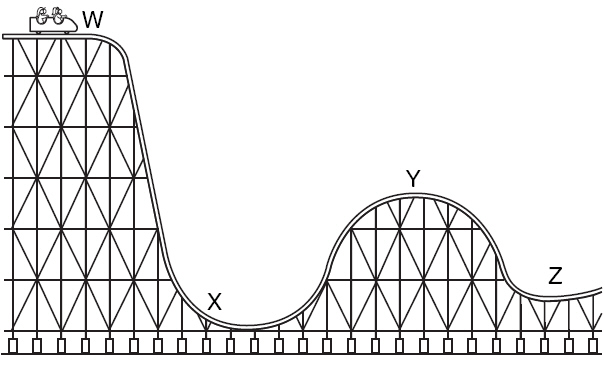
At which point is stored energy greatest?
W
X
Y
Z
When you eat fruits and vegetables, chemical bonds are releasing stored energy, this is...
a. thermal energy
b. sound energy
c. electrical energy
d. chemical energy
The ability to do work
A. chemical energy
B. Friction
C. electrical energy
D. Energy

Where is the stored energy the greatest?
A
B
C
D


We can hear a musical instrument because it produces _______ energy.
sound
thermal
mechanical
light
When playing tug of war, you are using which type of energy?
Sound energy
Heat energy
Mechanical energy
Light energy

