
 Worksheets
USI Chapter 3 Test
Total questions: 28
Worksheet time: 14mins
Name
Class
Date
1.
European explorers learned about farming techniques from —
a)
Indigenous people
b)
other Europeans
c)
Spanish conquistadors
d)
French traders
2.
Which was NOT an obstacle to European exploration?
a)
Disease and starvation
b)
Fear of the unknown
c)
Limited desire to expand European empires
d)
Poor maps and navigational tools
3.
What did French explorers set up so they could get goods, such as furs?
a)
Territories
b)
Supply ships
c)
Missions
d)
Trading posts
4.
What were three reasons why Europeans wanted to explore North America?
a)
To find gold and other natural resources
b)
To increase their power by claiming land
c)
To shut down all trading posts
d)
To spread their religion
5.
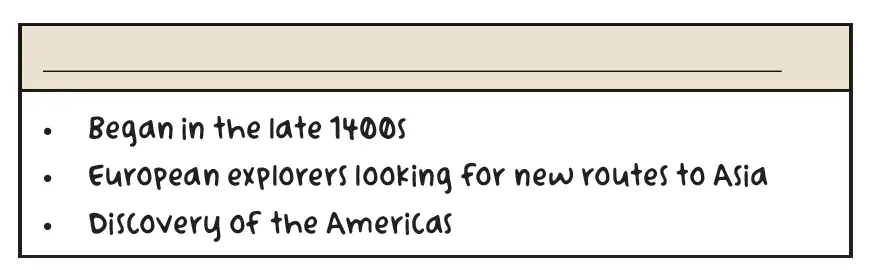
What is the best title for this chart?
a)
Age of Navigation
b)
Age of Exploration
c)
Transatlantic Slave Trade
d)
The Crusades
6.
How did Indigenous people help the English and Dutch with their settlements?
a)
Taught them new farming techniques
b)
Gave them salt for preserving their meats
c)
Showed them how to hunt with metal weapons
d)
Taught them building techniques for log homes
7.
French is the official language of Québec because the city was established by —
a)
Francisco Coronado
b)
Robert de La Salle
c)
Samuel de Champlain
d)
John Cabot
8.
Which country explored eastern Canada, including Newfoundland?
a)
Spain
b)
France
c)
England
9.
Which country claimed the Southwest of present-day U.S.?
a)
Spain
b)
France
c)
England
10.
Which country claimed the Mississippi River Valley?
a)
Spain
b)
France
c)
England
11.
Why did many Indigenous people die after the arrival of Europeans?
a)
There was a terrible drought that destroyed all the food they tried to grow.
b)
They starved after giving European settlers all their stored food in the winter.
c)
The tribes lacked wilderness survival skills and an understanding of the land.
d)
They were exposed to new diseases brought by the Europeans that spread quickly.
12.
Which of the following was NOT an accomplishment of early European exploration?
a)
Exchanged goods in trade networks in North America
b)
Improved navigational tools and ships
c)
Claimed land for individual ownership and not for a country
d)
Mapped territories and established colonies
13.
Why did the French want to explore North America?
a)
To help Indigenous tribes defend their lands
b)
To explore and increase the fur trade
c)
To send conquistadors to find gunpowder
d)
To bring horses to give to the Indigenous people
14.
Indigenous tribes believed that land was to be —
a)
owned by the first people to live there
b)
respected, shared, and not owned
c)
conquered and ruled by a home country
d)
used only by those who owned it
15.
Which two actions were taken by explorers from Spain?
a)
Spread the Christian religion to the Americas
b)
Established fur trading posts with Indigenous tribes
c)
Built the first missions in North America
16.
Which two actions were taken by explorers from France?
a)
Spread the Christian religion to the Americas
b)
Established fur trading posts with Indigenous tribes
c)
Built the first missions in North America
17.
Early explorations along the coast of West Africa were led by —
a)
Portugal
b)
France
c)
Spain
d)
England
18.
What region of North America was claimed by the explorer Robert de La Salle?
a)
Québec
b)
Mississippi River Valley
c)
Eastern Canada
d)
Southwest North America
19.
What two navigational tools increased the ability of explorers to travel across the sea?
a)
Improved paper maps
b)
Kites to measure distance
c)
Telescopes to calculate the height of the tides
d)
Astrolabes that made measurements using the stars
20.
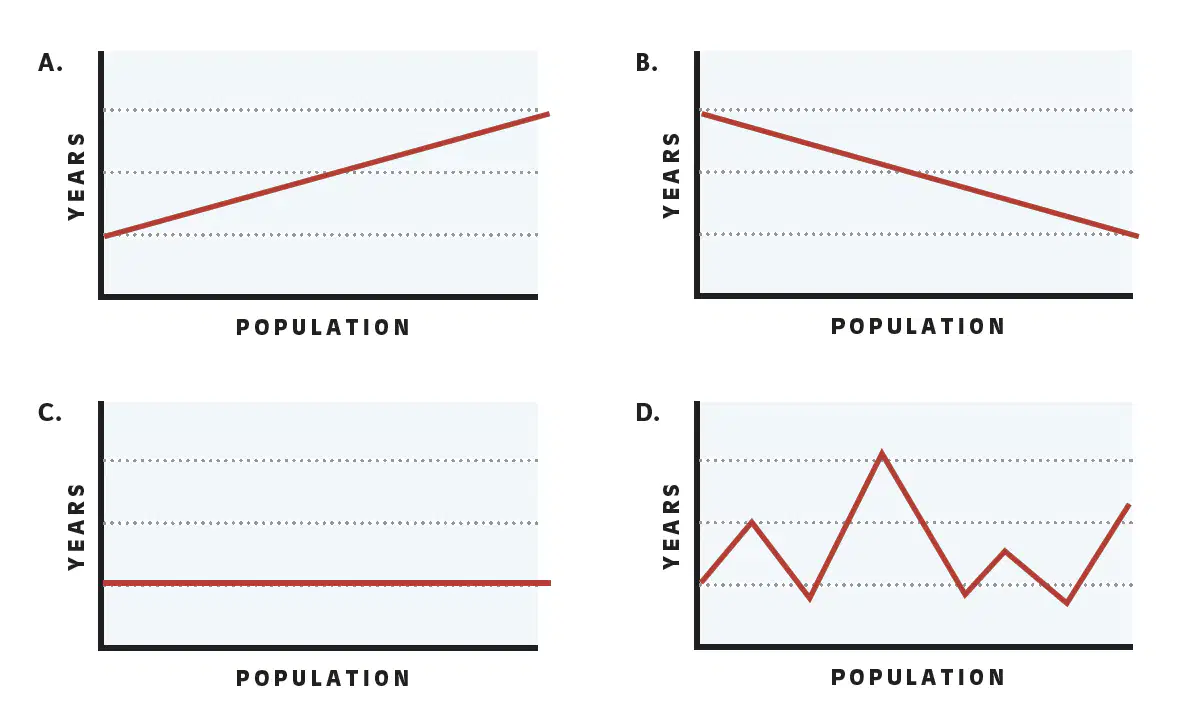
Which line graph shows how European contact impacted Indigenous populations?
a)
A
b)
B
c)
C
d)
D
21.
Conquistadors who came to the Americas wanted to —
a)
conquer a large empire for Spain
b)
trade metal tools with Indigenous nations
c)
learn about the culture of the Aztec people
d)
establish agricultural communities
22.
The Dutch paid for which English man to explore and claim waterways in North America?
a)
Jacques Cartier
b)
Giovanni de Verrazzano
c)
Hernán Cortés
d)
Henry Hudson
23.

What best completes the organizer below?
a)
Indigenous people began hunting horses after the buffalo population decreased.
b)
Horses helped the Spanish cover long distances as they explored.
c)
Horses brought diseases, such as smallpox and measles, to the Americas.
d)
The Spanish traded their horses for maps created by Indigenous tribes.
24.
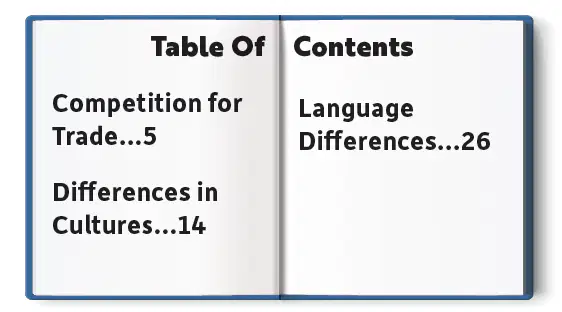
The title for this book would most likely be —
a)
Areas of Conflict During European Exploration
b)
Trade Routes to West Africa
c)
Economic Interests in Europe
d)
Spanish Accomplishments in North America
25.
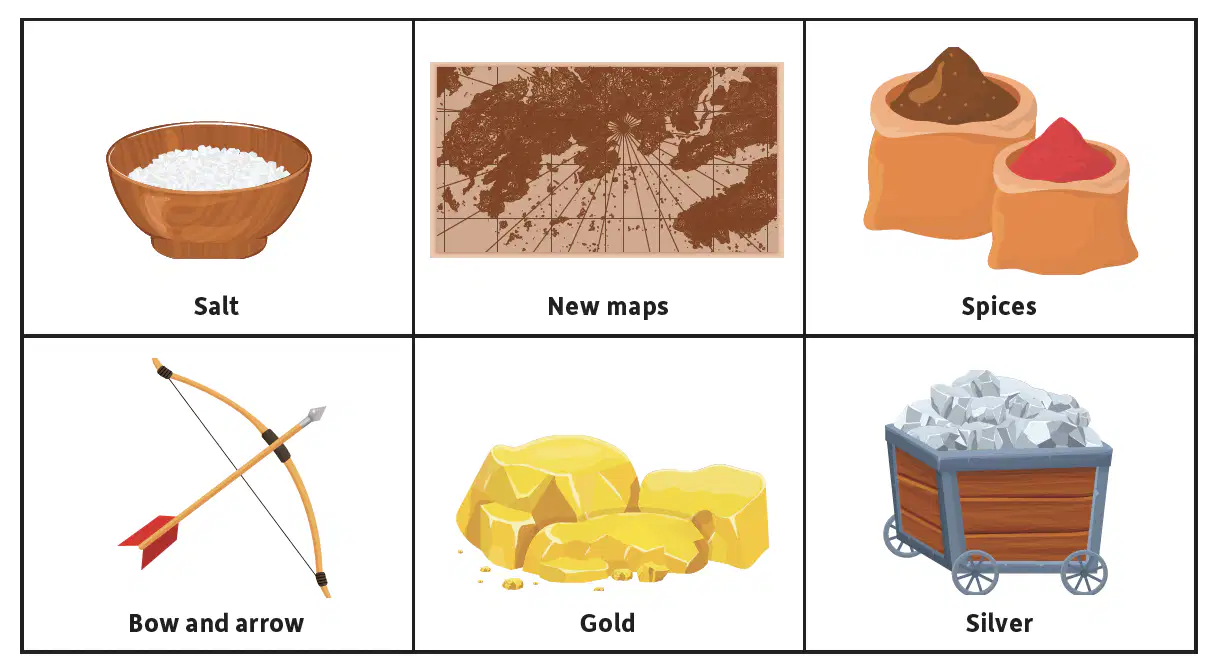
What four natural resources did Europeans hope to find in the Americas?
a)
Salt
b)
Spices
c)
Gold
d)
Silver
e)
New maps
26.
Who was sponsored to explore and claim land in the Americas for Spain?
a)
Francisco Coronado
b)
Ferdinand Magellan
c)
Robert La Salle
d)
Christopher Columbus
27.
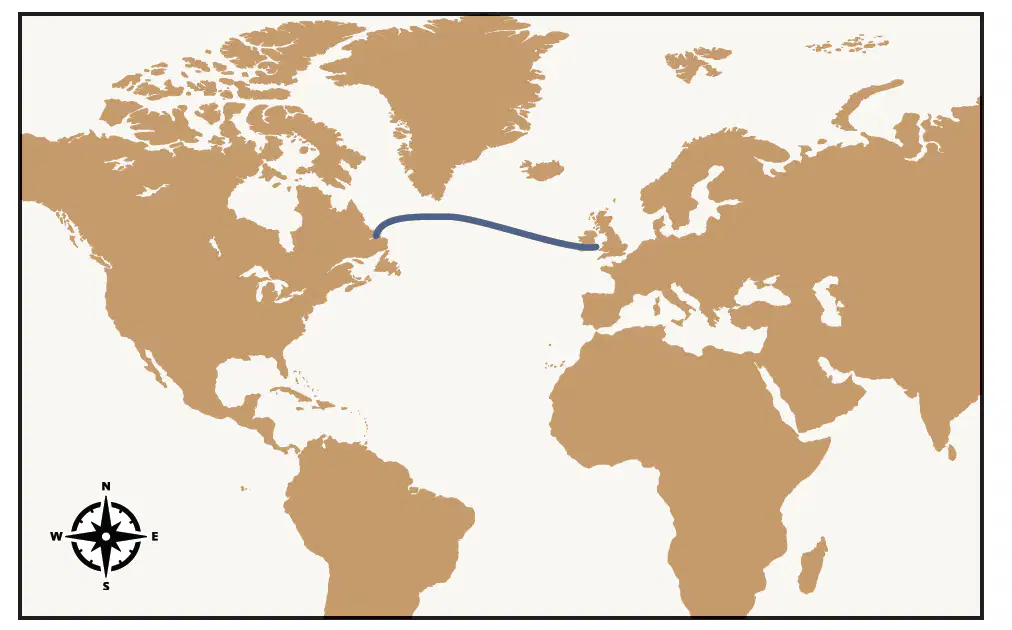
The line on the map shows the journey of which explorer who left England and landed in Eastern Canada?
a)
Henry Hudson
b)
Christopher Columbus
c)
John Cabot
d)
Francisco Coronado
28.
When explorers left Europe and headed west toward the Americas, what ocean became an obstacle for them to travel across?
a)
Pacific
b)
Indian
c)
Arctic
d)
Atlantic
100 %

