
 Worksheets
HEMA_50ITEM-H.Y.Qs
Total questions: 50
Worksheet time: 25mins
Name
Class
Date
1.
The majority of the iron in an adult is found as a constituent of:
a)
a. Hemoglobin
b)
b. Hemosiderin
c)
c. Myoglobin
d)
d. Transferrin
2.
In order for hemoglobin to combine reversibly with oxygen, the iron must be:
a)
a. Complexed with haptoglobin
b)
b. Freely circulating in the cytoplasm
c)
c. Attached to transferrin
d)
d. In the ferrous state
3.
Which description best fits the Donath-Landsteiner antibody?
a)
a. IgM cold agglutinin
b)
b. Biphasic IgM hemolysin
c)
c. IgG biphasic hemolysin
d)
d. IgG warm agglutinin
4.
Which of the following ions is bound to hemoglobin in methemoglobin?
a)
a. Ca2+
b)
b. Fe3+
c)
c. Fe2+
d)
d. Mg2+
5.
An increased amount of cytoplasmic basophilia in a blood cell indicates:
a)
a. Increased cytoplasmic maturation
b)
b. Decreased Cytoplasmic maturation
c)
c. Reduction in size of the cell
d)
d. Decreased nuclear maturation
6.
Specific (secondary) granules of the neutrophilic granulocyte:
a)
a. Appear first at the myelocyte stage
b)
b. COntain esterases
c)
c. Are formed on the mitochondria
d)
d. Are derived from azurophilic (primary) granules
7.
In normal adult bone marrow, the most common granulocyte is the:
a)
a. Basophil
b)
b. Myeloblast
c)
c. Eosinophil
d)
d. Metamyelocyte
8.
Pluripotent hematopoietic stem cells are capable of producing
a)
a. Daughter cells of one one cell line
b)
b. Only t lymphocytes and b lymphocytes
c)
c. Erythropoietin, thrombopoietin, and leukopoietin
d)
d. Lymphoid and myeloid stem cells
9.
Which of the following cytokines is the most responsible for Eosinophil differentiation from the bone marrow?
a)
a. IL-1
b)
b. IL-2
c)
c. IL-4
d)
d. IL-5
10.
Auer rods are characterized as:
a)
a. Fused primary granules
b)
b. DNA precipitates
c)
c. Denatured hemoglobin
d)
d. Large cytoplasmic granules
11.
Which of the following cells is the largest cell in the bone marrow:
a)
a. Megakaryocyte
b)
b. Histiocyte
c)
c. Osteoblast
d)
d. Mast cell
12.
After the removal of red blood cells from the circulation, hemoglobin is broken down into:
a)
a. Iron, porphyrin, and amino acids
b)
b. Iron, heme, and globin
c)
c. Heme, protoporphyrin, and amino acids
d)
d. Heme, hemosiderin, and globin
13.
The main function of the hexose monophosphate shunt in the erythrocyte is to:
a)
a. Regulate the level of 2,3-DPG
b)
b. Provide reduced glutathione to prevent hemoglobin oxidation
c)
c. Prevent the reduction of heme iron
d)
d. Provide energy for the membrane maintenance
14.
In the normal adult, the spleen acts as a site for:
a)
a. Storage of the red blood cells
b)
b. Production of the red blood cells
c)
c. Synthesis of erythropoietin
d)
d. Removal of imperfect and aging cells
15.
A patient is on 100mg of aspirin/day to prevent the formation of clots caused by platelets. The mechanism in which aspirin impairs platelet function is by:
a)
a. Inactivating cyclooxygenase which blocks thromboxane A2
b)
b. Impairs vWF via GPIb/IX/V receptor
c)
c. Decreased amounts of arachidonic acid
d)
d. Inactivation of ADP and phospholipase A2
16.
The characteristic erythrocyte found in pernicious anemia is:
a)
a. Microcytic
b)
b. Spherocytic
c)
c. Hypochromic
d)
d. Macrocyte
17.
Hemolysis in paroxysmal nocturnal hemoglobinuria is:
a)
a. Temperature dependent
b)
b. Complement-independent
c)
c. Antibody-mediated
d)
d. Caused by a red cell membrane defect
18.
A patient with polycythemia vera who is treated with phlebotomy is most likely to develop a deficiency of:
a)
a. Iron
b)
b. Vitamin B12
c)
c. Folic acid
d)
d. Erythropoietin
19.
The anemia of chronic inflammation is characterized as
a)
a. Decreased iron stores in the reticuloendothelial system
b)
b. Decreased serum iron levels
c)
c. Macrocytic erythrocytes
d)
d. Increased serum iron binding capacity
20.
Factors commonly involved in causing anemia in patients with chronic renal disease include:
a)
a. Marrow hypoplasia
b)
b. Inadequate erythropoiesis
c)
c. Vitamin B12 deficiency
d)
d. Increased erythropoietin production
21.
Which of the following characteristics are common to hereditary spherocytosis, hereditary elliptocytosis, hereditary stomatocytosis, and paroxysmal nocturnal hemoglobinuria?
a)
a. autosomal dominant inheritance
b)
b. red cell mebrane defects
c)
c. positive direct antiglobulin test
d)
d. measured platelet count
22.
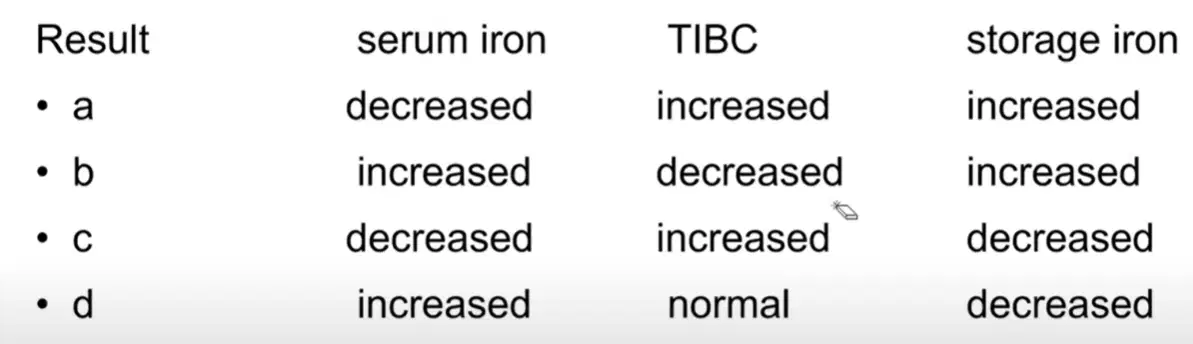
A patient is admitted with a history of chronic bleeding secondary to peptic ulcer. Hematology results reveal a several microcytic, hypochromic anemia. Iron studies are requested. Which result set would be expected in this case?
a)
a. result a
b)
b. result b
c)
c. result c
d)
d. result d
23.
Evidence indicates that the genetic defect in thalassemia usually results in:
a)
a. the production of abnormal globin chains
b)
b. a quantitative deficiency in RNA resulting in decreased globin chain production
c)
c. structural change in the heme portion of the hemoglobin
d)
d. an abnormality in the alpha- or beta-chain binding or affinity
24.
Deficiency of this enzyme is associated with a moderate to severe hemolytic anemia after the patient is exposed to drugs and characterized by red cell inclusions formed by denatured hemoglobin:
a)
a. lactate dehydrogenase
b)
b. G6PD
c)
c. pyruvate kinase
d)
d. hexokinase
25.
Which of the following is the most characteristic finding in autoimmune hemolytic anemia
a)
a. Increased reticulocyte count
b)
b. Leukopenia and thrombocytopenia
c)
c. Peripheral spherocytosis
d)
d. Positive direct antiglobulin test
26.
Peripheral blood smears from patients with untreated pernicious anemia are characterized by:
a)
a. Leukopenia and macrocytosis
b)
b. Leukocytosis and elliptocystosis
c)
c. Leukocytosis and ovalocytosis
d)
d. Pancytopenia and microcytosis
27.
Megaloblastic asynchronous development in the bone marrow indicates which one of the following?
a)
a. Proliferation of erythrocyte precursor
b)
b. Impaired synthesis of DNA
c)
c. Inadequate production of erythropoietin
d)
d. Deficiency of G6PD
28.
Laboratory findings in hereditary spherocytosis include:
a)
a. Decreased WBCs
b)
b. Decreased RBC band 3 protein
c)
c. Reticulocytopenia
d)
d. Positive direct antiglobulin test
29.
The characteristic morphologic feature in lead poisoning is:
a)
a. macrocytosis
b)
b. target cells (codocytes)
c)
c. basophilic stippling
d)
d. rouleaux formation
30.
The white cell feature most characteristic of pernicious anemia:
a)
a. Eosinophilia
b)
b. Toxic granulation
c)
c. Hypersegmentation
d)
d. Reactive lymphocytes
31.
Which parameter is most consistently abnormal in hereditary spherocytosis?
a)
a. RBC count
b)
b. MCV
c)
c. Hemoglobin
d)
d. MCHC
32.
The basic mechanism associated with the development of sideorblastic anemia is:
a)
a. enzyme defect in heme synthesis causes iron accumulation
b)
b. quantitative decrease in the production of globin chains
c)
c. defective iron utilization
d)
d. ineffective erythropoietin production decreases RBC response
33.
What is the specificity of cold agglutinin disease?
a)
a. anti-i
b)
b. anti-H
c)
c. anti-Pr
d)
d. anti-I
34.
In a patient with an increased red cell mass into the 99th percentile and serum erythropoietin level below reference range for normal, which of the following criteria confirms a diagnosis of polycythemia vera?
a)
a. bone marrow panmyelosis
b)
b. inv(16) mutation
c)
c. JAK2 V617F mutation
d)
d. BCR/ABL1 translocation
35.
Hemoglobin H disease results from:
a)
a. absence of 3 of 4 alpha genes
b)
b. absence of 2 of 4 alpha genes
c)
c. absence of 1 of 1 alpha genes
d)
d. absence of all 4 alpha genes
36.
How does the bone marrow respond to anemic stress?
a)
a. expand production, release RBCs prematurely
b)
b. expand production, rush platelets into circulation
c)
c. diminish production, increase M:E
d)
d. diminished production, M:E remains normal
37.
The Philadelphia chromosome is formed by a translocation between:
a)
a. chromosome 22 and chromosome 9
b)
b. chromosome 21 and chromosome 9
c)
c. chromosome 21 and chromosome 6
d)
d. chromosome 22 and chromosome 6
38.
The mechanism causing catecholamine-induced neutrophilia includes:
a)
a. a shift in granulocytes from the marginating pool to the circulating pool
b)
b. an increased exit of granulocytes from the circulation
c)
c. a decreased exit of granulocytes from the bone marrow
d)
d. granulocyte return from the tissues to the circulating pool
39.
What accounts for the frequent smudge cells in CLL?
a)
a. increased in vivo cell lysis
b)
b. apoptosis related changes
c)
c. artifact due to fragile cells
d)
d. artifact due to heparin
40.
Auer rods are most likely present in which of the following?
a)
a. chronic myelocytic leukemia
b)
b. primary myelofibrosis
c)
c. erythroleukemia
d)
d. acute myelocytic leukemia
41.
The reactive lymphocytes seen in the peripheral blood smear of patients with infectious mononucleosis is probably derived from which of these cell types?
a)
a. T lymphocytes
b)
b. B lymphocytes
c)
c. monocytes
d)
d. mast cells
42.
A differential count of 50-90% myeloblast in a peripheral blood smear is typical of which of the following?
a)
a. chronic myelocytic leukemia
b)
b. primary myelofibrosis
c)
c. erythroleukemia
d)
d. acute myelocytic leukemia
43.
Which of the following is mostly closely associated with chronic myelogenous leukemia?
a)
a. ringed sideroblasts
b)
b. disseminated intravascular coagulation
c)
c. micromegakaryocytes
d)
d. BCR/ABL gene
44.
Acute (pure) erythroid leukemia is characterized by the presence of:
a)
a. more than 20% bone marrow myeloblasts
b)
b. less than 20% bone marrow proerythroblasts
c)
c. more than 30% bone marrow proerythroblasts
d)
d. less than 90% bone marrow erythroid precursors
45.
All stages of neutriphils are most likely to be seen in the peripheral blood of a patient with:
a)
a. chronic myelocytic leukemia
b)
b. myelofibrosis with myeloid metaplasia
c)
c. erythroleukemia
d)
d. acute myelocytic leukemia
46.
Increased levels of TdT activity of:
a)
a. Burkitt lymphoma
b)
b. acute promyelocytic leukemia
c)
c. acute lymphocytic leukemia
d)
d. eosinophilia
47.
Which of the following is true of acute lymphoblastic leukemia (ALL)?
a)
a. occurs most commonly in children 1 to 2 years of age
b)
b. patient is asymptomatic
c)
c. primitive lymphoid appearing cells accumulate in bone marrow
d)
d. children under 1 year of age have a good prognosis
48.
The most common form of childhood leukemia is:
a)
a. acute lymphocytic
b)
b. acute granulocytic
c)
c. acute monocytic
d)
d. chronic granulocytic
49.
Which of these characteristics is usually associated with hairy cell leukemia?
a)
a. neutrophilia
b)
b. mononucear cells with ruffled edges
c)
c. positive for CD5
d)
d. increased resistance to infection
50.
Morphologic variants of plasma cells include:
a)
a. flame cells
b)
b. cabot rings
c)
c. pelger-huet anomaly
d)
d. gaucher cells
100 %

