
 Worksheets
Solar System Unit Test Review
Total questions: 12
Worksheet time: 9mins
A video shows the objects in the solar system orbiting the sun. Why do objects orbit the sun?
The sun is so massive that it has the most gravity.
The sun is so bright that objects are forced away.
The sun is moving so quickly that other objects move around it.
The sun is releasing heat and pushing objects away.
Suppose a person built a sandcastle of moon sand on the moon. A month later a person would expect to find (a) because the moon has no wind. (No Changes or Many Changes)
How do outer planets differ from inner planets?
They have very large solid surfaces.
They consist of a mixture of gases and liquid.
They are not different from inner planets.
They are smaller than the inner planets.
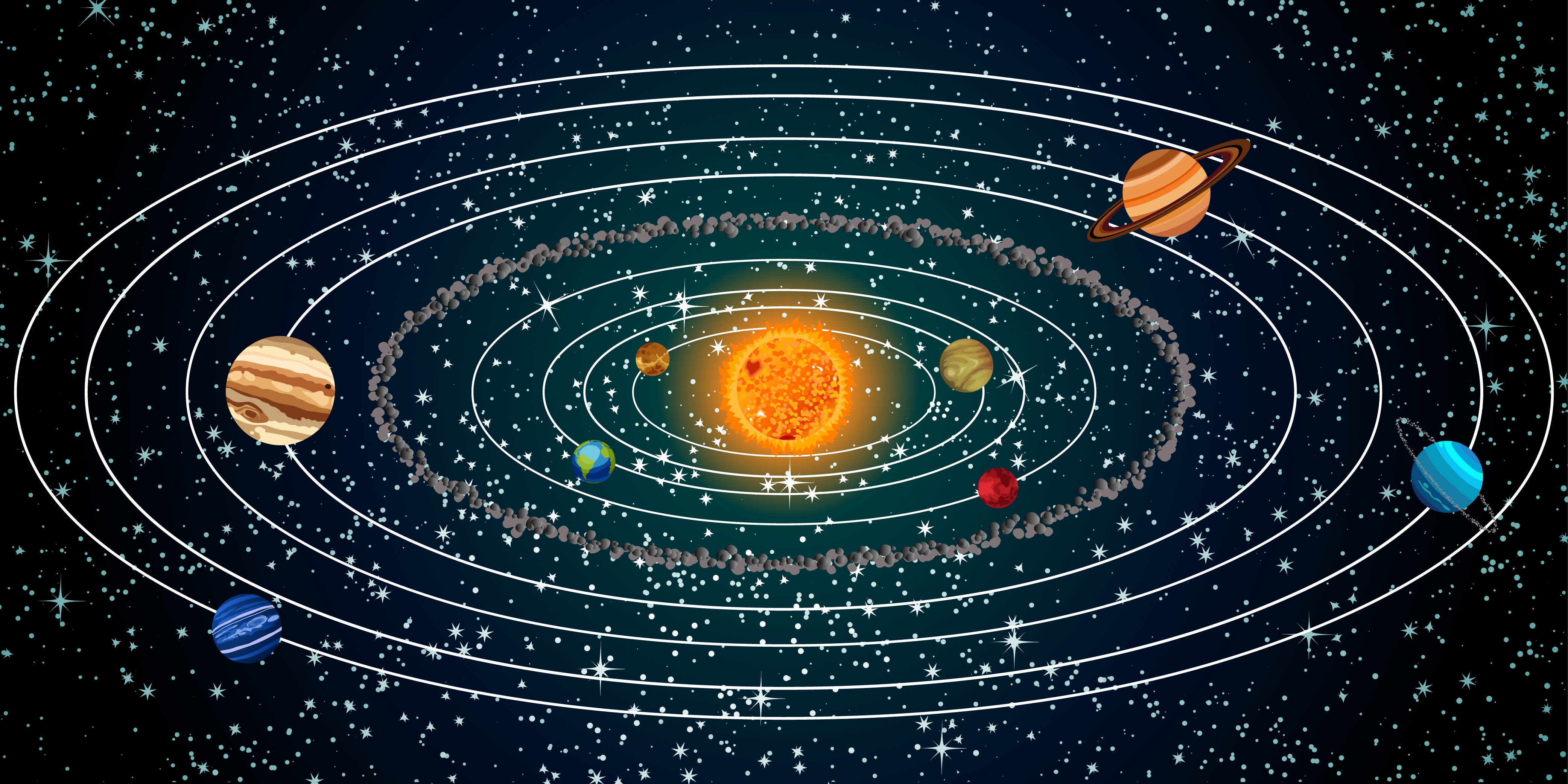
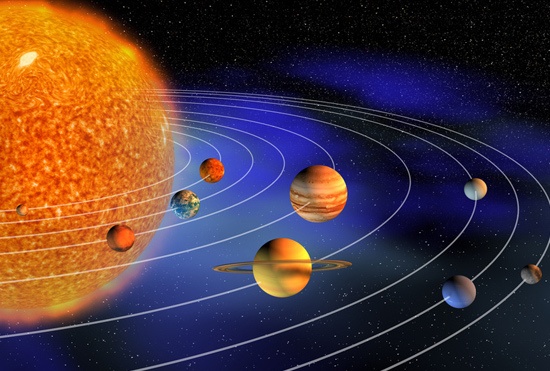
Why do all of the planets orbit the sun rather than Earth?
the sun has more mass
the sun is a star
the Earth is heavier
the sun is in the middle of the milky way

What would happen to Earth without the sun's gravity?
Earth would DRIFT INTO SPACE
Earth would ORBIT the sun
Earth would be SMALLER
Earth would get CLOSER TO OTHER PLANETS

F
G
H
J

Which of the following claims is supported by the data above?
Gravitational force is not affected by mass.
Gravitational forces are strongest between objects with the same mass.
Gravitational forces are related to the mass of objects.
Gravitational forces are weaker when one object has more mass than the other.

What celestial object do all planets revolve around in our solar system?
The Sun
The Moon
Earth
Jupiter
What is being used by scientists to organize Earth’s history?
fossil record
mass extinctions
layers of rock
geologic time scale
Imagine the Moon moved twice as far away from Earth but stayed the same size. How would this change the gravitational force between Earth and the Moon?
Gravity would stay the same because the Moon’s mass didn’t change.
Gravity would become weaker because the distance increased.
Gravity would become stronger because the Moon is farther away.
Gravity would disappear completely.
Scientists study the origin of Earth’s water. What evidence supports the idea that some of Earth’s water may have come from comets?
Comets contain frozen water, and their composition of water molecules is similar to Earth’s oceans.
Comets are made of solid rock, just like Earth’s crust.
Comets orbit close to Earth, making them easy to study.
Comets release gases that are identical to Earth’s atmosphere.

