
 Worksheets
Unit 2 Review
Total questions: 34
Worksheet time: 37mins
Which scientist is credited with the discovery of the electron?
John Dalton
J.J. Thomson
Ernest Rutherford
Niels Bohr
What is the charge of a proton?
Negative
Positive
Neutral
Variable
Which part of the atom contains most of its mass?
Electron cloud
Nucleus
Orbitals
Energy levels
What is the relationship between the frequency ( f ) and wavelength ( λ ) of light?
f increases as λ increases
f decreases as λ increases
f and λ are unrelated
f is always zero when λ is maximum
Which subatomic particle is found in the electron cloud?
Proton
Neutron
Electron
Positron
Which model of the atom first introduced the idea of a dense, positively charged nucleus?
Dalton’s model
Thomson’s model
Rutherford’s model
Bohr’s model
Which of the following best describes an ion?
An atom with equal numbers of protons and electrons
An atom with a different number of protons and electrons
An atom with only neutrons
An atom with no nucleus
Given an atom with 11 protons, 12 neutrons, and 10 electrons, what is its net charge?
+1
0
-1
+2
If the wavelength of light is halved, what happens to its frequency, assuming the speed of light is constant?
It is halved
It is doubled
It remains the same
It becomes zero
A neutral atom of chlorine has 17 protons and 18 neutrons. How many electrons does it have?
17
18
35
1
An atom has 20 protons, 20 neutrons, and 18 electrons. What is the symbol and charge of this ion?
Ca 2+
Ca 2−
Ar 2+
Ar 2−
Given the electromagnetic spectrum, how would you determine which type of radiation has the highest energy?
The one with the longest wavelength
The one with the highest frequency
The one with the lowest frequency
The one with the lowest speed
Which subatomic particle determines the atomic number of an element?
Electron
Neutron
Proton
Photon
What is the charge of a neutron?
Variable
Neutral
Negative
Positive


Aluminum has (a) protons.

How many protons are shown in this model of Carbon?2
12
6
5
18

How many electrons are shown in this image?
2
3
4
5
How many neutrons are shown in this image?
2
3
4
5

Electrons are atoms with a_____________ charge, and are found in the __________ of an atom
positive, nucleus
negative, nucleus
neutral , nucleus
negative , outer shells

What is the atomic number of Rhodium?
102.90550
45
57.9055
What does energy have to do with wavelength and frequency?
The higher the frequency the less energy the wave has.
The lower the frequency the more energy the wave has.
The shorter the wavelength the more energy the wave has.
The longer the wavelength the more energy the wave has.
What happens to the energy of a photon as its wavelength increases?
The energy increases
The energy decreases
The energy stays the same
The energy becomes zero

Which is true about the following chlorine atom?
17 protons and 36 neutrons
17 protons and 19 electrons
17 protons and 19 neutrons
36 protons and 17 neutrons


A wave with a large wavelength will have a ______ frequency and _____ energy
high, low
low, high
high, high
low, low

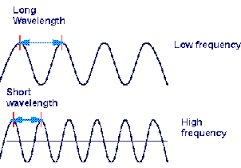
Wavelength and Frequency are related in that...
they are always the same
when one increases, the other decreases (inversely proportional)
there is no correlation
they both vary in an irregular pattern
Aluminum has (a) neutrons.

Which element has 5 proton, 6 neutrons, & 5 electrons?
Boron
Carbon
Sodium
Neon

