
Font size
 Worksheets
Wayground Review: Graphing Relationships
Total questions: 28
Worksheet time: 14mins
What is the variable you change or control in an experiment or graph called?
Independent variable
Dependent variable
Constant variable
Controlled variable
On which axis is the independent variable usually plotted?
x-axis
y-axis
z-axis
w-axis
Which of the following is an example of an independent variable?
Plant height
Test scores
Time
Speed
What is the variable that responds or depends on the independent variable called?
Dependent variable
Control variable
Constant variable
Manipulated variable
On which axis is the dependent variable usually plotted?
y-axis
x-axis
z-axis
origin
Which of the following is an example of a dependent variable?
Time
Temperature setting
Plant height
Amount of fertilizer
What type of relationship is described when the independent variable increases and the dependent variable also increases?
Direct relationship
Inverse relationship
No relationship
Cyclic relationship
What type of relationship is described when the independent variable increases and the dependent variable decreases?
Indirect relationship
Direct relationship
Cyclic relationship
No relationship
When changes in the independent variable do not affect the dependent variable, what type of relationship is this?
No relationship
Direct relationship
Inverse relationship
Causal relationship
What does a graph with no clear pattern or trend indicate?
No relationship
Strong positive relationship
Strong negative relationship
Cyclical relationship
What type of relationship is shown when the dependent variable repeats a pattern at regular intervals as the independent variable changes?
Cyclic relationship
Linear relationship
Exponential relationship
Random relationship
Which of the following is NOT an example of a cyclic relationship?
A) Day and night temperature changes
B) Seasons
C) Number of hours studied vs. shoe size
D) Moon phases
What are sunspots?
Dark spots on the surface of the Sun caused by intense magnetic activity and cooler than surrounding areas but still very hot.
Bright spots on the Sun that are hotter than the surrounding areas.
Large craters on the Sun's surface formed by meteor impacts.
Clouds of gas that float above the Sun's surface.
Sunspots increase and decrease in a roughly ____ year cycle. Fill in the blank with the correct number.
11
5
22
7
Which of the following is influenced by the sunspot activity cycle? Choose the correct option.
Solar radiation
Ocean tides
Lunar phases
Earth's gravity
The sunspot activity starts low, rises to a peak, then falls again.
True
False

What is the approximate period of the sunspot cycle shown in the graph?
11 years
5 years
20 years
50 years
Nuclear fusion is the process where two light atomic nuclei combine to form a heavier nucleus.
True
False
What does the Sun fuse to form helium in its core?
Oxygen nuclei
Hydrogen nuclei (protons)
Carbon nuclei
Helium nuclei
Fusion in the Sun occurs at extremely high temperatures and pressures.
True
False
What does the process of nuclear fusion in the Sun release?
A) A small amount of energy
B) A huge amount of energy
C) No energy
D) Only light
Why does fusion matter for life on Earth?
It produces energy that sustains life on Earth through sunlight.
It produces oxygen for breathing.
It creates water for plants.
It cools the planet.
What is one goal scientists have regarding fusion?
To create more pollution
To harness fusion for clean, abundant energy on Earth
To make fusion less efficient
To stop fusion from happening
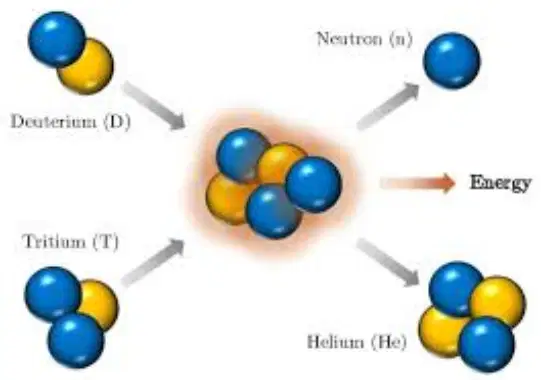
Refer to the diagram showing the fusion of Deuterium (D) and Tritium (T). What are the products of this fusion reaction?
Helium (He), Neutron (n), and Energy
Hydrogen (H) and Oxygen (O2)
Carbon Dioxide (CO2) and Water (H2O)
Helium (He) and Proton (p) only

Match the following particles from the fusion diagram to their correct names:
Neutron
Neutron
Helium
Helium
Deuterium
Deuterium
Tritium
Tritium
Which of the following best describes a direct relationship between two variables?
Both variables remain constant.
There is no connection between the variables.
As one variable increases, the other also increases.
As one variable increases, the other decreases.
What is the main source of energy produced by nuclear fusion in the Sun?
Electricity
Sound waves
Heat and light
Magnetism
Which of the following is an example of a variable that is controlled or kept constant in an experiment?
Type of fertilizer used
Time allowed for growth
Height of the plants measured
Amount of sunlight given to all plants

