
 Worksheets
20250903
Total questions: 10
Worksheet time: 10mins
Normal stress and normal strain are defined as:
Force per unit length; Energy absorbed by the material
Shear force divided by area; Change in length divided by original length
Force per unit area perpendicular to the surface; Deformation per unit length
Force per unit area perpendicular to the surface; Stress intensity
The point on a stress–strain curve where permanent deformation begins is called:
Proportional limit
Elastic limit
Ultimate strength
Yield point
A material returns to its original shape after load removal only within which region?
Elastic region
Creep region
Fracture region
Plastic region
Creep is best described as:
Sudden brittle failure
Oscillatory vibration in structures
Linear elastic recovery
Time-dependent permanent deformation under sustained load
Poisson’s ratio is the ratio of:
Shear stress to shear strain
Lateral strain to axial strain
Stress to strain
Plastic strain to elastic strain
Shear strain can be measured as:
Tangential displacement per unit thickness
Energy absorbed per volume
Ratio of shear stress to modulus of elasticity
Change in length per unit length
What is the purpose of a factor of safety? How is it used to calculate allowable stress?
Reduce the cost of design;
Ultimate stress × Factor of safety
Ensure materials are used at their maximum stress capacity;
Elastic limit × Factor of safety
Increase stress in materials;
Shear modulus ÷ Factor of safety
Provide a margin against uncertainties in load and material strength;
Yield stress ÷ Factor of safety
Direct shear failure typically occurs in:
Beams under bending
Columns under axial compression
Rivets, bolts, or pins
Long slender rods
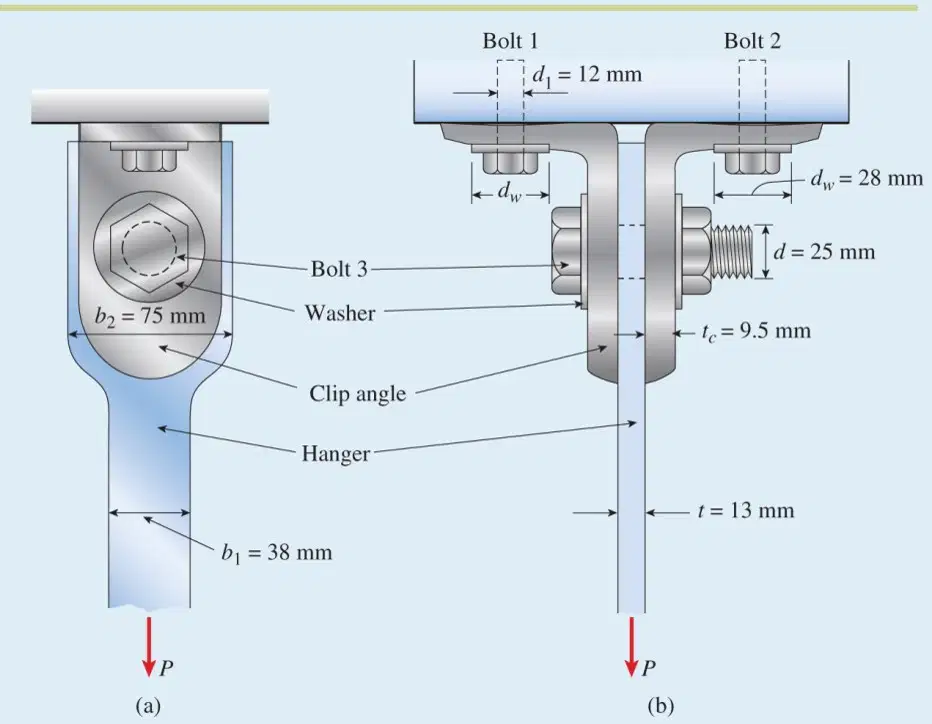
For the vertical hanger shown in the figure, which of the following diagrams can be used to calculate the bearing stress between the hanger and bolt 3?


For the vertical hanger shown in the figure, which of the following diagrams can be used to calculate the normal stress caused by the force P? (can have multiple correct answers)

