
 Worksheets
8 Unit 2 A1.3.3 Fabrication Shearing and drawing
Total questions: 10
Worksheet time: 5mins
Fill in the blank: In the shearing process, the material is placed between two blades and a ________ force is applied.
downward
upward
lateral
rotational
Fill in the blank: Shearing is best suited for ______ cuts, and complex shapes may require additional processes like punching or laser cutting.
straight
curved
angled
spiral
Fill in the blank: Thin sheets may deform during the cutting process if not properly supported or if the ______ are dull.
blades
handles
screws
motors
Which industries widely use the drawing process to create components such as car body panels, metal containers, and appliance housings?
Automotive, aerospace, ships, and packaging industries.
Textile, pharmaceutical, and food processing industries.
Software, telecommunications, and entertainment industries.
Education, healthcare, and tourism industries.
When the metal is forced through the die by a tensile force applied to the metal at the exit of the die, the process is called ________.
drawing
extrusion
forging
rolling
When a compressive force is applied at the entry of the die, the process is called _________.
extruding
casting
forging
rolling
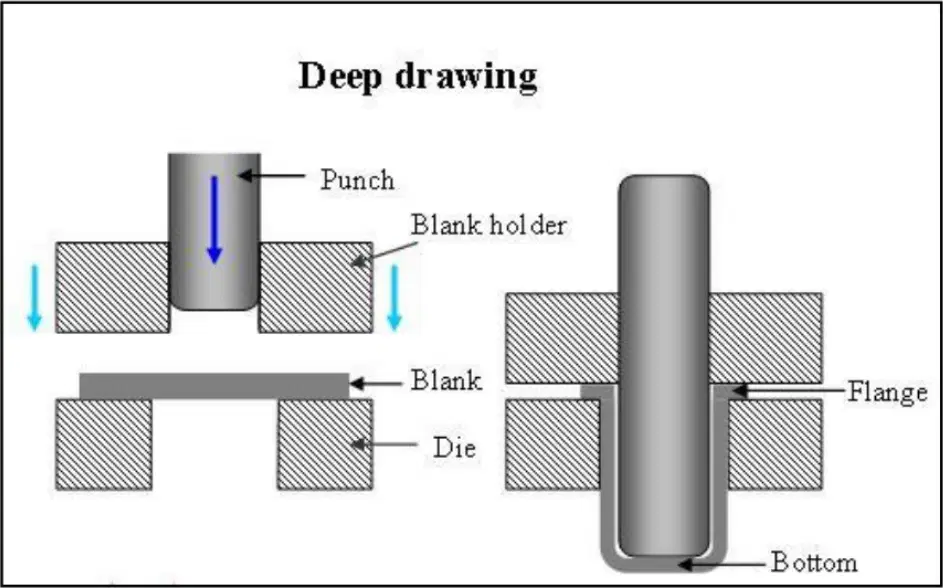
Which part in the deep drawing diagram is responsible for pushing the blank into the die?
Die
Blank holder
Punch
Flange
Wire drawing is a process used to ______ the diameter of a metal wire by pulling it through a series of progressively smaller dies. The wire becomes longer as its diameter decreases. (Fill in the blank)
reduce
increase
color
polish
Fill in the blank: Without proper control of variables like blank size, lubrication, and punch speed, defects like _______, wrinkling, and thinning can occur.
tearing
bending
coating
polishing
Fill in the blank: There are limits to how deep a part can be drawn in a single step due to the material's ductility and the drawing ratio. Deep parts often require _______ drawing steps.
multiple
single
random
shallow

