
 Worksheets
A2-CHAPTER 2 TEST 2025-26
Total questions: 188
Worksheet time: 9hrs 1mins
Where the parabola (U shape) crosses the x-axis.
Domain
Range
Y-intercept
X-intercept
An equation that can be written in the form y = ax2 + bx + c
Quadratic equation
Polynomical equation
Linear equation
Maxical equation
A vertical line that cuts the parabola into 2 symmetrical halves. This always goes through the vertex and ALWAYS begins with "x=" This is sometimes called the "line of symmetry".
Parabola
Quadratic
Axis of Symmetry
Domain
Where the parabola crosses the y-axis.
X-intercept
Domain
Y-intercept
Axis of Symmetry
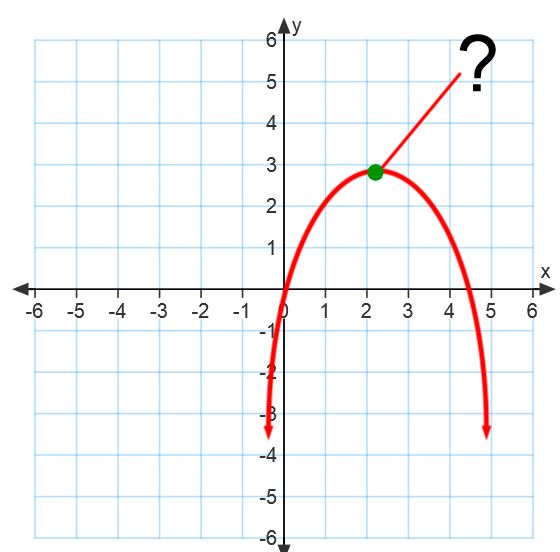
The vertex is defined as:
The maximum.
The minimum.
The highest or lowest point of the parabola.
The vertical height of the parabola
If the vertex is the highest point of the parabola, it is called a _______________.
valley
peak
minimum
maximum
If the vertex is the lowest point of the parabola, it is called a ________________.
valley
peak
minimum
maximum


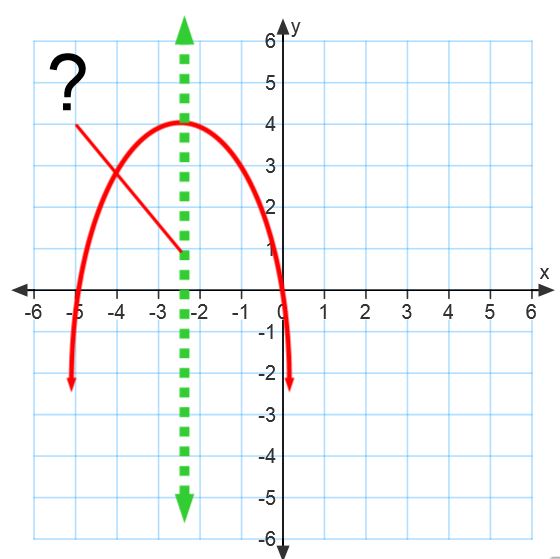
What is the green dashed line called?
roots or x-intercepts
parabola
axis of symmetry
y intercept

What is the significance of the ordered pair (0, -2) to the graph?
It is the vertex
It is an x-intercept
It is the y-intercept
It is the axis of symmetry

Is this parabola a maximum or minimum?
maximum
minimum
cannot be determined
The highest or lowest point on the parabola
Parabola
Domain
Vertex
Range

What are the x-intercept(s) of this graph?
-1 and -3
-1 and 3
1 and 3
1 and -3

What are the coordinates of the y-intercept?
(-3, 0)
(0, -3)
(2, 1)
y=-3

What is the significance of the ordered pair (2, -4) to the graph?
it is the vertex
it is the y-intercept
it is the axis of symmetry
it is the x-intercept

What is the equation for axis of symmetry?
y = 3
x = 3
x = 5
x = 1
Is the graph of the equation y=2x2 wider, narrower or the same width as the standard parabola y = x2?
wider
narrower
same
impossible to tell

Use the picture to find the vertex and axis of symmetry.
Vertex: (8, 3); axis of symmetry: y=3
Vertex: (8, 3); axis of symmetry: x=3
Vertex: (3, 8); axis of symmetry: y=3
Vertex: (3, 8); axis of symmetry: x=3

A parabola has a vertex at (-3,2).
What is the axis of symmetry?
y = -2
x = 3
x = -3
y = 2



Name the vertex
(1,1)
(0,0)

This is a _______________ function.
Linear
Exponential
Quadratic

Quadratic equations take the shape of a _______ when graphed.
parabola
straight line
snaked line
elliptical
f(x) = x2- 8x + 15.
The equation for the axis of symmetry line is
x=2a−btrue
false
Which letter determines if a parabola opens up or down?
a
h
k
Find the Axis of Symmetry of y=x2+12x−7
x = -6
x = 6
x = 12
x = -12
Find the Axis of Symmetry of y = - x2 - 14x - 59
x = 14
x = 7
x = -14
x = -7
Find the Axis of Symmetry of y = x2 - 12x + 46
x = 12
x = 6
x = -12
x = -6
y=4x2-8x+9
Find the Axis of Symmetry of
y = x2 - 6x + 11?
x = -3
x = -6
x = 6
x = 3
Find the axis of symmetry for y=x2−8x+15
x = -4
x = 4
y = 4
y = -4
Find the axis of symmetry of
y=3x2−6x+4
x=1
x=−6
x=2
x=−1
Determine the axis of symmetry for the function
f(x)=x2+4x+3x = -2
x = 2
x = -1.5
x = 4
Determine the axis of symmetry for the function
f(x)=x2−4x = 0
x = -2
x = 2
Cannot be determined
What is an equation of the axis of symmetry
of the parabola represented by y=2x2−3x+7? ?
x=43
y=43
x=23
y=23
Which equation represents the axis of symmetry of
the graph of the equation y = x2 + 4x - 5?
x = -4
x = -2
x = 4
x = 2
y=−x2+6x−4
What is an equation of the axis of symmetry
of the parabola represented by the equation above?
x = 3
y = 3
x = -3
y = -3
Which equation represents the axis of symmetry of
the graph of the equation y = x2 + 4x - 5?
x = -4
x = -2
x = 4
x = 2

What is the vertex of the equation
y=(x−3)2+5(-3, 5)
(3, 5)
(-3, -5)
(3, -5)
What is the vertex of the equation
y=(x+7)2+3(7, 3)
(7, -3)
(-7, 3)
(-7, -3)
What is the vertex of the equation
y=(x−4)2(-4, 0)
(4, 0)
(0, 4)
(0, -4)
What is the vertex of the equation
y=x2−1(0, -1)
(0, 1)
(1, 0)
(-1, 0)
What is the vertex of the equation
y=2(x+1)2−5(1, -5)
(-1, -5)
(-1, 5)
(1, 5)
What is the vertex of the equation
y=−2(x−1)2+5(-1, -5)
(-1, 5)
(1, 5)
(1, -5)
What is the vertex of the equation
f(x)=(x−4)2−5(-4, -5)
(-4, 5)
(4, 5)
(4, -5)
What direction does the following graph open?
f(x)=(x−4)2−5left
right
up
down
What is the vertex of the equation
g(x)=−x2+5(0, 5)
(0, -5)
(5, 0)
(-5, 0)
What direction does the following graph open?
g(x)=−x2+5right
left
down
up
y = 3(x + 5)2 - 4,
what is the vertex of the parabola?

y=a(x-h)2+k
What is the vertex of the equation
y=2(x+1)2−5(1, -5)
(-1, -5)
(-1, 5)
(1, 5)
What direction does the following graph open?
f(x)=(x−4)2−5left
right
up
down
f(x)=−(x−4)2+1
Choose the correct graph of the equation.


Which equation has a vertex of (5, −7)
y=2(x−5)2−7
y=(x−7)2−5
y=(x+5)2+7
y=2(x−1)2−4
Which equation has a vertex of (−3,−6)
y=2(x+3)2+6
y=(x+6)2+3
y=(x+12)2+16
y=2(x+3)2−6

What is the equation of this graph?
f(x)=(x+4)2+3
f(x)=(x+3)2−4
f(x)=(x−4)2−4
f(x)=(x−6)2−1

What is the equation of this graph?
(f(x)=(x+3)2−2
f(x)=(x+6)2−9
f(x)=(x+2)2+3
f(x)=(x−6)2−1
Given the equation
y=21(x−6)2+5
What is the X-value of the vertex?
21
5
−6
6
Given the equation
y=21(x+2)2−1
What is the Y-value of the vertex?
21
−2
1
−1

What is the vertex of the graph?
(4, 4)
(2, 2)
(0, 6)
(−2, 2)

IDENTIFY THE VERTEX AND AXIS OF SYMMETRY OF EACH
A
B
C
D

IDENTIFY THE VERTEX AND AXIS OF SYMMETRY OF EACH
A
B
C
D

IDENTIFY THE VERTEX AND AXIS OF SYMMETRY OF EACH
A
B
C
D

IDENTIFY THE VERTEX AND AXIS OF SYMMETRY OF EACH
A
B
C
D

IDENTIFY THE VERTEX AND AXIS OF SYMMETRY OF EACH
A
B
C
D

IDENTIFY THE VERTEX AND AXIS OF SYMMETRY OF EACH
A
B
C
D

IDENTIFY THE VERTEX AND AXIS OF SYMMETRY OF EACH
A
B
C
D

IDENTIFY THE VERTEX AND AXIS OF SYMMETRY OF EACH
A
B
C
D

IDENTIFY THE VERTEX AND AXIS OF SYMMETRY OF EACH
A
B
C
D
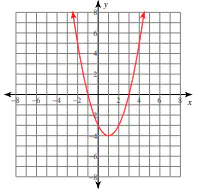
What is the equation of the axis of symmetry?
x = 1
y = -4
y = 1
x = -4
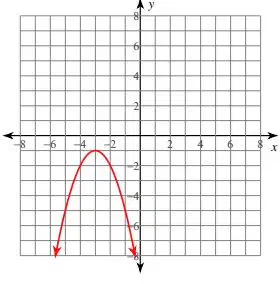
Does this graph have a maximum or a minimum?
Both
Neither
Minimum
Maximum
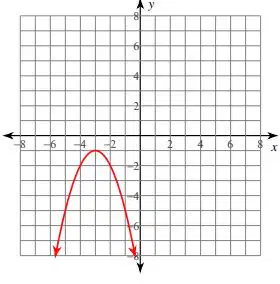
What is the equation of the axis of symmetry for the parabola?
y = -1
x = -3
y = -3
x = -1
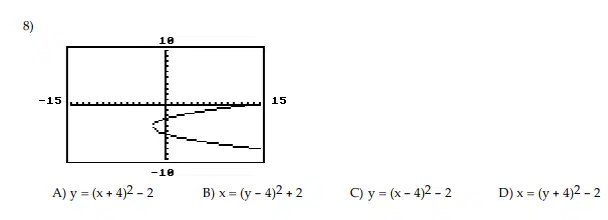
CHOOSE BEST ANSWER
A
B
C
D
x2 – 8x + ___
Find the missing value "c" to create a perfect square trinomial:
x2 – 6x + ___
9
18
3
6
Find the missing value "c" to create a perfect square trinomial:
x2 + 10x + ___
20
25
5
100
To complete the square for x2 + 14x, what value should be added?
28
7
49
14
Find the missing value "c" to complete the square.
x2 + 6x + ____
9
12
36
- 9
Complete the square for
x2 - 12x + ____
144
36
- 36
24
x2 +8x + c
x2 - 12x + c
Complete the square for
x2 - 14x + ____
(find the missing value that goes in the blank)
- 196
49
- 49
28
Complete the square for
x2 + 12x + ____
(find the missing number in the blank)
x2 + 12x + 144
x2 + 12x + 36
x2 + 12x - 36
x2 + +12x - 144
Complete the square for
x2 + 6x + ____
(find the missing value that goes in the blank)
9
12
36
- 9
Convert the equation y= 5x2 - 40x + 67 into vertex form.
y= -5(x + 4)2 + 13
y= 5(x + 4)2 - 13
y=5(x - 4)2 - 13
y= 5(x - 13)2 + 4
Write y = x2 - 6x + 3 in vertex form.
y = (x - 3)2 + 3
y = (x - 3)2 - 6
y = (x + 3)2 + 3
y = (x + 3)2 - 6
Convert the equation y = 2x2 + 8x + 1 into vertex form.
y = 2(x + 4)2 + 1
y = 2(x - 2)2 + 9
y = 2(x + 2)2 - 7
y = 2(x + 2)2 + 7
Write y = x2 + 10x + 21 in vertex form.
y = (x + 5)2 - 4
y = (x - 5)2 + 46
y = (x + 5)2 + 21
y = (x + 10)2 + 21
x2-12x+40
into vertex form
f(x) = x2 + 12x - 2
written in vertex form?
f(x) = x2 - 8x + 1
written in vertex form?
y = x2 - 6x + 10?
Convert f(x) = 3x2+ 6x - 5 to vertex form.
f(x) = 3(x + 1)2 - 8
f(x) = 3(x - 1) 2 - 8
f(x) = 3(x + 2)2 - 8
f(x) = 3(x - 2)2 - 8
Convert f(x) = 4x2 - 32x + 2 to vertex form.
f(x) = 4(x + 4)2 - 62
f(x) = 4(x - 4)2 - 62
f(x) = 4(x - 8)2 - 62
f(x) = 4(x + 8)2 - 62


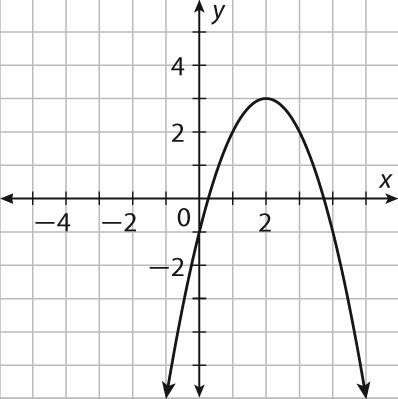
*Hint: Range is all of the y-values included in the function.

*Hint: Domain is the set of all x-values included in the function.
Which graph best represents a function with a range of all real numbers greater than or equal to -6?


What is the domain of this parabola?
All real #'s
y > 4
y < 4
3 < y < 7

What is the range of this parabola?
All real #'s
y > 16
y < 16
x > 16

What is the domain of this parabola?
All real #'s
y > -9
y < -9
x > -9

What is the domain of the function?
D:{ x is greater than or equal to 3}
D:{x is less than or equal to 3}
D:{all real numbers}
D:{ x is all real numbers between and including -1 and 5}
Determine the domain and range of the function
Domain: All real numbers, Range: All real numbers
Domain: x ≥ -4, Range: All real numbers
Domain: All real numbers, Range: y ≥ -4
Domain: -1 ≤ x ≤ 5, Range: y ≥ -4

Determine the domain and range of the function.
Domain: all real numbers.
Range: all real numbers less than or equal to 1.
Domain: all real numbers.
Range: all real numbers less than or equal to 2.
Domain: all real numbers less than or equal to 1.
Range: all real numbers.
Domain: all numbers between 1 and 3.
Range: all real numbers less than or equal to 1.

A
B
C
D

F
G
H
J

F
G
H
J

A
B
C
D

F
H
J
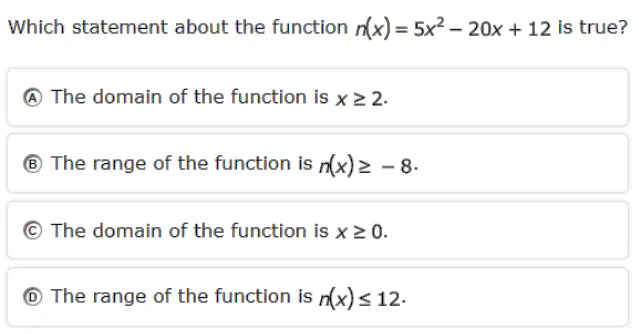
A
B
C
D
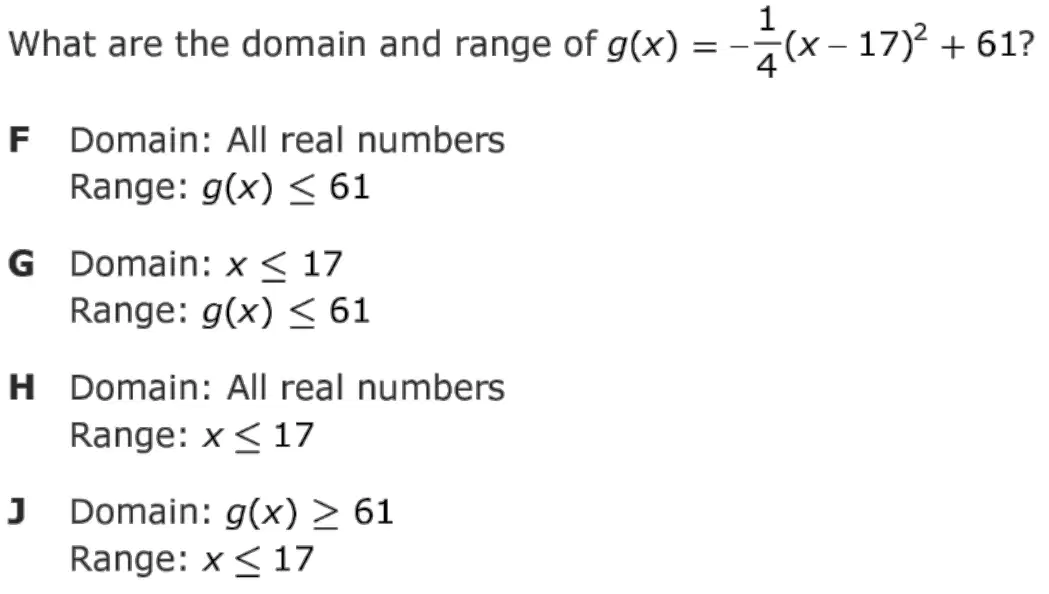
(a)
G
H
J
What is the range of y=−x2−2x+3 ?
x≤4
x≥−4
y≤4
y≥−4

A
B
C
D
A
B
C
D
What is the range of the function
f(x) = x2 + 2x - 10?
y ≥ -11
y ≥ -1
x ≥ -11
x ≥ -1

Determine the Domain and Range of the following function.
Domain: All Real #'s; Range: y ≤ 4
Domain: All Real #'s; Range: y ≥ 4
Domain: All Real #'s; Range: y ≤ -4
Domain: All Real #'s; Range: y ≥ -4
What is the domain and range of the equation y=2x2+4x−3 ?
Domain: All real numbers
Range: y≤−1
Domain: All real numbers
Range: y≥−5
Domain: −1≤x≤0
Range: y≥−5
Domain: All real numbers
Range: y≥−3
Write a quadratic equation given the x intercepts and one other point.
The roots of the function are (-3, 0) and (5, 0).
The point (4, -3) is also on the graph.
y=4(x+3)(x-5)
y=3/7(x-3)(x+5)
y=-3(x-3)(x+5)
y=3/7(x+3)(x-5)
vertex: (4, -2)
point: (0,-6)
opens down

A
B
C
D
A parabola has a vertex at (1,6) and passes through (3,-18). Write the equation in vertex form.
Formula: f(x) = a(x - h)2 + k
f(x) = 3(x - 1)2 - 18
f(x) = -6(x - 1)2 + 6
f(x) = 6(x - 3)2 - 18
f(x) = -3(x + 1)2 - 6
Write the equation of the quadratic function that has x-intercepts at (-1, 0) and (3, 0) and passes through the point (1, -8).
y = 2(x + 1)(x - 3)
y = -2(x + 1)(x - 3)
y = 2(x - 1)(x + 3)
y = -2(x - 1)(x + 3)
Write the equation of the quadratic in vertex form given the following:
vertex: (2, 5)
point: (4, 1)
f(x)= -(x-2)2+5
f(x)=2(x-2)2+5
f(x)=-1/2(x-2)2+5
f(x)=1/2(x-2)2+5
A parabola has a vertex at (-3, 7) and passes through (0, 1). Write the equation in vertex form.
Formula: f(x) = a(x - h)2 + k
f(x) = 2(x + 3)2 + 7
f(x) = -2/3(x + 3)2 + 7
f(x) = 1/2(x + 3)2 + 7
f(x) = -1/2(x + 3)2 + 7
Write the equation of the quadratic function that has a x-intercepts at 9 and 1 and passes through the point (0, -18).
y = x2 + 9x - 18
y = -2(x - 9)(x - 1)
y = -2(x + 9)(x + 1)
y = 2(x + 9)(x + 1)
Write the equation of the quadratic function that has a x-intercepts at 12 and -6 and passes through the point (14, 4).
y = 10(x - 12)(x + 6)
y = 1/10(x + 12)(x - 6)
y = 1/10(x - 12)(x + 6)
y = 2(x - 12)(x + 6)

Write the equation of the quadratic function in Intercept Form using the x-intercepts and ANY point on the graph.. Remember: Intercept form is written as y = a(x-p)(x-q)
y =(x - 1)(x - 3)
y = -1/2(x - 1)(x + 3)
y = 2(x + 1)(x - 3)
y = - 1(x - 1)(x - 3)
Write the equation of the quadratic function that has x-intercepts at -4 and 5 and passes through the point (1, 12).
y = 1/2(x + 4)(x - 5)
y = -3/5(x + 4)(x - 5)
y = -1(x + 4)(x - 5)
y = 3(x - 4)(x + 5)
Write the equation of the quadratic function in Intercept Form using the x-intercepts at 7 and -2 and the point (3, -24).
y = -1(x - 7)(x + 2)
y = 6(x - 7)(x + 2)
y = 1/2(x - 7)(x + 2)
y = 2(x - 7)(x + 2)
Write the equation of the quadratic function that has x-intercepts at 0 and 8 and passes through the point (4, -32).
y = 2(x - 0)(x - 8)
y = -2(x - 0)(x - 8)
y = 1(x - 0)(x - 8)
y = -1(x - 0)(x - 8)
Write the equation of the quadratic function that has x-intercepts at -3 and 6 and passes through the point (2, -40).
y = -1(x + 3)(x - 6)
y = 1(x + 3)(x - 6)
y = -2(x + 3)(x - 6)
y = 2(x + 3)(x - 6)
Write the equation of the quadratic function in Intercept Form using the x-intercepts at 4 and -5 and the point (0, 20).
y = 2(x - 4)(x + 5)
y = 1(x - 4)(x + 5)
y = -1(x - 4)(x + 5)
y = -2(x - 4)(x + 5)
Write the equation of the quadratic function that has x-intercepts at 2 and 10 and passes through the point (6, -48).
y = -1(x - 2)(x - 10)
y = 6(x - 2)(x - 10)
y = 2(x - 2)(x - 10)
y = 1(x - 2)(x - 10)
Write the equation of the quadratic function in Intercept Form using the x-intercepts at -7 and 3 and the point (1, 32).
y = -2(x + 7)(x - 3)
y = 2(x + 7)(x - 3)
y = 1(x + 7)(x - 3)
y = -1(x + 7)(x - 3)
Write the equation of the quadratic function that has x-intercepts at 5 and -9 and passes through the point (2, -42).
y = 2(x - 5)(x + 9)
y = -1(x - 5)(x + 9)
y =14/11(x - 5)(x + 9/)
y = 1(x - 5)(x + 9)
Write the equation of the quadratic function in Intercept Form using the x-intercepts at 8 and -4 and the point (0, 32).
y = 1(x - 8)(x + 4)
y = -3/5(x - 8)(x + 4)
y = -1(x - 8)(x + 4)
y = -2(x - 8)(x + 4)

Write the equation of the quadratic function in Intercept Form using the x-intercepts at 7 and -2 and the point (3, -24).
y = -1(x - 7)(x + 2)
y = 6/5(x - 7)(x + 2)
y = 1/2(x - 7)(x + 2)
y = 2(x - 7)(x + 2)
Which equation has the x intercepts of -2 and 1?
Which equation has the x intercepts of -2 and 1?
Define Zero
Where the parabola touches or intersects the x- axis, also called the x-intercept
A line that divides the graph into two equal parts. i.e. cuts the graph in half
The highest or lowest point on the graph
Where the parabola touches or intersects the y-axis
What is a quadratic function in factored (intercept) form with x-intercepts of 5 and -2
f(x) = x2 + 3x -10
f(x) = (x + 5)(x - 2)
f(x) = (x - 5)(x + 2)
f(x) = (x + 1.5)2 - 12.25
Which equation has the x intercepts of -2 and 1?
Given the solution x = -3 and x = 5, write the quadratic equation in standard form
(x+3)(x-5)=0
x2−2x−15=0
x2+2x−15=0
x2−2x+15=0
Build a Polynomial with the following Zeros:
-1, 4
x2 - 3x - 4
x2 + 3x + 4
x2 - 5x + 5
x2 - 5x - 4
The zeroes of a polynomial p(x) are -2 and -3 then p(x) =
x2+5x+6
x2−5x+6
x2−5x−6
x2+6x−5
Write the equation of the quadratic
whose roots are -4, -2.
x2-6x+8
x2+6x+8
x2-4x-2
x2-2x-4
What is another word for zeros?
y-intercepts
roots
vertex
axis of symmetry
The solutions of a quadratic equation are -3, and -5. What is the quadratic equation in factored and standard form
(x-3)(x-5) = 0; x2 - 8x - 15 = 0
(x-3)(x-5) = 0; x2 - 8x + 15 = 0
(x+3)(x+5) = 0; x2 + 8x + 15 = 0
(x+3)(x+5) = 0; x2 + 2x + 15 = 0



