
Font size
 Worksheets
G4 TX Science Chapter 4 Test
Total questions: 13
Worksheet time: 13mins

Observe the illustration. Waves have formed on the surface of a lake. A cork is floating in the lake. How do the motions of the cork and the waves compare? Moves up and down in a circular path. Check cork, wave, or both cork and wave for each description.
cork
wave
both cork and wave

Observe the illustration. Waves have formed on the surface of a lake. A cork is floating in the lake. How do the motions of the cork and the waves compare? Moves across the lake. Check cork, wave, or both cork and wave for each description.
cork
wave
both cork and wave
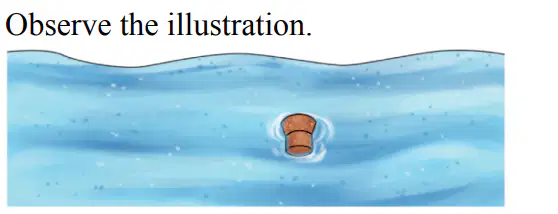
Observe the illustration. Waves have formed on the surface of a lake. A cork is floating in the lake. How do the motions of the cork and the waves compare? Moves faster when the wind blows stronger. Check cork, wave, or both cork and wave for each description.
cork
wave
both cork and wave

Myra is investigating transfers of energy at a bowling alley. Which observations show a transfer of energy? Select THREE correct answer choices.
The pins fall over when the ball strikes them.
The ball makes a rumbling noise as it rolls down the alley.
The ball and pins make a crashing noise when the ball strikes the pins.
The ball rolls into the gutter to the end of the alley.
The ball rolls very close to a pin, but the pin remains upright and does not move.

What is the source of energy for the sound from the trumpet?
the metal shell of the trumpet
the air inside the trumpet
the musician blowing into the trumpet
the light that is shining on the trumpet

Shanice assembles a battery, wire, and a light bulb as shown in the diagram. The bulb lights when she joins together the two loose ends of wire. What has Shanice demonstrated about the electrical energy needed to produce light?
The electrical energy must travel outward from an energy source and not return to it.
The electrical energy must travel into a device that produces light and not leave it.
The electrical energy must travel in a closed path that includes an energy source.
The electrical energy travels through the wires of a closed path, but not through other parts of the path.
Which event occurs because electrical energy is transformed into thermal energy?
A lamp shines light into a room.
A campfire heats the campers sitting around it.
A computer displays a movie with sound.
Cookies bake inside an electric oven.
Turning on a lamp happens in a series of quick steps. Arrange these steps in the correct order from 1 to 4, where 1 is the first step and 4 is the last step.
1. Someone turns the switch on the lamp from off to on. 2. The switch closes the gap in the wires of an electric circuit. 3. Electric current begins to flow through the circuit. 4. Light shines from the light bulb of the lamp.
1. Electric current begins to flow through the circuit. 2. Someone turns the switch on the lamp from off to on. 3. The switch closes the gap in the wires of an electric circuit. 4. Light shines from the light bulb of the lamp.
1. Light shines from the light bulb of the lamp. 2. Someone turns the switch on the lamp from off to on. 3. The switch closes the gap in the wires of an electric circuit. 4. Electric current begins to flow through the circuit.
1. Someone turns the switch on the lamp from off to on. 2. Electric current begins to flow through the circuit. 3. The switch closes the gap in the wires of an electric circuit. 4. Light shines from the light bulb of the lamp.
Which pair of appliances transform electrical energy into the same form of energy?
an electric toothbrush and a lamp
a radio and a hot-water heater
a hot-water heater and a clothes dryer
an electric can opener and an iron for clothes
The property of wool that makes it useful in clothes for cold weather is:
Its ability to trap air and provide insulation
Its smooth and shiny texture
Its ability to absorb water quickly
Its lightweight and thin fibers
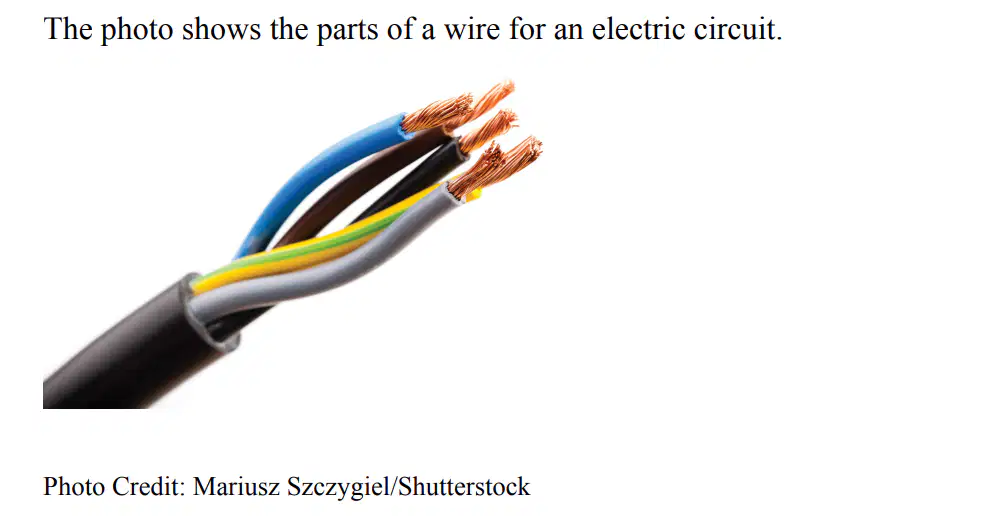
Fill in the blanks using the available answer choices. The photo shows the parts of a wire for an electric circuit. How does electricity flow through the wire?
conductor
insulator
only the metal
only the plastic
both the metal and plastic
Select an object that should be made from a good conductor of thermal energy and explain why.
Cooking pan – because it needs to transfer heat efficiently to food.
Blanket – because it should keep heat in and not transfer it.
Thermos flask – because it should prevent heat transfer.
Oven mitt – because it should protect hands from heat.
Waves transfer
Matter
Energy
Particles
Water

