
NEW
Font size
 Worksheets
Unit 2 Review 2025
Total questions: 42
Worksheet time: 22mins
Which was an important cause of the rise of feudalism in Europe?
increasing power of the Catholic Church
weakness of central government authority
political ideas brought back by the Crusaders
growth of national monarchies
Which action is linked to the spread of the Black Death to Europe during the 14th century?
trade with Asia
conquest of Japan
trade across the Sahara
exploration of the Western Hemisphere
After the fall of Rome, the eastern portion of the Roman Empire became known as the
Persian Empire
Byzantine Empire
Mongol Empire
Gupta Empire
“All things were under its domain…its power was such that no one could hope to escape its scrutiny.” Which European institution during the Middle Ages is best described by this statement?
the guild
knighthood
the Church
the nation-state
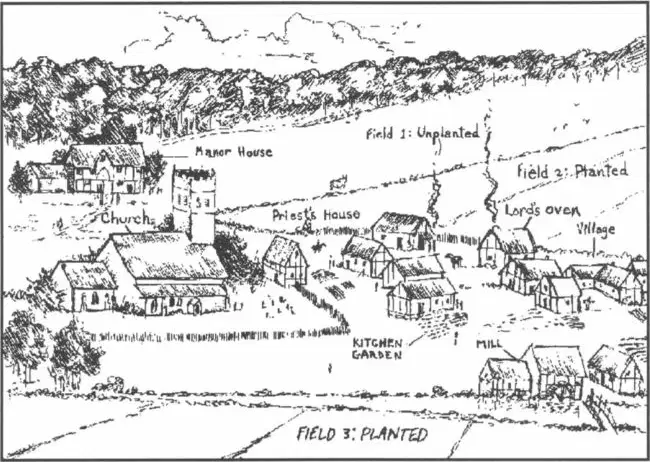
What inference can be drawn from the location of the church in this drawing?
The mill was managed by the church.
Religion played a significant role in the lives of the residents.
The church controlled trade within the manor.
The church played a limited role in education.
Base your answer to the following question on the quotation below and on your knowledge of social studies. "the...relationship was essentially a contract between lord and vassal which was defined and enforced by mutual agreement.... It was assumed that lord and vassal had a common interest—the welfare of the fief." —Sidney Painter Which political system is described in this quotation?
pure democracy
absolute monarchy
feudalism
fascism
An important long-term result of the Crusades in the Middle East was the
increased tension between Muslims and Christians
destruction of Muslim military power
creation of a large Christian state on the Red Sea
restoration of the Byzantine Empire
One important effect of the Crusades on western Europe was that they
led to a decline in the importance of the church in western Europe
furthered cultural diffusion throughout western Europe
introduced the Industrial Revolution to western Europe
ended the western European quest for an overseas empire
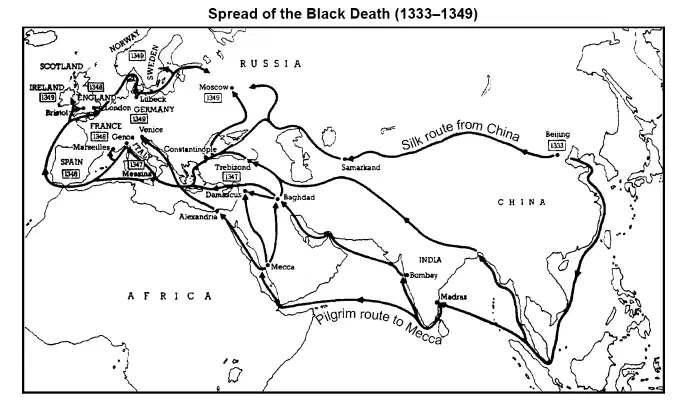
Which groups of people were most closely associated with the spread of the Black Death?
merchants and pilgrims
bankers and explorers
missionaries and slave traders
soldiers and diplomats
Which was a characteristic of feudalism?
Land was exchanged for military service and obligations.
Government was provided by a bureaucracy of civil servants.
Power rested in the hands of a strong central government.
Unified national court systems were developed.
A major goal of the Christian Church during the Crusades (1096-1291) was to
establish Christianity in western Europe
capture the Holy Land from Islamic rulers
unite warring Arab peoples
strengthen English dominance in the Arab world
The trans-Saharan trade carried out by West African civilizations was primarily based on an exchange of
gold and salt
ivory and silk
silver and tea
hardwoods and animal skins
Which statement best describes the role of the Roman Catholic Church in Europe during the Middle Ages?
The Church encouraged individuals to question authority.
Church leaders were involved solely in spiritual activities.
The Church gained influence as the world became more secular.
The Church provided a sense of stability, unity, and order.
In Europe, a long-term effect of the Crusades was
the strengthening of the feudal system
the adoption of Islamic religious practices
an increased demand for goods from the East
increased European isolation
What was a direct result of the Black Death in Europe?
The rate of urbanization increased.
A shortage of workers developed.
Food crops had to be imported from the Americas.
German states dominated trade in the eastern Mediterranean.
An important contribution of feudalism was that it
advanced the ideals of a democratic society
provided for some law and order in society
strengthened the powers of the monarchy
fostered the idea of a classless society
Which statement accurately describes the actions of Muslims during the Crusades?
Most Muslims converted to Christianity.
Muslims attacked and conquered Constantinople.
Muslims defended Jerusalem because it was sacred to them.
Many Muslims visited Europe for the first time to obtain luxury goods.
Which statement best characterizes Europe during the early Middle Ages?
A. A centralized government provided law and order.
B. Manorialism developed to meet the people’s economic needs.
C. People adopted humanism and questioned the Church.
D. A standardized currency promoted international trade.
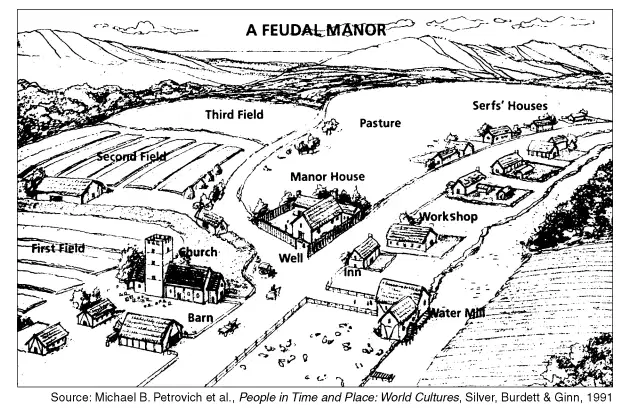
Most economic activities on this feudal manor were related to
guilds
industry
banking
agriculture
In western Europe, feudalism developed after the
A. Roman Empire collapsed
B. Renaissance began
C. city of Constantinople fell
D. Mongols invaded
The contributions of the ancient civilizations of Ghana, Axum, Kush, and Mali demonstrate that
industrial technology was needed for African civilizations to develop
many African civilizations developed in southern Africa
most of the African Continent was unified under a single political system
advanced societies developed in Africa before Europeans colonized this region
Which factor contributed to Mali becoming a wealthy kingdom?
enforcement of mercantilist policies
alliances with the Hanseatic League
control of Mediterranean trade routes
dominance of the gold and salt trade
Which achievement is most closely associated with Mansa Musa of Mali?
an increase in the influence of Islam and Islamic culture
the discovery of diamonds in the Congo
the defeat and capture of Cairo
an exclusive trade agreement with European merchants
Which statement supports the claim that diversity was an important characteristic of the Mongol Empire (1200-1350)?
All people in the Mongol Empire were Hindu.
The Mongol Empire ruled peoples from China, Russia, eastern Europe, and India.
Genghis Khan organized a network of communication across the Empire.
The Mongol Empire covered only central Asia.
Which factor contributed to the success of the vast empire created by the Mongols?
avoiding contacts with the West
paying monetary tribute to local rulers
employing superior military skills
converting conquered peoples to Confucianism
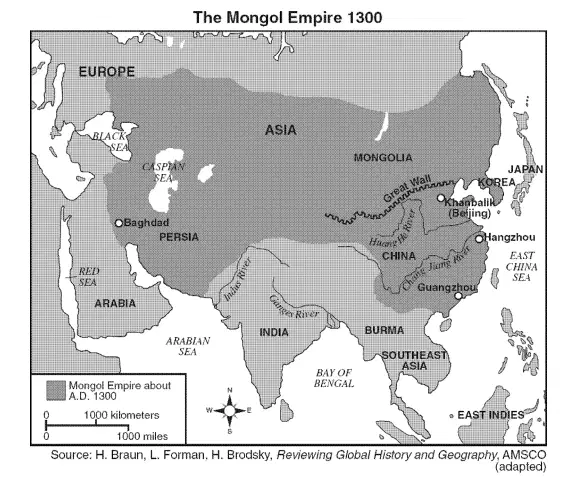
Base your answer(s) to the following question(s) on the map below and on your knowledge of social studies. The Mongol Empire 1300. Which statement is best supported by the information on this map?
By 1300, the Mongol Empire had reached the Red Sea.
The Mongol Empire controlled India and Japan by 1300.
By 1300, most of Europe had been conquered by the Mongols.
The Mongol Empire controlled a large portion of Asia by 1300.
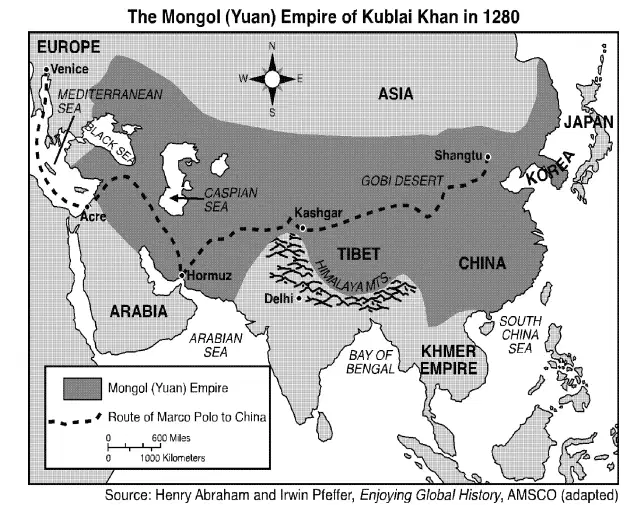
What was the effect of the extensive Mongol Empire on the people who lived in Europe and Asia in the 1200s?
development of a common language
adoption of Confucian ideas and practices
expansion of Japanese cultural traditions
significant increases in trade and travel
What was one of the primary reasons for the spread of the bubonic plague?
increase in trade
colonization of the Americas
development of the manorial system
economic decline
Which situation was a result of Pax Mongolica?
Trade increased between Europe and Asia.
China became isolated from its neighbors.
Warfare between Japan and Vietnam escalated.
Europeans conquered the Aztecs and Incas.
The Roman Catholic Church of the Middle Ages has been compared to a modern-day government because the Church
employed artists who might otherwise have starved
was responsible for providing many services needed by the people
insisted on the importance of religion in bringing order to society
provided for regularly held elections to select members of the legislative bodies
During the early Middle Ages, western European societies were most influenced by
national monarchies
the Roman Catholic Church
elected parliaments
the Byzantine emperors
Mansa Musa’s journey to Mecca in the 1300’s is evidence that
the Crusades had a great influence on western Africa
most African leaders were educated in the Middle East
European culture was superior to the cultures of western Africa
Islam had a major influence on the Mali Empire
Many achievements of Islamic civilization reached European society by way of the
Crusades and eastern Mediterranean trading networks
merchant guilds and the Industrial Revolution
Middle Passage and the Columbian Exchange
conquests of the Germanic tribes and trade along the Silk Road
Which shows the importance the Mongols placed on improving trade contacts with other civilizations?
the conquest of Constantinople
the establishment of caravan routes
the construction of large merchant fleets
the creation of a national currency
One important impact of the Mongol expansion across Asia and Europe was the
increased authority of the Kievan princes
rise in trade along the Silk Roads
introduction of Hinduism into Chinese culture
maritime exploration of the Arabian seacoast

What were the Crusades?
A tournament in Europe fought be the best knights.
A series of wars between the Christians and the Muslims.
The Muslim attempt to take over all of Europe.
The name of the battle between William, Duke of Normandy and Harold, King of England.


Which of the following was a significant impact of the Crusades on Europe?
Isolation from the rest of the world
Strengthening of feudalism
Increased cultural exchanges with the East
Decline in religious influence
How did the Black Death spread across Europe?
Through contaminated water sources
Via fleas on rats
Through airborne particles
By direct contact with the sick

What was the goal of The Crusades?
To control the Holy Land (Jerusalem)
To control the Catholic Church
To control the Iberian Peninsula
To maintain the borders of the Byzantine Empire

What was one direct result of the Crusades?
Trade increased between Europe and the Middle East.
Islamic kingdoms expanded into Europe.
Arabs and Christians divided the city of Jerusalem between them.
Alexander the Great became a powerful leader in Eurasia.

