
NEW
Font size
 Worksheets
Working at Height Safety Quiz
Total questions: 53
Worksheet time: 27mins
Which of the following workers is at risk when working at height?
Accountant
Steel worker
Chef
Librarian
What is one of the main risks associated with working at height?
Fire hazard
Worker falling
Electrical shock
Chemical exposure
Which of the following is a possible accident from working at height?
Allergic reaction
Neck or spinal injury
Hearing loss
Frostbite
What are fragile roofs not designed to do?
Carry loads
Withstand high winds
Resist water damage
Provide insulation
Which materials are mentioned as being part of fragile roofs?
Wood and metal
Cement and asbestos
Brick and stone
Rubber and tar
What is a characteristic of sloping roofs that increases risk?
Pitch greater than 10 degrees
Made of lightweight materials
Flat surface
Covered with tiles
What factor makes injuries worse on sloping roofs?
High temperatures
Acceleration down the roof
Heavy rainfall
Strong winds
What can falls from any height cause?
No injury
Minor discomfort
Injury
No effect
What is only one factor in causing injury from falls?
Horizontal distance
Vertical distance
Speed
Weight
Falls from what height can cause death or major injury?
Less than two metres
More than five metres
Exactly three metres
Only at ten metres
Which of the following is a hazard related to falling materials?
Deterioration of materials
Unprotected edges
Crumbling brickwork, loose tiles
Weather
What is a risk associated with bad housekeeping?
Unstable access equipment
Accumulation of debris
Weather
Unprotected edges
Which of the following is NOT listed as a hazard in the document?
Weather
Unprotected edges
Stable access equipment
Falling materials
What is a potential consequence of bad storage of materials on scaffolding?
Improved safety
Falling materials
Enhanced stability
Reduced debris
What are some hazards of working at height for a power network operative?
Working up a pole
Working on the ground
Working in an office
Working in a vehicle
Which of the following is a rule for working at height?
Always work alone
Use proper scaffolding
Ignore safety gear
Work without supervision
Which of the following is a factor to consider when selecting control measures?
Color of the equipment
Nature and duration of task
Brand of the equipment
Personal preferences of workers
Why is it important to consider the competence of workers when selecting control measures?
To ensure tasks are completed quickly
To ensure tasks are completed safely
To reduce the cost of equipment
To increase the number of workers
Which of the following is NOT listed as a consideration for selecting control measures?
Weather conditions
Health of workers
Color of the building
Need for a rescue plan
What is the first step in the hierarchy of control for preventing falls?
Minimise the distance and consequences of falls
Prevent falls
Avoid work at height
Use personal protective equipment
When applying the last two controls in the hierarchy of control, what should be prioritized?
Personal protection over group protection
Group protection over personal protection
Cost over safety
Speed over thoroughness
What is one way to avoid working at height according to the document?
Use a ladder
Work from ground level
Wear a safety harness
Use scaffolding
How can modifying a design help in avoiding work at height?
By using lighter materials
By assembling steel at ground level and craning it into place
By reducing the height of the structure
By using more workers
What should be remembered about avoiding work at height?
It is always possible
It may not be possible to achieve
It is the safest option
It requires no planning
What is important to prevent falls from height and falling materials?
Proper planning and supervision of work
Increased workload
Ignoring safety protocols
Working in bad weather
What should those responsible for preventing falls be?
Experienced
Untrained
Inexperienced
Uninformed
Why is regular inspection of the workplace important?
To ensure safety and proper work methods
To increase workload
To delay work processes
To avoid using correct equipment

What is the first step in the falls hierarchy?
Equipment to arrest falls
Properly installed suspended access equipment
Safe working platform
Fit toe boards and brick guards
Which of the following is a measure to prevent falling materials?
Use of safety harnesses
Properly installed suspended access equipment
Fit toe boards and brick guards
Equipment to arrest falls
If the risk of falling materials remains, what additional measures should be taken?
Use of safety harnesses
Debris netting and covered walkways
Safe working platform
Equipment to arrest falls
What is the preferred method for collective protection systems to minimize the consequences of falls?
Full-body harness
Nets and air bags
Helmets and gloves
Safety goggles
Why are collective protection systems considered the best systems for fall arrest?
They are the cheapest option.
They protect all workers.
They require no training.
They are easy to install.
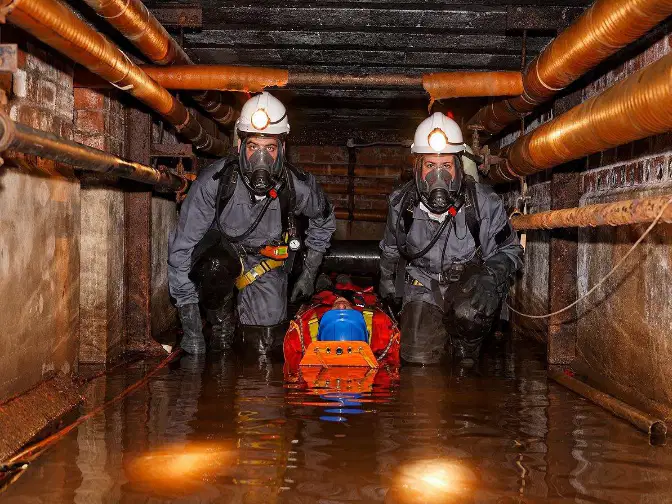
What is considered a confined space?
Any open field with no barriers
Any place with enclosed nature posing foreseeable risk
A large, open warehouse
An outdoor park
Which of the following is a foreseeable risk related to gases and fumes?
Fire or explosion
Loss of consciousness from gas, fumes, vapour, lack of oxygen
Drowning
Asphyxiation/entrapment in free flowing solid
What is a potential risk associated with free flowing solids?
Fire or explosion
Drowning
Asphyxiation/entrapment in free flowing solid
Loss of consciousness from increased temperature
Which risk involves a danger from increased temperature?
Fire or explosion
Loss of consciousness from increased temperature
Drowning
Asphyxiation/entrapment in free flowing solid
What needs to be considered before work takes place in a confined place?
Safety protocols and emergency procedures
The color of the walls
The type of flooring
The number of windows
Which of the following is a factor to consider regarding the general condition of a confined space?
Cleaning chemicals and release of fumes
Previous contents
Sources of ignition
Emergency rescue
What is a potential hazard arising from work in a confined space?
Physical dimensions
Oxygen deficiency
Sources of ignition
Other substances entering the space
Which of the following is a hazard from outside the confined space?
Increasing temperature
Other substances entering the space
Oxygen enrichment
Residues
What is a concern related to oxygen in a confined space?
Physical dimensions
Emergency rescue
Oxygen deficiency and oxygen enrichment
Cleaning chemicals
Which of the following is a component of a Safe System of Work (SSOW)?
Financial auditing
Supervision
Marketing strategies
Product design
What does PPE stand for in the context of a Safe System of Work?
Personal Protective Equipment
Public Policy Evaluation
Professional Performance Enhancement
Personal Productivity Efficiency
Which of the following is NOT typically included in a Safe System of Work (SSOW)?
Fire prevention
Lighting
Social media management
Ventilation
What is the purpose of atmospheric testing/monitoring in a Safe System of Work?
To measure employee satisfaction
To ensure air quality and safety
To track financial performance
To evaluate marketing effectiveness
What do the LOLER regulations require from responsible people and companies?
To ensure the safety of all employees
To own, operate, or have control over lifting equipment
To provide training for all machinery
To manage financial records
Under which regulations is lifting equipment also covered?
Health and Safety at Work Act
Equipment Safety Regulations
Provision and Use of Work Equipment Regulations (PUWER)
Machinery Directive
What does Regulation 8(2) of LOLER define as a lifting operation?
An operation concerned with the lifting or lowering of a load
An operation concerned with the transportation of goods
An operation concerned with the assembly of machinery
An operation concerned with the maintenance of equipment
What is included in the definition of a 'load' according to LOLER?
Only inanimate objects
Only machinery
Items being lifted, including a person or people
Only construction materials
What does 'lifting equipment' refer to according to LOLER?
Work equipment for lifting and lowering loads
Tools for repairing machinery
Devices for measuring weight
Equipment for cleaning surfaces
What must you do to manage and control risks in lifting operations?
Ignore safety protocols
Use outdated equipment
Plan them properly
Hire untrained personnel
Who should be involved in lifting operations to ensure safety?
People who are sufficiently competent
People with no experience
People who are unavailable
People who are uninterested
What is essential to ensure lifting operations are carried out safely?
Supervise them appropriately
Leave them unsupervised
Rush through the process
Ignore safety measures

