
Font size
 Worksheets
Grade 6 Science Review 9/25
Total questions: 11
Worksheet time: 6mins
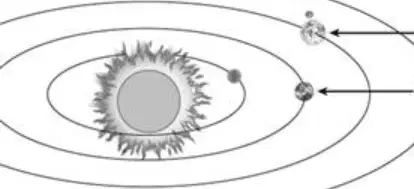
Mia and Aiden are exploring the solar system! If number 1 points to Earth, can you help Abigail figure out which planet number 2 is pointing to?
Mercury.
Jupiter.
Venus.
Mars.
Mason, Sophia, and Ethan are having a space debate! They want to know: In what ways are the terrestrial planets different from the gaseous planets? Can you help them settle the score?
The gaseous planets are closer to the sun than the terrestrial planets.
The gaseous planets are larger than the terrestrial planets.
The terrestrial planets are closer to the sun than the gaseous planets.
The terrestrial planets are larger than the gaseous planets.

Abigail, Ethan, and Benjamin are on a mission to create the coolest solar system diagram ever! They each draw a picture showing the orbits of the planets around the Sun (S). Check out their creative diagrams below. Which one is the MOST accurate?
A. [Diagram A]
B. [Diagram B]
C. [Diagram C]
D. [Diagram D]

Sophia, Noah, and Ava are on a space adventure! They discover four mysterious pairs of space objects, each with different masses but all 100 km apart. Which pair will experience the GREATEST amount of gravitational force between them? Help our explorers figure it out!
M1 = 1,000 kg, M2 = 75 kg, distance = 100 km
M1 = 1,000 kg, M2 = 50 kg, distance = 100 km
M1 = 1,000 kg, M2 = 25 kg, distance = 100 km
M1 = 1,000 kg, M2 = 100 kg, distance = 100 km
Arjun, Priya, and Elijah are stargazing and notice how the Moon always stays close to Earth. They wonder: What non-contact force from Earth keeps the Moon in orbit?
electrical force
magnetic force
centripetal force
gravitational force
Benjamin, Daniel, and Isla are stargazing with their new telescope. They wonder how this invention changed what people know about our solar system. What did the telescope help scientists discover?
It provided evidence that stars are at the center of the solar system.
It provided evidence that the Sun is at the center of the solar system.
It provided evidence that the Moon is at the center of the solar system.
It provided evidence that Earth is at the center of the solar system.
Abigail, Aria, and Kai are curious about why the planets in our solar system revolve around the Sun. Can you help them figure it out? The Sun is...
made of hydrogen and helium.
older than other objects in the solar system.
the source of most heat and light energy.
the strongest source of gravity in the solar system.
Priya, Evelyn, and Avery are stargazing and start wondering: Why does the Moon keep circling around Earth instead of floating away into space? Which is the BEST explanation?
The Moon has a thinner atmosphere than Earth.
The Moon is too large to move away from Earth.
The Moon is attracted by the gravity of Earth.
The Moon has a smaller gravitational force than Earth.
Luna and William are on a space adventure, exploring our solar system! They want to know: Of the eight planets, which ones are considered terrestrial planets? Help them choose the right ones!
B. Saturn
A. Earth
C. Venus
G. Mars
H. Mercury
Nora, Evelyn, and Abigail are building models of the Moon and Earth for their science project. How should their model of the Moon be different from their model of Earth?
be smaller than Earth.
have a source of light inside.
have a smoother surface than Earth.
have fewer impact craters on the surface.

Ava, Benjamin, and Daniel are working together on a space art project. Ava draws a picture of the Sun and Earth, but Benjamin notices something funny—Earth looks almost as big as the Sun! Their teacher says the sizes aren’t quite right. How should Ava change her drawing to show the real size difference between Earth and the Sun?
Increase the size of the Sun so it is twice the size of Earth.
Increase the size of Earth so it is twice the size of the Sun.
Decrease the size of Earth so it is a tiny dot compared to the Sun.
Decrease the size of the Sun so it is a tiny dot compared to Earth.

