
 Worksheets
Week 7 CFA Review 25-26
Total questions: 59
Worksheet time: 2hrs 5mins
What are the domain and range of f(x) = 19?
Domain: {19} Range: All real numbers
Domain: All real numbers Range: All real numbers greater than or equal to 19
Domain: All real numbers Range: {19}
Domain: All real numbers greater than or equal to 19 Range: All real numbers
Which graph represents a range of all real numbers greater than -4?


The cost of hiring a machinist, y, to work x hours to repair a machine can be modeled using a linear function. The machinist charges a fixed assessment cost of 25 plus an additional cost of 35 per hour. The machinist will take a maximum of 6 hours to repair the machine. What is the domain and range of the function for this situation?
Range: 25 ≤ y ≤ 235
Domain: All real numbers
Domain: 0 ≤ x ≤ 6
Range: 0 ≤ x ≤ 6
Domain: 25 ≤ y ≤ 235
The total cost, c, of renting college textbooks for a semester can be found using the function c = 22.99t + 8.50, where t is the number of textbooks rented. A student can rent no more than 10 textbooks. Karla will need at least 4 textbooks. What is the domain of the function for this situation?
F {4,5,6,7,8,9,10}
G 4 ≤ t ≤ 10
H 100.46 ≤ t ≤ 238.40
J {100.46,123.45,146.44,169.43,192.42,215.41,238.40}
What are the domain and range of f(x) = -12?
Domain: All real numbers Range: {-12}
Domain: All real numbers Range: All real numbers less than or equal to -12
Domain: {-12} Range: All real numbers
Domain: All real numbers less than or equal to -12 Range: All real numbers

The graph shows a train’s distance in miles from Janesville, Wisconsin after riding the train for x hours. What is the range of the function for this situation?
All real numbers less than or equal to 8
All real numbers greater than or equal to 0 and less than or equal to 8
All real numbers greater than or equal to 0 and less than or equal to 400
All real numbers less than or equal to 400

The graph of part of linear function h is shown on the grid. Which inequality best represents the domain of the part shown?
-3 < h(x) ≤ 3
-4 ≤ x < 2
-3 ≤ h(x) < 3
-4 < x ≤ 2
The total cost, t, of traveling by taxi can be found using the function t = 2.20m + 2.80, where m is the number of miles traveled in a single trip. The taxi will travel no more than 100 miles in a single trip. What are the domain and range for this function?
Domain: All real numbers greater than 0
Domain: All real numbers greater than or equal to 2.80 and less than or equal to 222.80
Domain: All real numbers greater than or equal 0 and less than or equal to 100
Range: All real numbers greater than or equal to 0 and less than or equal to 100
Range: All real numbers greater than or equal to 2.80 and less than or equal to 222.80
The total cost, y, of renting a party venue is a function of the number of people, x, attending the party. The owner of the party venue charges a fixed cost of 780 plus 9.75 per person. There is a maximum of 120 people attending the party. What is the greatest value in the range for this situation?
$1,950
$1,940
$2,000
$1,875

The Paint Pals shop is available for painting parties. The graph shows the cost of booking a painting party based on the number of people attending. What is the domain of the function for this situation?
0 ≤ x ≤ 5
{0,1,2,3,4,5}
0 ≤ y ≤ 350
{25,75,125,175,225,275}
Things to help me:
Complete Assignments
Re-do Assignments
Tutoring
The cost, y, of buying x movie tickets is given by y = 12x + 5, where x is the number of tickets and there is a maximum of 8 tickets per customer. What is the range of the function for this situation?
All real numbers greater than or equal to 5 and less than or equal to 101
All real numbers greater than or equal to 12 and less than or equal to 96
All real numbers less than or equal to 101
All real numbers greater than or equal to 5 and less than or equal to 101


Determine the domain
All real numbers
{x: −3 ≤ x ≤ 6}
{x : −6 ≤ x ≤ 6}
{x : −10 ≤ x ≤ 10}
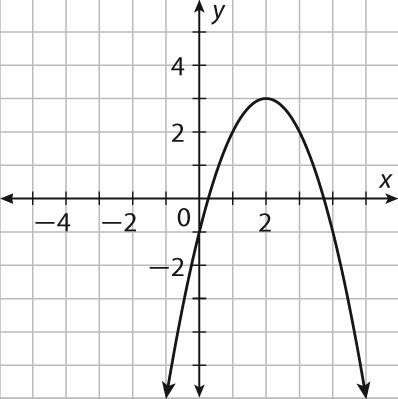
What is the range of the function?
{y : y ≤ 3}
{y : y ≥ 3}
All real numbers
{y : -6 ≤ y ≤ 3}


Determine the domain.
0≤x≤6
0≤x≤8
0≤y≤6
0≤y≤8
52(16 − 4x) = 12x + 3
(a)
6.5 − 3x − 7 = 7x + 6.5 + 3
(a)
6x + 4 = 9x − 5
(a)
2x + 8x − 4x = −24 + 36
(a)
−15 + 4x − 2(x + 4) = 6x − 15
(a)
Solve: 10x + 9 = 4x - 9
3
0
-18
-3
The goal of solving a one, two, or multi-step equations is to:
Find the coefficient
Find the value of the variable
Find the constant
Be confused
When graphing an inequality, you use a closed circle when you use which symbols?
≤, ≥
<, >

Solve the inequality
x ≤ -17
x ≤ -11
x ≤ 7
x ≤ -35
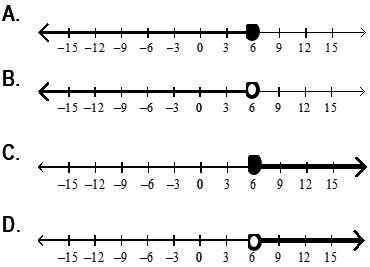
6 > x
Would the inequality sign flip? (Type Yes or No)
−2x +3< 8
(a)
What is the inequality sign for greater than?
<
>
≤
≥

x = 1
x = 2
x = 1/2
x = 3/2
Match the following

−5(1−4x)>−5

−2(x+1)+4<10

2x+7≥27 or 3+3x≤30

−1<9+x<17
f(x) = x-9 find f(-1)
-10
8
-8
10
f(x) = x-5 find f(0)
4
-5
5
-4
f(x) = x-5 find f(8)
5
3
9
13
f(x) = x-5 find f(9)
4
14
9
13
f(x) = x+7 find f(4)
11
12
9
10


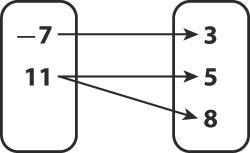
Is this a function?
Yes, it is a function.
No, it is not a function.

What variable typically represents the domain?
x
y
What variable typically represents the range?
x
y

What is the RANGE of this graph?
-7<x<5
-7≤y<5
-3<x<1
-3≤y<1
What is the domain of a relation?
the set of all x-values
the set of all y-values
Which is the set of all y-values or the outputs?
Domain
Range
Relation
Function
6 > x
2x + 2y = 6
4x + 3y = 9
y + 2 = 3x

