
Font size
 Worksheets
CAFC CHP 3 UNIT 1Theory of Production
Total questions: 70
Worksheet time: 2hrs 20mins
Identify the correct statement:
The average product is at its maximum when marginal product is equal to average product.
The law of increasing returns to scale relates to the effect of changes in factor proportions.
Economies of scale arise only because of indivisibilities of factor proportions.
Internal economies of scale can accrue when industry expands beyond optimum.
Which of the following is not a characteristic of land?
Its supply for the economy is limited.
It is immobile.
Its usefulness depends on human efforts.
It is produced by our forefathers.
Which of the following statements is true?
Accumulation of capital depends solely on income of individuals.
Savings can be influenced by government policies.
External economies go with size and internal economies with location.
The supply curve of labour is an upward slopping curve.
In the production of wheat, all of the following are variable factors that are used by the farmer except:
the seed and fertilizer used when the crop is planted.
the field that has been cleared of trees and in which the crop is planted.
the tractor used by the farmer in planting and cultivating not only wheat but also corn and barley
the number of hours that the farmer spends in cultivating the wheat fields.
The marginal product of a variable input is best described as:
total product divided by the number of units of variable input
the additional output resulting from a one-unit increase in the variable input.
the additional output resulting from a one-unit increase in both the variable and fixed inputs.
the ratio of the amount of the variable input that is being used to the amount of the fixed input that is being used.
Diminishing marginal returns implies:
decreasing average variable costs.
decreasing marginal costs
increasing marginal costs
decreasing average fixed costs.
The short run, as economists use the phrase, is characterized by
at least one fixed factor of production and firms neither leaving nor entering the industry.
generally, a period which is shorter than one year.
all factors of production are fixed and no variable inputs.
all inputs are variable and production is done in less than one year.
The marginal, average, and total product curves encountered by the firm producing in the short run exhibit all of the following relationships except:
when total product is rising, average and marginal product may be either rising or falling.
when marginal product is negative, total product and average product are falling.
when average product is at a maximum, marginal product equals average product, and total product is rising.
when marginal product is at a maximum, average product equals marginal product, and total product is rising.
To economists, the main difference between the short run and the long run is that:
In the short run all inputs are fixed, while in the long run all inputs are variable
In the short run the firm varies all of its inputs to find the least-cost combination of inputs.
In the short run, at least one of the firm’s input levels is fixed.
In the long run, the firm is making a constrained decision about how to use existing plant and equipment efficiently.
Which of the following is the best definition of “production function”?
The relationship between market price and quantity supplied.
The relationship between the firm’s total revenue and the cost of production.
The relationship between the quantities of inputs needed to produce a given level of output
The relationship between the quantity of inputs and the firm’s marginal cost of production.
The “law of diminishing returns” applies to:
the short run, but not the long run.
the long run, but not the short run.
both the short run and the long run.
neither the short run nor the long run.
Diminishing returns occur:
when units of a variable input are added to a fixed input and total product falls.
when units of a variable input are added to a fixed input and marginal product falls
when the size of the plant is increased in the long run
when the quantity of the fixed input is increased and returns to the variable input falls.
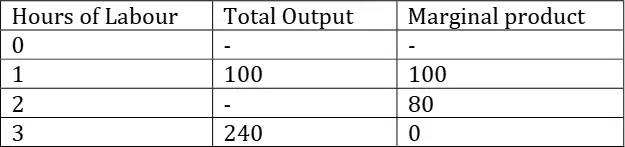
What is the total output when 2 hours of labour are employed?
80
100
180
200
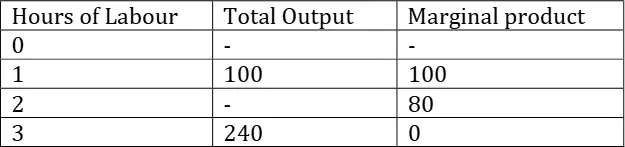
What is the marginal product of the third hour of labour?
60
80
100
240
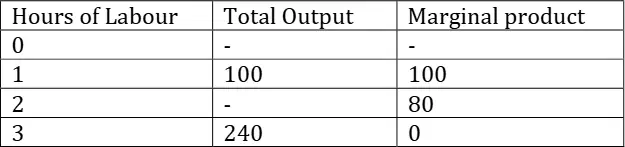
What is the average product of the first three hours of labour?
60
80
100
240
If a firm moves from one point on a production isoquant to another, which of the following will not happen?
A change in the ratio in which the inputs are combined to produce output
A change in the ratio of marginal products of the inputs
A change in the marginal rate of technical substitution
A change in the level of output.
Which of the following statements is true?
The services of a doctor are considered production
Man can create matter
The services of a housewife are considered production.
When a man creates a table, he creates matter.
Which of the following is a function of an entrepreneur?
Initiating a business enterprise
Risk bearing
Innovating.
All of the above
In describing a given production technology, the short run is best described as lasting:
up to six months from now.
up to five years from now
as long as all inputs are fixed
as long as at least one input is fixed.
If decreasing returns to scale are present, then if all inputs are increased by 10% then:
output will also decrease by 10%
output will increase by 10%.
output will increase by less than 10%
output will increase by more than 10%
The production function is a relationship between a given combination of inputs and:
another combination that yields the same output.
the highest resulting output.
the increase in output generated by one-unit increase in one output.
all levels of output that can be generated by those inputs.
If the marginal product of labour is below the average product of labour, it must be true that:
the marginal product of labour is negative.
the marginal product of labour is zero
the average product of labour is falling.
the average product of labour is negative
The average product of labour is maximized when marginal product of labour
equals the average product of labour
equals zero
is maximized
none of the above.
The law of variable proportions is drawn under all of the assumptions mentioned below except the assumption that:
the technology is changing
there must be some inputs whose quantity is kept fixed
we consider only physical inputs and not economically profitability in monetary terms.
the technology is given and stable.
What is a production function?
Technical relationship between physical inputs and physical output
Relationship between fixed factors of production and variable factors of production.
Relationship between a factor of production and the utility created by it.
Relationship between quantity of output produced and time taken to produce the output.
Laws of production does not include ......
returns to scale.
law of diminishing returns to a factor
law of variable proportions
least cost combination of factors.
An Iso-quant shows:
All the alternative combinations of two inputs that can be produced by using a given set of output fully and in the best possible way.
All the alternative combinations of two products among which a producer is indifferent because they yield the same profit
All the alternative combinations of two inputs that yield the same total product.
Both (b) and (c).
Economies of scale exist because as a firm increases its size in the long run:
Labour and management can specialize in their activities more.
As a larger input buyer, the firm can get finance at lower cost and purchase inputs at a lower per unit cost
The firm can afford to employ more sophisticated technology in production.
All of these
The production function:
Is the relationship between the quantity of inputs used and the resulting quantity of product.
Tells us the maximum attainable output from a given combination of inputs.
Expresses the technological relationship between inputs and output of a product.
All the above.
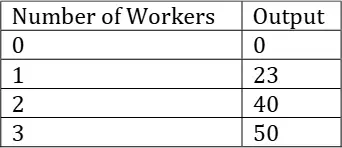
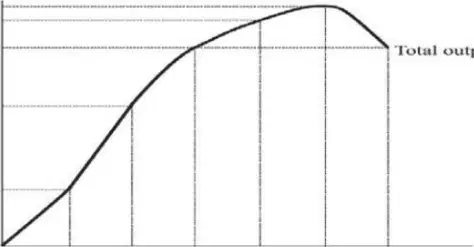
The production process described below exhibits.
constant marginal product of labour.
diminishing marginal product of labour
increasing return to scale
increasing marginal product of labour.
In the short run, the firm's product curves show that
Total product begins to decrease when average product begins to decrease but continues to increase at a decreasing rate.
When marginal product is equal to average product, average product is decreasing but at its highest.
When the marginal product curve cuts the average product curve from below, the average product is equal to marginal product.
In stage two, total product increases at a diminishing rate and reaches maximum at the end of this stage.
A fixed input is defined as
That input whose quantity can be quickly changed in the short run, in response to the desire of the company to change its production.
That input whose quantity cannot be quickly changed in the short run, in response to the desire of the company to change its production.
That input whose quantities can be easily changed in response to the desire to increase or reduce the level of production.
That input whose demand can be easily changed in response to the desire to increase or reduce the level of production.
Average product is defined as
total product divided by the total cost.
total product divided by marginal product.
total product divided by the number of units of variable input
marginal product divided by the number of units of variable input.
Which of the following statements is true?
After the inflection point of the production function, a greater use of the variable input induces a reduction in the marginal product
Before reaching the inevitable point of decreasing marginal returns, the quantity of output obtained can increase at an increasing rate
The first stage corresponds to the range in which the AP is increasing as a result of utilizing increasing quantities of variable inputs
All the above.
Marginal product, mathematically, is the slope of the
total product curve.
average product curve
marginal product curve
implicit product curve.
Suppose the first four units of a variable input generate corresponding total outputs of 200, 350, 450, 500. The marginal product of the third unit of input is:
50
100
150
200
Which of the following statements is false in respect of fixed cost of a firm?
As the fixed inputs for a firm cannot be changed in the short run, the TFC are constant, except when the prices of the fixed inputs change
TFC continue to exist even when production is stopped in the short run, but they exist in the long run even when production is not stopped
Total Fixed Costs (TFC) can be defined as the total sum of the costs of all the fixed inputs associated with production in the short run.
In the short run, a firm’s fixed cost cannot be escaped even when production is stopped.
Diminishing marginal returns for the first four units of a variable input is exhibited by the total product sequence
50, 50, 50, 50
50, 110, 180, 260
50, 100, 150, 200
50, 90, 120, 140
The marginal physical product of the third unit of labour is (a) , the MP of the (b) labour is Negative
Six; fourth
Six; third
Six; fifth
Six; sixth
In the third of the three stages of production:
the marginal product curve has a positive slope.
the marginal product curve lies completely below the average product curve.
total product increases
marginal product is positive.
Which of the following statements describes increasing returns to scale?
Doubling of all inputs used leads to doubling of the output.
Increasing the inputs by 50% leads to a 25% increase in output.
Increasing inputs by 1/4 leads to an increase in output of 1/3
None of the above
The most important function of an entrepreneur is to _________?
a. Innovate
b. Follow orders
c. Avoid risks
d. Maintain status quo
Assertion (A): In the short run, a producer operates in only II stage of Law of Diminishing Returns where average product of variable factor is declining Reason (R): In stage I and stage III the marginal product of the fixed and the variable factors respectively are negative.
(A) is true and (R) is false
Both (A) and (R) are true & (R) is the correct explanation of (A)
Both (A) and (R) are true & (R) is not the correct explanation of (A)
(A) is false and (R) is true
In the long run which factor of production is fixed?
Labour
Capital
Building
None of these
Law of diminishing returns to scale is relevant to_
Short period
Long period
Market period
None of these
The Cobb-Douglas homogeneous production function given as: Q = L1/2 k1/2 exhibits-
Constant returns to scale
Decreasing returns to scale
Increasing returns to scale
All of the above at various level of output
In second stage of the Law of Variable Proportion-
MP diminishes & AP increases
AP diminishes but MP increases
Both MP& AP diminish
Both MP& AP increase
If all inputs are increased in the same proportion, then it is the case of
Long run production function
Short run production function
Law of Variable Proportion
2 & 4 only
Law of Returns to Scale
Assertion (A): An Iso-cost line is a straight line. Reason (R): The market rate of exchange between the two inputs is constant.
(A) is true and (R) is false
Both (A) and (R) are true & (R) is the correct explanation of (A)
Both (A) and (R) are true & (R) is not the correct explanation of (A)
(A) is false and (R) is true
“Returns to Scale” refers to the effect on total output of changes in:
a factor
various inputs separately
all the inputs simultaneously
None of these
Which one of the following is not an assumption of law of variable proportion?
Technology of production remains unchanged.
Only physical inputs & output are considered.
All units of variable factors are different.
The must be some inputs whose quantity is kept fixed.
Isoquant word is made up of two words i.e., Iso & Quant. Where quant means quantity or output then Iso means-
Maximum
Equal
Minimum
None of these
An isoquant slopes:
downward to the left
downward to the right
upward to the left
upward to the right
The marginal cost curve intersects the average cost curve when average cost is:
Maximum
Minimum
Raising
Falling
Which is the other name that is given to the long run average cost curve?
profit curve
planning curve
demand curve
indifference curve
Diminishing marginal returns imply
decreasing average variable costs
decreasing marginal costs
increasing marginal costs
decreasing average fixed costs
The producer is in equilibrium at a point where the cost line is:
above the isoquant
below the isoquant
cutting the isoquant
tangent to isoquant
Which of the following is not a characteristic of land?
its supply for the economy is limited
it is immobile
its usefulness depends on human efforts
it is produced by our forefathers
A firm’s production function:
Shows how much output and the level of input required for the firm to maximize profits
Establishes the minimum level of output that can be produced using the available resources
Shows the maximum output that can be produced with a given amount of inputs with available technology
Shows labour force which is employed
Which of the following function can never be delegated by the entrepreneur?
Initiating the business enterprise
Innovation
Risk bearing
All of the above
When Average product is maximum:
MP is at maximum
MP curve cuts AP from below
Total Product is at maximum
First stage of Increasing returns to factor ends.
Which of the following statement is not true?
Iso-cost line never touches the axis
Isoquants are convex to the origin
Isoquants are non-intersecting
Higher Iso-cost line shows higher budget
____ is that point on TP at which MP is maximum
Saturation point
Production Optimization point
Inflexion point
Maximum point
The quantity of the variable factor becomes too excessive relative to the fixed factor so that they get in each other’s way, is the case of:
Increasing return to scale
Decreasing return to scale
Diminishing return to factor
Negative return to factor
In Cobb-Douglas production function, if labour elasticity and capital elasticity is more than 1, it refers to:
Increasing return to factor
Constant return to scale
Increasing return to scale
Decreasing return to scale
If a firm moves from one point on a production isoquant to another, which of the following will not happen:
A change in the ratio in which the inputs are combined to produce output
A change in the ratio of marginal products of the inputs
A change in the marginal rate of technical substitution
A change in the level of output
Stages I and III are called
Economic Absurdity
Economic Stability
Economic Equilibrium
All of the above
What happens to total output when all inputs are increased by 20% under constant returns to scale?
Total output will increase by 20%
Total output will decrease by 20%
Total output will remain unchanged
Total output will increase by more than 20%
In the context of production, what does the term 'marginal product' refer to?
The total output produced by all inputs
The additional output generated by adding one more unit of a variable input
The output level at which average costs are minimized
The average output produced per unit of input
Which of the following best describes the concept of 'returns to scale'?
The relationship between average costs and output levels
The change in output resulting from a change in fixed inputs
The effect of increasing one input while keeping others constant
The relationship between input quantities and output levels as all inputs are varied

