
 Worksheets
SS7 Chapter 1 Study Guide
Total questions: 25
Worksheet time: 13mins
Name
Class
Date
1.
Choose the correct definition of artifact.
a)
an object that will be made by humans in the future.
b)
a story told by humans log ago.
c)
a story that will be told by humans in the future.
d)
an object made or used by humans long ago.
2.
Read the definition. Then choose the vocabulary term that is being defined.
Principles or standards of behavior that are considered important or desirable.
a)
collective
b)
values
c)
perspective
d)
consequence
3.
Read the definition. Then choose the vocabulary term that is being defined.
To favor or oppose someone or something because of certain characteristics, especially in an unfair manner.
a)
credible
b)
reliable
c)
verify
d)
bias
4.

Which vocabulary tern best describes the image?
a)
chronological order
b)
primary source
c)
secondary source
d)
artifact
5.
Read the definition. Then choose the vocabulary term that is being defined.
A major discussion or disagreement between opposing views.
a)
compromise
b)
controversy
c)
negotiation
d)
consideration
6.
Read the definition. Then choose the vocabulary term that is being defined.
An original record of a past event, usually created by someone who actually saw or participated in the event.
a)
secondary source
b)
encyclopedia
c)
primary source
d)
story
7.
Read the definition. Then choose the vocabulary term that is being defined.
A broad statement or idea that is applied to a group of people or things.
a)
comparison
b)
generalization
c)
discrimination
d)
nation
8.
Choose the correct definition of perspective.
a)
the way a person views or interprets events or issues; point of view
b)
the facts a person knows about events or issues.
c)
the research a person does on events or issues; a report.
d)
the stories a person writes about imaginary events or issues.
9.
Choose the correct definition of historical narrative.
a)
the story of what happened in the past.
b)
the physical evidence of what happened in the past.
c)
a diary written in the past.
d)
a painting created in the past.
10.
Choose the correct definition of norm.
a)
an individual value that is not shared in a culture.
b)
an assumption that people who share some characteristics also share other characteristics
c)
the way a person views or interprets events or issues.
d)
a typical belief or behavior in a culture.
11.
Read the definition. Then choose the vocabulary term that is being defined.
The way something is explained or understood.
a)
norm
b)
primary source
c)
interpretation
d)
generalization
12.
An archaeologist finds an artifact that has writing on it about a historical event. How should the archaeologist describe the historical event?
a)
from the perspective of people living at the time
b)
from the perspective of today's norms and values
c)
from the perspective of a reliable secondary source
d)
from the perspective of previous historical investigations.
13.
Determine if the piece of information below about the bubonic plague is a primary source or a secondary source.
film describing life during the bubonic plague
a)
Primary Source
b)
Secondary Source
14.
Determine if the piece of information below about the bubonic plague is a primary source or a secondary source.
illustration created during the bubonic plague
a)
Primary Source
b)
Secondary Source
15.
Determine if the piece of information below about the bubonic plague is a primary source or a secondary source.
diary of a priest living during the bubonic plague
a)
Primary Source
b)
Secondary Source
16.
Determine if the piece of information below about the bubonic plague is a primary source or a secondary source.
recent scientific analysis of the infection level during the bubonic plague
a)
Primary Source
b)
Secondary Source
17.
Why do historians and archaeologists use as many primary sources about a historical event as possible?
Choose 2
a)
to examine different perspectives
b)
to provide a specific point of view
c)
to avoid creating a historical narrative
d)
to capture key details that some sources may be missing
18.
Four people see a food fight between two tables in the lunchroom.
- Andre, who is friends with the students at one table.
- Anna, who just walked in the door of the lunchroom furthest from the two tables.
- Sebastian, who just moved to the country from an area where food is scarce
- Sarah, who whispered something to one of the people involved in the food fight just before it began.
What is Andre's role in the food fight?
a)
Role in the event
b)
Connections to friends
c)
Physical location when event occured
d)
Individual characteristics and life experiences
19.
Four people see a food fight between two tables in the lunchroom.
- Andre, who is friends with the students at one table.
- Anna, who just walked in the door of the lunchroom furthest from the two tables.
- Sebastian, who just moved to the country from an area where food is scarce
- Sarah, who whispered something to one of the people involved in the food fight just before it began.
What is Anna's role in the food fight?
a)
Role in the event
b)
Connections to friends
c)
Physical location when event occured
d)
Individual characteristics and life experiences
20.
Four people see a food fight between two tables in the lunchroom.
- Andre, who is friends with the students at one table.
- Anna, who just walked in the door of the lunchroom furthest from the two tables.
- Sebastian, who just moved to the country from an area where food is scarce
- Sarah, who whispered something to one of the people involved in the food fight just before it began.
What is Sebastian's role in the food fight?
a)
Role in the event
b)
Connections to friends
c)
Physical location when event occured
d)
Individual characteristics and life experiences
21.
Four people see a food fight between two tables in the lunchroom.
- Andre, who is friends with the students at one table.
- Anna, who just walked in the door of the lunchroom furthest from the two tables.
- Sebastian, who just moved to the country from an area where food is scarce
- Sarah, who whispered something to one of the people involved in the food fight just before it began.
What is Sarah's role in the food fight?
a)
Role in the event
b)
Connections to friends
c)
Physical location when event occured
d)
Individual characteristics and life experiences
22.
When historians examine a group's perspective, they often assume that people who share certain characteristics and beliefs also share other characteristics and beliefs. When historians do so, they are making a ______________.
a)
generalization
b)
historical narrtive
c)
historical norm
23.
Historians make generalizations when they examine a group's perspective. The assumptions should not be applied to _____________.
a)
an individual person
b)
a contemporary event
c)
a historian or achaeologist
24.
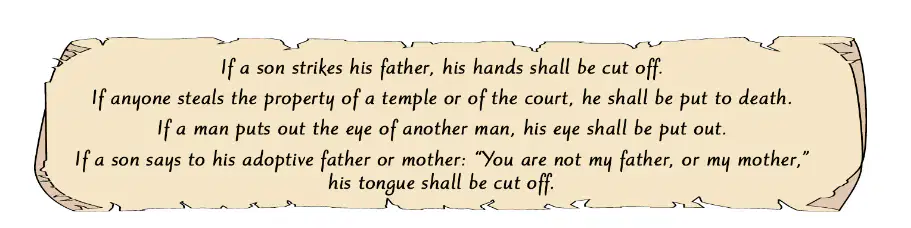
Read the excerpt from a primary source known as the Code of Hammurabi dated around 1754 BC. Select each statement about the excerpt that is from a past perspective. Choose 3.
a)
By putting laws in writing, Hammurabi demonstrated concern for his citizens and a commitment to justice.
b)
Hammurabi's code showed compassion by limiting punishments to what was considered appropriate at the time based on the crime.
c)
By creating written laws that applied to all citizens, Hammurabi established a lasting legacy that can be seen in the concepts of our U.S. government today.
d)
These punishments for breaking laws violated human rights.
e)
Luckily, these laws are nothing like the laws of our country today!
25.
Which statement BEST describes a historical narrative?
a)
an interpretation of a historical event or issue that includes multiple sources and perspectives
b)
an interpretation of a historical event or issues that relies on secondary sources only
c)
an interpretation of a historical event or issue that uses fictional characters or events
d)
an interpretation of a historical event or issue that is built from memoirs rather than artifacts.
100 %

