
 Worksheets
Ionic
Total questions: 100
Worksheet time: 3hrs 25mins
Ionic bonds are beween
Metals and Non-metals
2 - non-metals
2-metals
covalent
What charge does group 1 make?
+1
-1
0
+2
What charge does group 2 make?
+1
-1
-2
+2
What charge does group 13 usually make?
+2
-2
+3
-3
What charge does group 15 usually make?
+5
-5
+3
-3
What charge does group 16 make?
+6
-6
+2
-2
What charge does group 17 make?
+7
-7
+1
-1
Charge in group 18 - noble gase
0
+18
-8
+8

The negative ions tend to _____________ electrons.
lose
gain
What are valence electrons?
The # of electrons in the atom
The # of electrons in the outermost shell
The # of electrons an atom will pick up
The # of electrons an atom will get rid of
An ion
an atom with a positive or negative charge
an atom with different number of protons
an atom with different number of neutrons
an atom with an atomic number
Anion
a negative charged ion
a positive charged ion
an isotope
a atomic mass multiple
Cation
an atom with a positive charge
an atom with a negative charge
an atom with multiple protons and neutrons
a nucleic acid
In ionic bonds electrons are
transferred
shared
opposite
In ionic bonds metals have a _______charge.
positive
negative
neutral
unknown
Ionic bonds non-metals have a ________charge.
negative
positive
neutral
Valence electrons in group 1?
1
11
varies
0
Valence electrons in group 2?
2
12
unknown
varies
Valence electrons in group 13?
13
3
unknown
33
Valence electrons group 14?
4
14
44
minus 4
Valence electrons in group 17?
7
17
full
8
Where are the transition elements found on the periodic table?
groups 1 and 2
groups 3-12
periods 4-6
groups 13-18
FeCl3
In the compound TiO2, titanium has a charge of ______. Hint: The charge on "O" is -2. Use the charge on oxygen to determine the charge on Ti.
4+
2+
2-
4-
LiBr is called
lithium bromine
lithium (I) bromine
lithium bromide
lithuim (I) bromide
NaBr
KF
What are the 3 subatomic particles of an atom?
shell, proton, electron
cloud, neutrons, protons
nucleus, protons, electrons
protons, neutrons, electrons
Which subatomic particle has a negative charge?
proton
neutron
electron
Which subatomic particle has a positive charge?
proton
neutron
electron
Which subatomic particle has a neutral or no charge?
proton
neutron
electron

What two parts of an atom make up the nucleus of the atom?
Electron and Protons
Neutron and Protons
Proton and Electrons

What is "a" in the picture?
Proton
Electron
Neutron
What is "b" in the picture?
Proton
Electron
Neutron
What is "c" in the picture?
Proton
Electron
Neutron
A region around the nucleus of an atom where electrons are likely to be found.
Electron Cloud or shell
Nucleus
Protons
Electrons

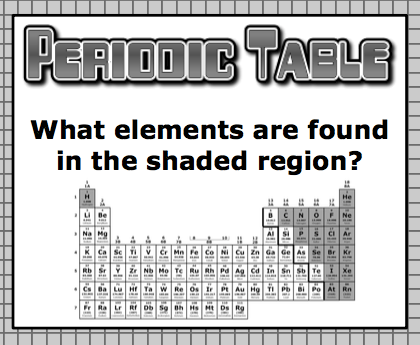
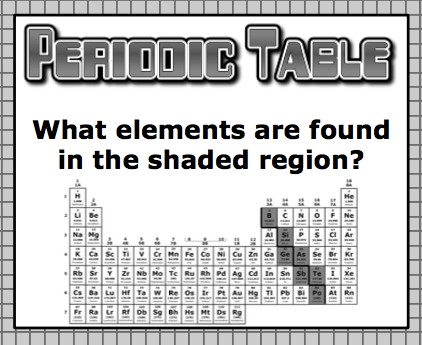
What is the name of group number 1?
halogens
noble gases
alkali metals
alkaline earth metals
What is the name of group number 2?
transition metals
halogens
metaloids
alkaline earth metals
What group number are the halogens found?
18 (8A)
1
2
17 (7A)
How is the Periodic Table arranged?
alphabetical order
atomic number
the year the element was discovered
Albert Einstein decided how to arrange it.
Which group on the periodic table contains elements that form ions with a +2 charge?
Group 1 (1A)
Group 17 (7A)
Group 2 (2A)
Group 16 (6A)
Which subatomic particle is found in the nucleus and has no charge?
Positron
Electron
Proton
Neutron
What is the correct name for Na2O?
Sodium oxide
Sodium monoxide
Disodium oxide
Sodium dioxide
Which subatomic particle has a negative charge?
proton
neutron
electron
What are the 3 subatomic particles of an atom?
shell, proton, electron
cloud, neutrons, protons
nucleus, protons, electrons
protons, neutrons, electrons
What is the organizational system or chart for elements?
Atomic weight
Families
Periodic table
Atomic number

What does the 6 represent?
atomic mass
atomic number
element name
chemical symbol
How many groups and periods does a Periodic Table have?
There are 17 groups or families and 7 periods.
There are 18 groups or families and 7 periods.
There are 7 groups or families and 18 periods.
There are 18 groups or families and 6 periods

What does 12.011 represent?
atomic mass
atomic number
element name
chemical symbol
The Modern Periodic Table of Elements is arranged by
atomic mass
atomic number
valence electrons
number of isotopes

What element is represented in this Bohr Model?
Good conductor of heat and electricity
Metal
Nonmetal
What is the center of an atom called?
Electron cloud
Nucleus
Proton
Neutron
Atoms of the same element with different numbers of neutrons are called:
Isobars
Isotopes
Isomers
Isoelectronic
How many electrons can the first energy level of an atom hold?
2
8
18
32
Which pair of properties describes the elements in Group 1?
They are chemically stable
They have 8 valence electrons
They are the most reactive metals
They are the most reactive non metals

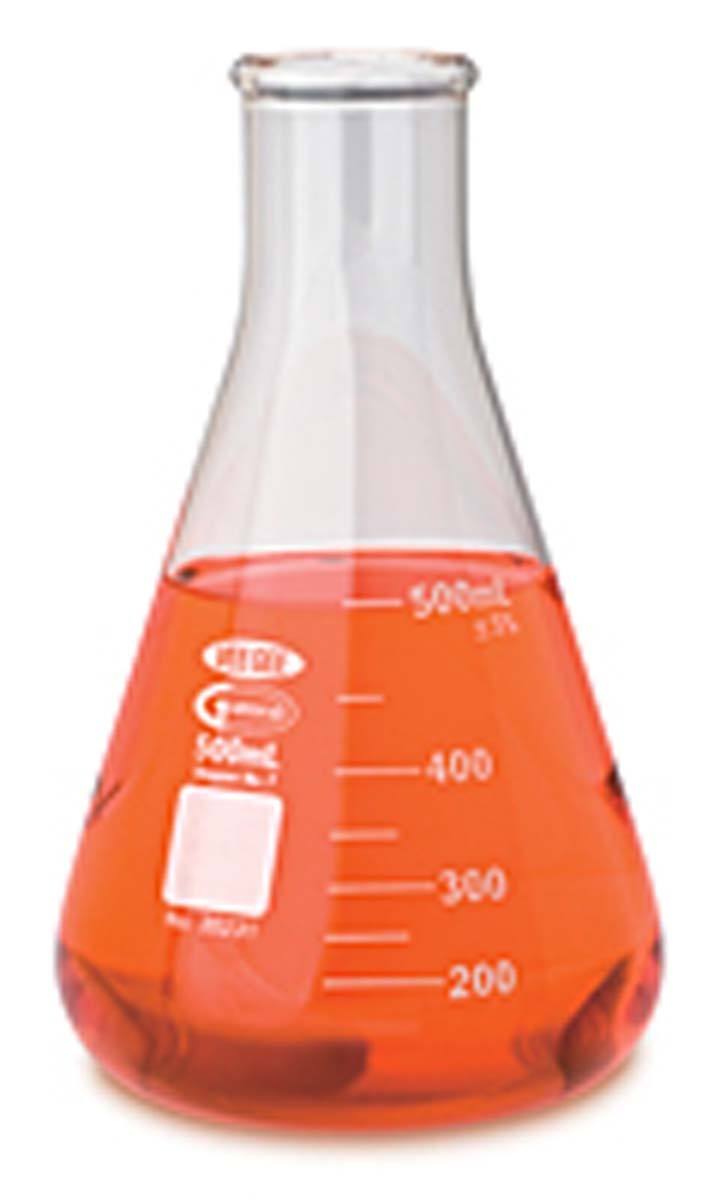
What is used to swirl, mix, or store chemicals?
Beaker
Erlenmeyer Flask
Test Tube
Graduated Cylinder
Which of these pieces of equipment is beaker?


A set of data are all close in value to each other, but they are not close to the actual value. This set of data can be described as _________________.
precise
accurate
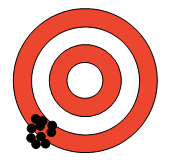
This bullseye demonstrates...
High Accuracy & High Precision
High Accuracy & Low Precision
Low Accuracy & High Precision
Low Accuracy & Low Precision
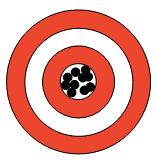
This bullseye demonstrates...
High Accuracy & High Precision
High Accuracy & Low Precision
Low Accuracy & High Precision
Low Accuracy & Low Precision
Largest element is
Fr
F
He
U
Which piece of equipment is best for measuring the most precise volume of a liquid?
Erlenmeyer Flask
Test Tube
Graduated Cylinder
Beaker
Consist of elements in Groups 3 through 12
Alkali Metals
Alkaline Earth Metals
Transition Metals
Noble Gases
The most electronegative element
F
Fr
Na
He
The charges in groups 3-12
Always positive but can vary
Always negative
Neutral
0 to 12
When was war of 1812
1812
No Clue

