
 Worksheets
Week 2 Resp 2410 Disorders
Total questions: 14
Worksheet time: 5mins
Which of the following is classified as a cyanotic congenital heart defect (CHD)?
Ventricular septal defect (VSD)
Atrial septal defect (ASD)
Tetralogy of Fallot (TOF)
Coarctation of the aorta

Based on the previous question, which of the following CHDs would look more like an egg 🥚 on CXR?
Patent ductus arteriosus (PDA)
Truncus arteriosus
Total anomalous pulmonary venous return (TAPVR)
Transposition of the Great Arteries (TGA)
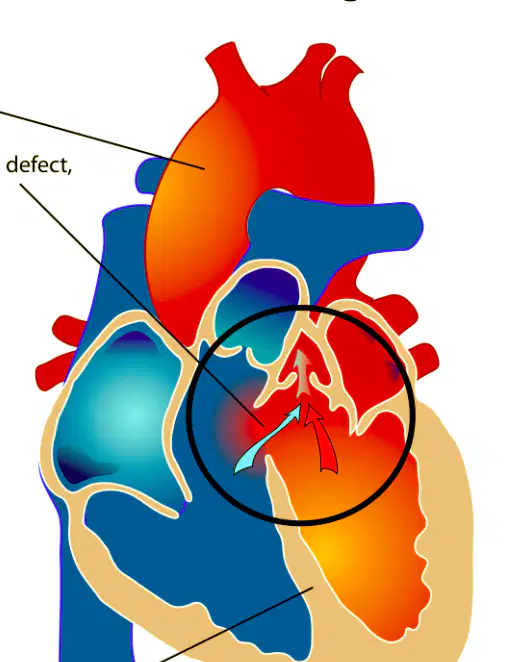
This picture depicts...
Overriding Aorta
Right Ventricular Hypertrophy
Pulmonary Stenosis
Is a congenital anomaly characterized by a stricture or blockage of the passage between the nasal sinus and the pharyngonasal airways
Omphalocele
Anencephaly
Choanal Atresia
Hirschsprung Disease
Branchial Cleft Cysts and Clefts
A child age 4 is admitted with a tentative diagnosis of congenital heart disease. When assessment reveals a bounding radial pulse coupled with a weak femoral pulse, the nurse suspects the child has:
Patent ductus arteriosus
Coarctation of the aorta
Ventricular septal defect
Truncus arteriosus
You’re caring for a child with coarctation of the aorta and educating the parents about the child’s condition. Which statement by the parents demonstrates they understood the pathophysiology of this defect?
“This condition can lead to right-sided heart failure.”
“The narrowing of the aorta leads to a high blood pressure in the arteries that are found before the site of narrowing in the aorta.”
“The dilation of the aorta leads to a decrease blood pressure in the arteries that are found after the site of dilation.”
“The upper and lower extremities will experience a decrease in blood flow due to the defect in the aorta.”
Failure to close foramen ovale in the interartial septum, so blood from L. atrium is shunted to R. atrium....enlargement of R. side of heart
Septal defect
Atrial septal defect
Ventricular septal defect
Tetralogy of Fallot
The patient has ventricular septal defect, pulmonary stenosis (narrowing), aorta that overlaps R. & L. ventricles, R. ventricular hypertrophy.
Septal defect
Atrial septal defect
Ventricular septal defect
Tetralogy of Fallot
Abnormal sound that consists of flow noise that is heard before, between or after the lubb-dupp o rmask sound entirely
Heart Murmur
Valvular insufficiency or incompetency
Valvular stenosis
Mitral Valve Prolapse
Rheumatic Fever
A child age 4 is admitted with a tentative diagnosis of congenital heart disease. When assessment reveals a bounding radial pulse coupled with a weak femoral pulse, the nurse suspects the child has:
Patent ductus arteriosus
Coarctation of the aorta
Ventricular septal defect
Truncus arteriosus
Which of the following is used to keep a PDA (patent ductus arterioles) open?
Prostaglandins (PGE)
Milrinone
Indomethacin
Potassium drip
Mutations in which gene causes cystic fibrosis?
HTT
PINK1
CFTR
HBB
The parent of a toddler calls the nurse, asking about croup. What is a distinguishing manifestation of spasmodic croup?
Wheezing is heard audibly.
It has a harsh, barky cough.
It is bacterial in nature.
The child has a high fever.
An ARDS patient on high flow nasal cannula has this blood gas PaO2 50, PCO2 50, 7.10 pH
Intubation
Bipap
100%
Non-rebreather mask
Cpap

