
 Worksheets
TTTC FINAL 2
Total questions: 79
Worksheet time: 40mins
Junk bonds which are rated lower than triple B are also classified as:
High yield bonds
Low yield bond
Zero floating bonds
… is often exempt from the federal income tax and from the income tax of the state in which they are issued.
Municipal bond
Treasury bond
Corporate bond
International bond
Which sentence is not true for high yield bond?
The firm issuing the bond is of high quality
The bond is rated below investment grade by the credit rating agencies
This type of bonds is riskier than low yield bond
B&C
… is the market through which Government can plan and implement different monetary policies.
Interbank market
Open market
Credit market
Money market
In domestic debt market, … are trading:
Instruments sell domestically
Instruments sell abroad
Instruments issued in foreign currencies
Instruments issued in domestic currencies
Par value of bond is …
The amount on which the issuer sell bond to investor
The amount on which the issuer has to be repaid at the end of the term
The buying price of the bonds at the time of issuance
The amount paid to bond holder between two interest payment times
According to Fitch’s Rating system, debt instruments with lowest default risk and highest credit quality are assigned rating of
BB
BBB
AAA
AA
… is a type of bond that, upon its issuance, the bond certificate shows a provision that allows the issuing organization to buy part or the entire of the bond before its maturity.
Callable bond
Warrant bond
Convertible bond
Registered bond
Why are bonds considered to be more stable and less risky than stocks?
Bonds do not gain any kind of ownership rights to the issuer, unlike in the case of equities
Bonds have priority on payment over the dividends paid to shareholders
Bonds have a greater claim on remaining assets than a shareholder in the case of liquidation
B and C
Treasury notes that provide returns tied to inflation rate are classified as
Clean price bonds
Discount index bonds
Premium index bonds
Inflation index bonds
What is NOT the characteristic of debt market?
The issuer in debt market takes out the loan in the manner of repayment of both principal and interest
The investor assumes no responsibility for the issuer’s results and in any case, the issuer shall be responsible to repay under the specified commitments agreed when issuing debt instruments
Operations of the debt market depend remarkably on the fluctuations of market interest rate
Instruments in debt market have no maturities
Which type of instruments is not defined as debt instruments?
Bond
Unsecured notes
Term loans
Stock
Stock markets in which already issued stocks are resold and re-bought are classified as
Primary markets
Secondary markets
Tertiary markets
Initial markets
Which of the following is classified as a market where previously issued securities are bought and sold?
Red herring stock market
Preemptive stock market
Silence stock market
Secondary stock markets
Right of stockholders of a firm that new shares must be offered to existing stockholders first, rather than new stockholders, is classified as
Non-offered rights
Preemptive rights
Existing rights
Securitize rights
Which of the following statements is incorrect concerning private placements?
Terms of the financing can be custom-tailored
The securities are not made available to the public
The securities are often less marketable
Only a small amount of corporate debt is financed in this manner
Which method involves the middleman committing with the issuing company to complete issuing preparation procedures, to buy a certain amount of issuing security or to buy all unsubscribed issuing shares?
Initial Public Offering
Direct Public Offering (DPO)
Second Public Offering
Issue Underwriting
Which type of underwriter agrees to purchase the portion of the new securities issue that remains after a public offering?
Firm Commitments
Best efforts
Stand-by underwriting
All or none
In Vietnam, which of the following is a requirement condition of public offering?
Charter capital is at least 30 billion VND
Charter capital is at least 25 billion VND
Charter capital is at least 80 billion VND
All of the above
A market where new securities are bought and sold for the first time is known as a ... market.
Primary
Secondary
Auction
Over-the-counter
Tertiary
The cases in which a company chooses the private offering rather than public offering are:
1
1,2,3
1,3,4
1,2,3,4
Which sentence is true for direct public offering?
Save issuing cost
Save time of the offering
The success of the offering is always guaranteed
It can’t eliminate the middlemen
Which sentence is not true when refers to characteristics of primary securities market?
The market operates infrequently
The issuers receive the money in return of selling new securities to the investors
Primary market performs the crucial function of facilitating long-term capital formation in the economy
The volume and transaction speed of the primary market are higher than those of secondary market
Which of the following is a capital market security?
Commercial papers
Federal agency bonds
Treasury bills
Eurodollars
Most bonds:
Are ranked after stocks in term of remaining assets upon liquidation
Give bondholders a voice in the affairs of the corporation
Are floating-rate securities
Are interest-bearing obligations of governments or corporations
Which method below is a type of public offering?
Direct Public Offering
Private Placement
Rights Issue
Preferential Allotment
… is a type of offering in which a company offers its securities without the middlemen-investment banks, broker-dealers, and underwriters.
Direct Public Offering
Firm Commitments
Best efforts underwriting
All of the above
A firm’s first offering of stock to the general public is known as
First-stage financing
An initial public offering (IPO)
A general cash offer
A seasoned offering
What is the role of the underwriter in an issue of securities?
Underwriters manage the sale of the securities and advise on the price at which the issue is sold. Then they buy the securities from the issuing company, and resell them to the public
The difference between the price at which the underwriter buys the securities and the price at which they are resold is the underwriter’s spread. Underwriting firms have expertise in such sales because they are in the business all the time, whereas the company raises capital only occasionally
Both A and B
Neither A and B
A market for relatively long-term (at least one-year original maturity) financial instruments is known as the … market
Primary
Secondary
Tertiary
Capital
A market for existing securities rather than new issues is known as the … market
Primary
Secondary
Tertiary
Capital
Which sentence is not true for issue underwriting?
Underwriter help issuers review financial management
Ensure a higher degree of success of the issue
Save time
Lower cost
Which sentence is not true when refers to private placement in Vietnam?
A private placement of securities is an arrangement for offering securities without using the mass media or the Internet
Issuers can organize small conferences with potential investors
A private placement of securities is an arrangement for offering securities to less than 100 investors excluding institutional investors
A private placement of securities is an arrangement for offering securities to at least 100 investors excluding institutional investors
Which is true for the reasons of private placement?
Facilitate tightening business relationships with business partners
The company does not want to share the ownership with outside investors
Encouraging the working spirit of staffs
All of the above
Which is true for the reasons of public offering?
The amount of capital needed is small
The company does not want to share the ownership with outside investors
The company wants to enhance its prestige
All of the above
… is a type offering in which the issuers themselves conduct all the steps of public offering.
Issue underwriting
Direct public offering
Auction or bidding method
Indirect public offering
A company intends to issue rights. Which is the best type of underwriting the company should use?
Firm Commitments
Best efforts
Stand-by underwriting
All or none
A company intends to mobilize 10 billion VND to invest in a new project. It cannot mobilize this amount of money, ???? project cannot be implemented. Which is the best type of underwriting the company should use?
Firm Commitments
Best efforts
Stand-by underwriting
All or none
A major purpose of the prospectus is to:
Inform investors of the security’s rate of return
Advise investors of the security’s potential risk
Distribute stock warrants to prospective
List the security’s dividend payment dates
In Vietnam, public offering of securities is the sale of securities to … investors
10 investors excluding institutional investors
Exactly 100 investors excluding institutional investors
Less than 100 investors excluding institutional investors
At least 100 investors excluding institutional investors
The New York Stock Exchange (NYSE) can be considered as being a part of the … and the …
Capital market; money market
Capital market; primary market for long-term securities
OTC market; secondary market for long-term securities
Secondary market for long-term securities; capital market
Which type of underwriting requires the highest fee?
Firm Commitments
Best efforts
Stand-by underwriting
All or none
In Vietnam, which case below is not public offering?
A company offers stocks to 100 employees
A company offers stocks through mass media, including the Internet
A company offers stocks to an unspecified number of investors
A company offers stocks to 105 investors in which 10 investors are institutional investors
Which sentence is true for direct public offering?
Increase issuing cost
Save time of the offering
Increase the number of intermediaries
Decrease transparency
In Vietnam, Private placement of securities is an arrangement for offering securities to how many investors not including institutional investors?
1000 investors
100 investors
Less than 100 investors
More than 100 investors
Which of the following is a disadvantage of private placement?
The offering procedure is quite complicated
The amount of capital mobilized is quite small
Encouraging the working spirit of staffs
Issuing costs are relatively low
Which sentence is true for competitive traders?
They are members who buy and sell securities for their own accounts
They can earn a lot of profits but are also likely to face many risks
They are the intermediaries between the buyer and the seller
a&b
Which type of underwriting is the riskiest one (from the underwriter’s view)?
Firm Commitments
Best efforts
Stand-by underwriting
All or none
Which of the following is not a method a firm can use to publicly issue common stock?
Private placement
Firm commitment underwriting
Shelf registration
Best efforts offering
Which type of underwriting is where the underwriter agrees to purchase the portion of the new securities issue that remains after a public offering?
Firm Commitments
Best efforts
Standby underwriting
All or none
Which types of orders are being used on Hanoi Stock Exchange (HNX)?
ATO, MP, LO, ATC
LO, MTL, MOK, ATC, PLO
ATO, MTL, MOK, MAK, LO
ATO, LO, MTL, MOK, MAK, ATC, PLO
Which type of orders will expire after the end of the trading day?
Day order
Open order
All or none
Immediate or cancel
A company declares the record date in this dividend payment is Monday, September 23rd, 2019. The ex-date is:
September 22nd, 2019
September 21st, 2019
September 20th, 2019
September 24th, 2019
... is a market for trading unlisted securities, which are carried out by securities companies via computer, telephone and facsimile networks
Centralized market
Bourse
Stock exchange
Decentralized market
Stock Exchange represents…
A decentralized market
A centralized market
A perfectly competitive market
All of the above
Which statement is INCORRECT about a limit order
A buy limit order can only be executed at the limit price or lower
A sell limit order can only be executed at the limit price or lower
Limit orders do not guarantee execution
Limit orders help ensure that an investor does not pay more than a pre-determined price
... is an arrangement of all orders from clients within a certain period to determine a price at which the largest number of stocks is traded
Periodic Auction
Negotiation
Single auction
Continuous Auction
In periodic auction, the orders are executed based on price priority with the first priority belonging to….
ATO/ ATC
Buying orders with higher price, selling orders with lower price are executed
Buying and selling orders having price equal to the listed price can be partly or fully executed depend on each case
All of the above
Why is the OTC market (decentralized market) riskier than the Stock Exchange (centralized market)?
Commodities on OTC market are mainly non-listed securities, standard for securities to be traded on this market is lower and more flexible than the listing standard on the stock exchange
Commodities on OTC market are mainly securities of small and medium-sized companies, high-tech companies, newly established companies with potential for development
Trading method on this market is agreement method
All of the above
Which sentence is true for the OTC market?
Commodities traded on this market are mainly securities of big and reputable companies
On this market, price is determined mostly through auction method
At a point in time, a given type of securities has many trading prices
Each security has one market maker
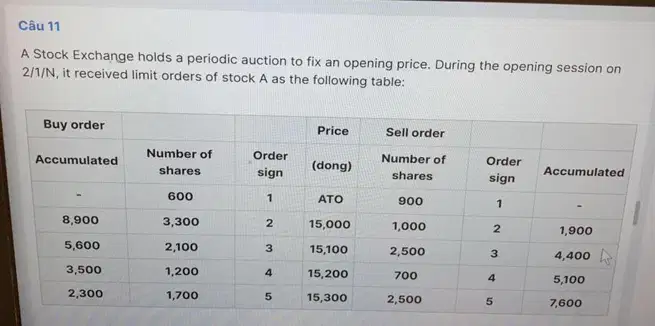
Determine the sell order executed based on the given table.
1, 2, 3
1, 2, 3, 4
1, 5, 4, 3
1, 2, 3, 4, 5
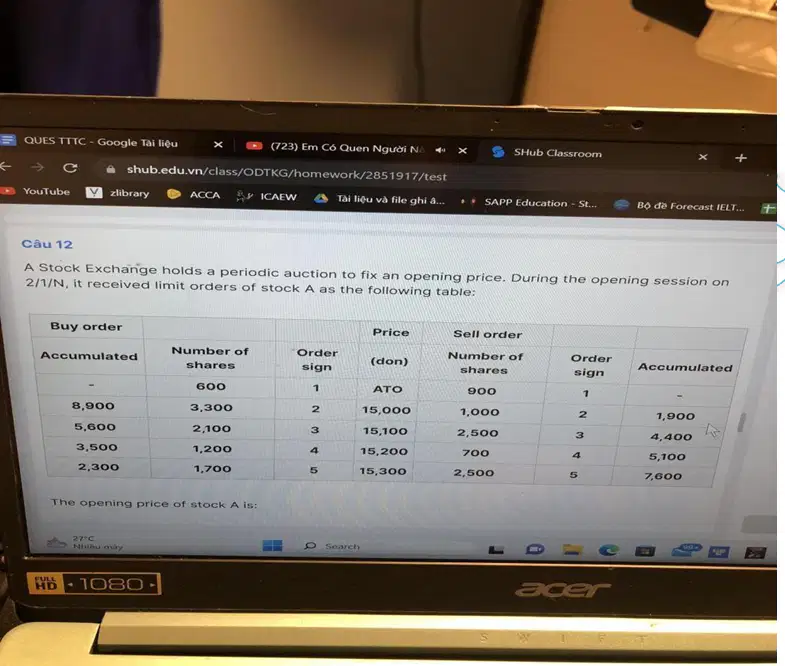
A Stock Exchange holds a periodic auction to fix an opening price. During the opening session on 2/1/N, it received limit orders of stock A as shown in the table. What is the opening price of stock A?
15,100 dong
15,000 dong
15,200 dong
15,300 dong
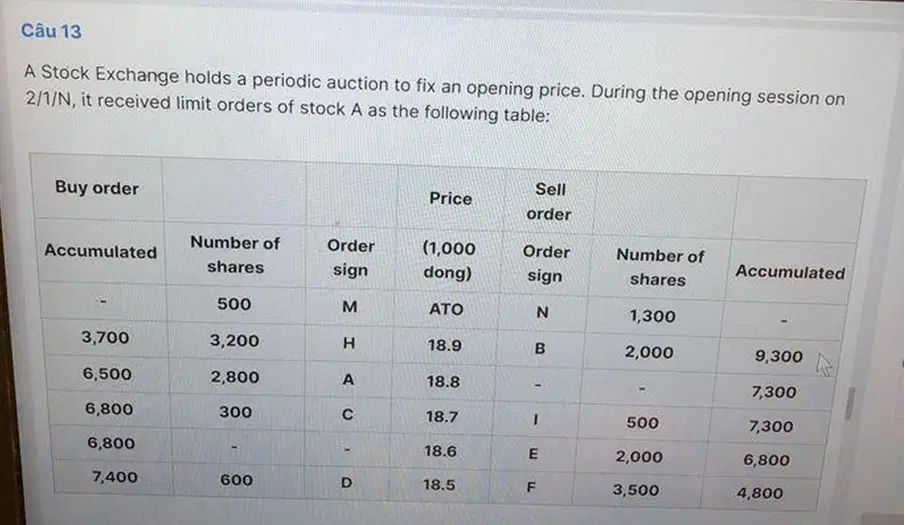
Assuming that the prior closing price is 18.7, determine the transaction value of this session.
127,160 (1,000 dong)
137,240 (1,000 dong)
126,480 (1,000 dong)
125,800 (1,000 dong)
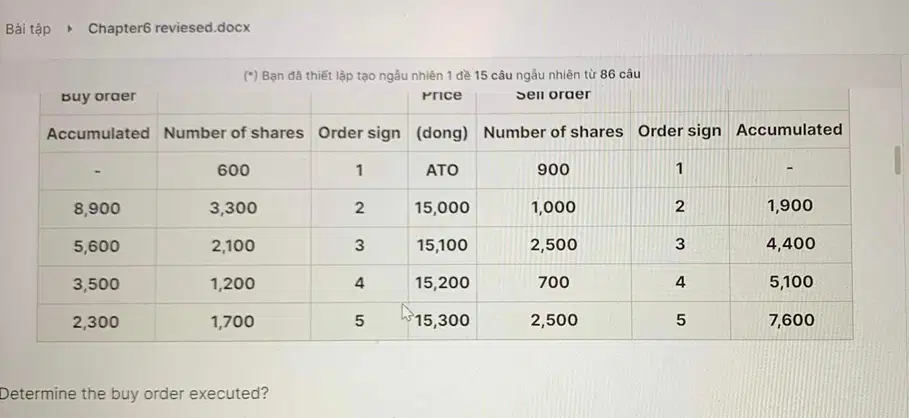
Determine the buy order executed based on the given buy and sell order table.
1,5,4,3 (partly)
1,5,4,3
1,2,3,4
1,2,3,4,5
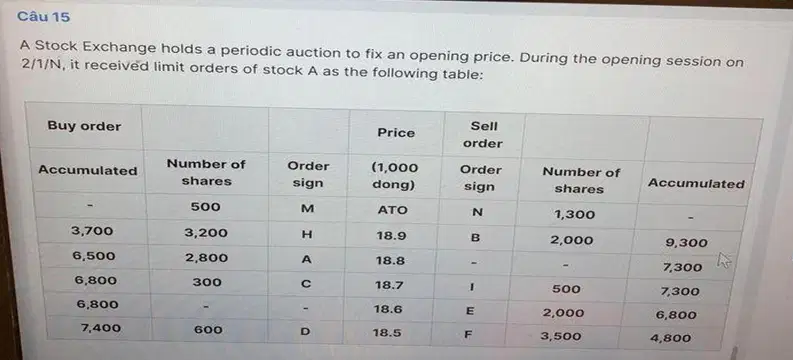
Assuming that the prior closing price is 18.7.
Mr. Nam places an order to buy 100 shares of stock at a price of 18,900 VND. Can he buy the stock? If he can buy the stock, determine the amount of money that Mr. Nam has to pay. Suppose that the brokerage fee is 0.2% on the transaction value.
No, he cannot sell any share of stock
Yes, he can sell entirely. The amount of money that he can receive: 1,873.74 dong
Yes, he can sell entirely. The amount of money that he can receive: 1,893,780 dong
Yes, he can sell entirely. The amount of money that he can receive: 1,870,000 dong
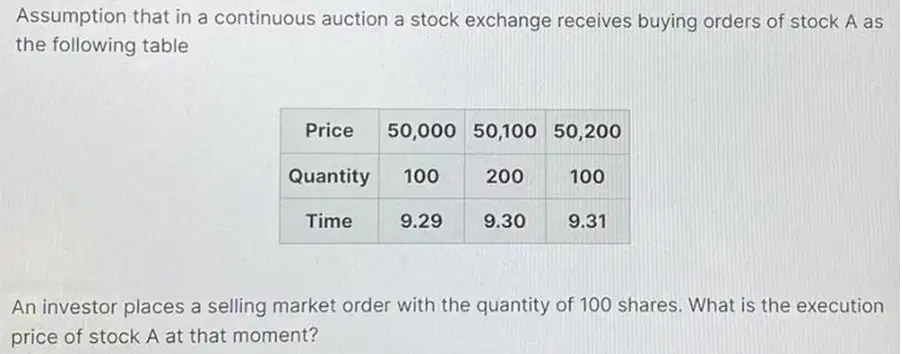
An investor places a selling market order with the quantity of 100 shares. What is the execution price of stock A at that moment?
50,000 VND
50,100 VND
50,200 VND
50,300 VND
Which sentence is true for a limit order?
It is not guaranteed to execute
The investor may miss out on the trading opportunity
It can be placed to avoid the danger of unexpected price can be changed
All of the above
Trading unit in Ho Chi Minh city Stock Exchange (HOSE) is
100 shares of stock
10 shares of stock
1000 VND
100 VND
Which of the following statements is false for OTC market?
There is no physical trading floor
It is carried out by market makers
OTC stocks are non-listed stocks
The trading securities are often stocks big and reputable companies
Price spread of Hanoi Stock Exchange (HNX) is
+/- 7%
+/- 10%
+/- 15%
+/- 20%
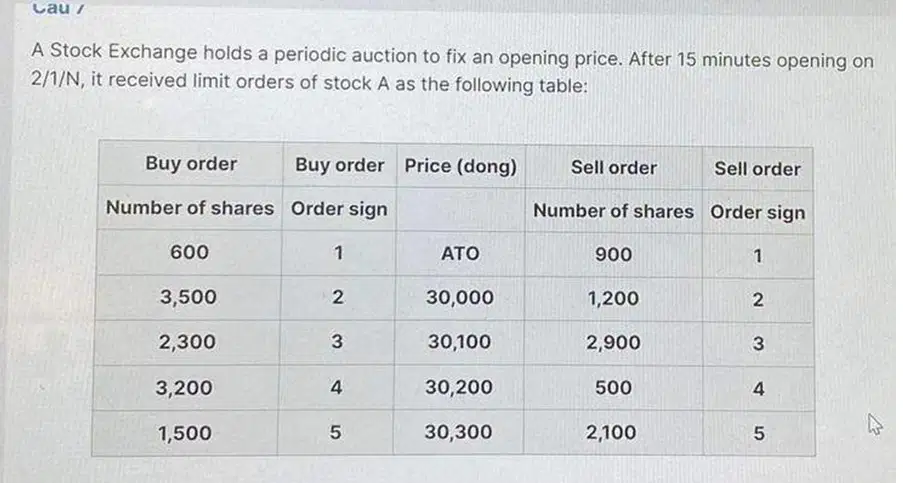
Determine the listed price of stock A?
30,000 đồng
30,100 đồng
30,200 đồng
30,300 đồng
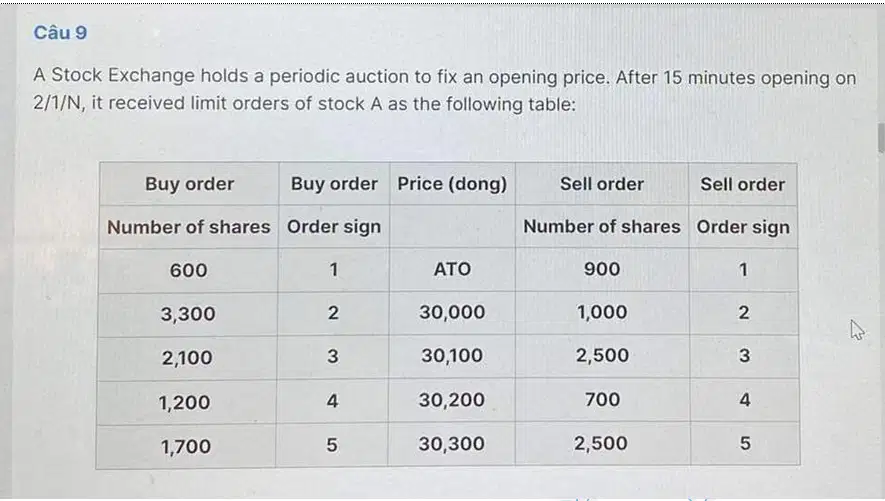
Determine the listed price of stock A?
30,000 dong
30,100 dong
30,200 dong
30,300 dong
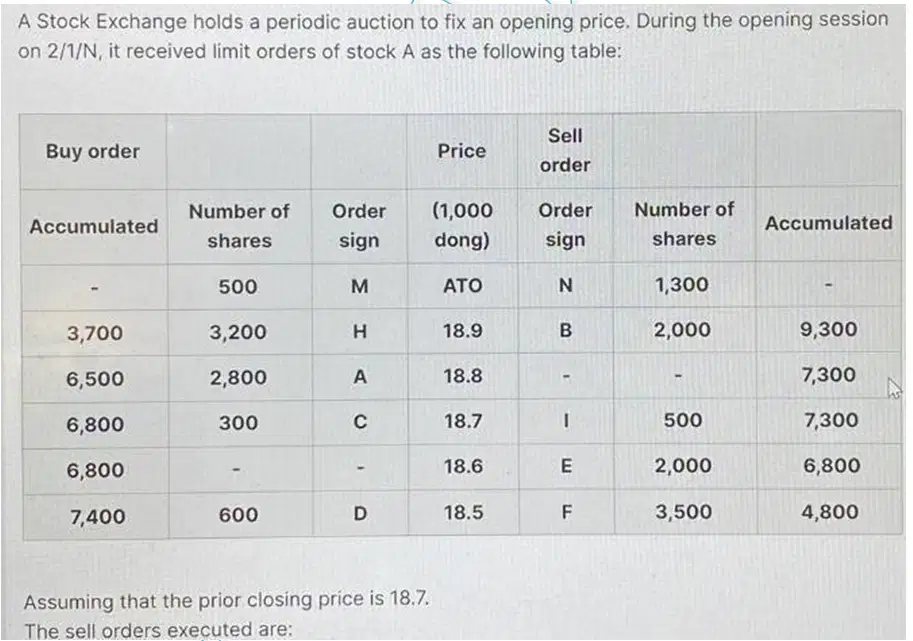
Assuming that the prior closing price is 18.7, which sell orders are executed?
N, F, E, I
N, B, I, E
N, F, E
N, B, I, E, F
Which is not true for market placement?
It can be executed immediately
It is riskier than limit order
It is used in periodic auction
It has priority over limit order in matching priority
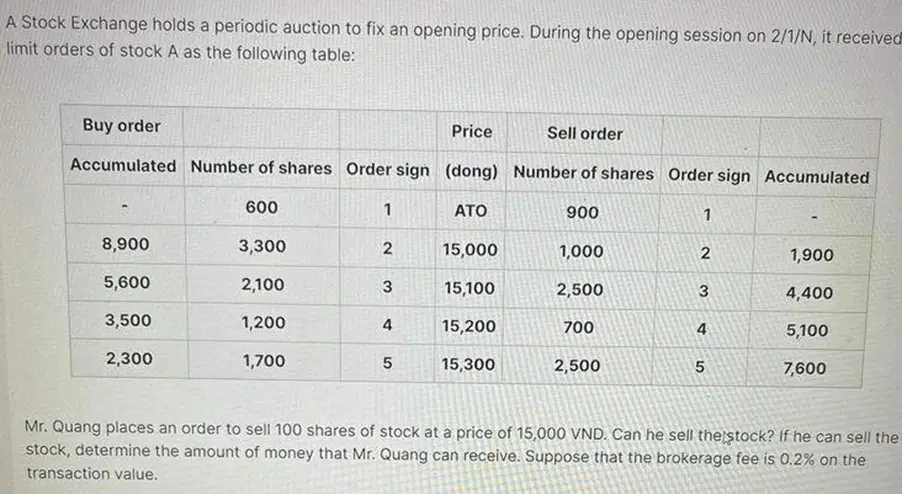
A Stock Exchange holds a periodic auction to fix an opening price. During the opening session, Mr. Quang places an order to sell 100 shares of stock at a price of 15,000 VND. Can he sell the stock? If he can sell the stock, determine the amount of money that Mr. Quang can receive, assuming the brokerage fee is 0.2% on the transaction value.
No, he cannot sell any share of stock
Yes, he can sell entirely. The amount of money that he can receive: 1,506,980 dong
Yes, he can sell entirely. The amount of money that he can receive: 1,500,000 dong
Yes, he can sell entirely. The amount of money that he can receive: 1,497,000 dong
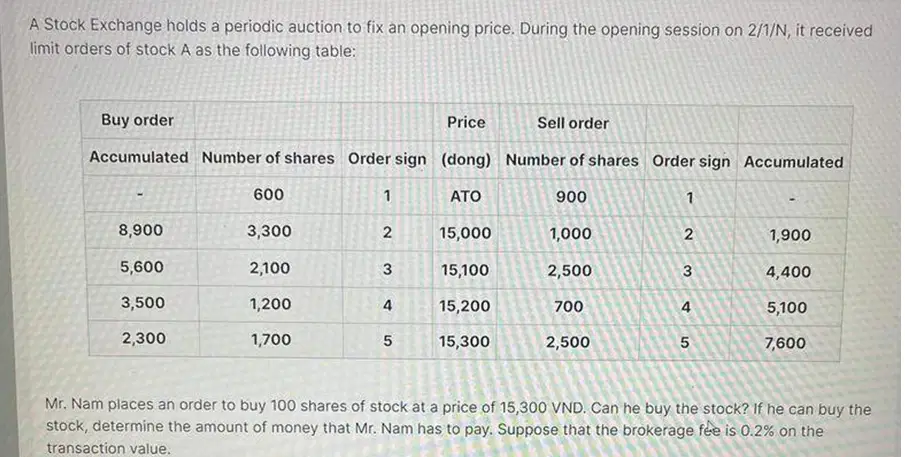
No, he cannot sell any share of stock
Yes, he can sell entirely. The amount of money that he has to pay: 1,513,020 dong
Yes, he can sell entirely. The amount of money that he can receive: 1,510,000 dong
Yes, he can sell entirely. The amount of money that he can receive: 1,533,060 dong
Which is the common point among ATO, ATC and MP?
They have priority over limit order in matching priority
They have priority after limit order in matching priority
They are all used in continuous auction
They are all used in periodic auction
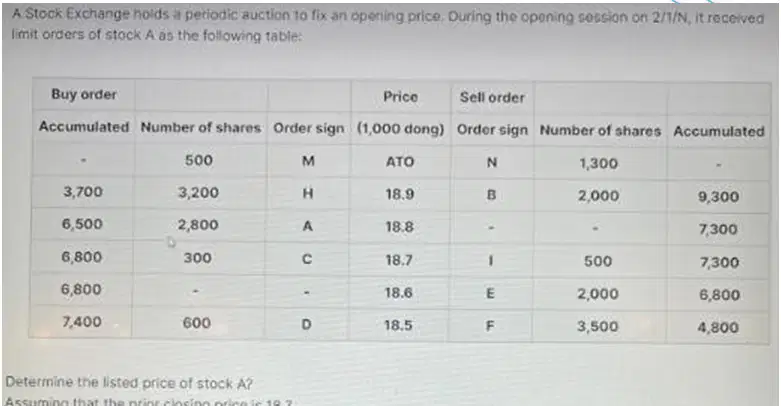
A Stock Exchange holds a periodic auction to fix an opening price. During the opening session on 2/1/N, it received limit orders of stock A as shown in the table. Determine the listed price of stock A, assuming that the prior closing price is 18.7.
18.7
18.6
18.5
18.8
______ is often the prior closing price.
Today listed price
Today opening price
Today reference price
Today executed price

