
Font size
 Worksheets
Heat, Temperature, Phases Practice
Total questions: 25
Worksheet time: 13mins
Which temperature represents the highest average kinetic energy of the particles in a sample of matter?
298 K
267 K
27°C
12°C
Which form of energy is associated with the random motion of the particles in a sample of water?
chemical energy
electrical energy
nuclear energy
thermal energy
Explanation: Thermal energy is the energy that comes from the random motion of particles within a substance. In a sample of water, the particles (molecules) are constantly moving, and this movement is what we refer to as thermal energy. The faster the particles move, the higher the temperature and the more thermal energy the sample has.
The temperature of a sample of matter is a measure of the
average potential energy of the particles of the sample
average kinetic energy of the particles of the sample
total nuclear energy of the sample
total thermal energy of the sample
Which sample of copper has atoms with the lowest average kinetic energy?
10. g at 45°C
20. g at 35°C
30. g at 25°C
40. g at 15°C
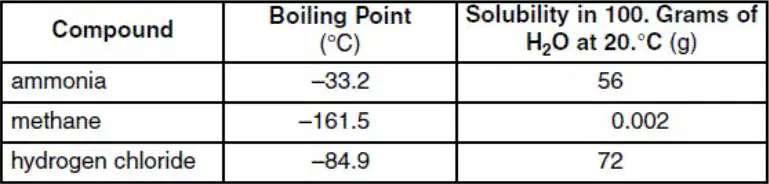
Convert the boiling point of hydrogen chloride at standard pressure to kelvin.
Answer Explanation:
The boiling point of hydrogen chloride is given as -84.9°C. To convert Celsius to Kelvin, use the formula: K = °C + 273.15
So, K = -84.9 + 273.15 = 188.25 K. Rounded to the nearest whole number, this is 188 K.
(a)
Solid X is placed in contact with solid Y. Heat will flow spontaneously from X to Y when
X is 20°C and Y is 20°C
Explanation: No heat will flow because both solids are at the same temperature; there is no temperature difference to drive heat transfer.
X is 10°C and Y is 5°C
Explanation: Heat always flows spontaneously from a region of higher temperature to a region of lower temperature. Since X (10°C) is warmer than Y (5°C), heat will flow from X to Y.
X is -25°C and Y is -10°C
Explanation: Even though the temperatures are negative, -10°C is warmer than -25°C. Heat would flow from Y to X, not from X to Y.
X is 25°C and Y is 30°C
Explanation: X is cooler than Y, so heat would flow from Y to X, not from X to Y.
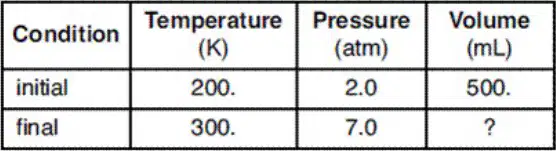
The final temperature of the helium gas sample in degrees Celsius is (a) .
Answer Explanation:
From the table, the final temperature is given as 300 K. To convert this to degrees Celsius, use the formula:
°C = K - 273
So, 300 K - 273 = 27°C.
Therefore, the final temperature of the helium gas sample in degrees Celsius is 27°C.
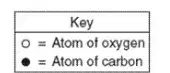
Which particle diagram represents a sample containing the compound CO(g)?

First diagram

Second diagram

Third diagram

Fourth diagram
In which 1.0-gram sample are the particles arranged in a crystal structure?
CaCl₂(s)
C₂H₆(g)
CH₃OH(ℓ)
CaI₂(aq)
Which sample is most likely to take the shape and total volume of its container?
CO2(g)
CO2(ℓ)
CO2(aq)
CO2(s)
Which sample of CO2 has a definite shape and a definite volume?
CO2(aq)
CO2(g)
CO2(ℓ)
CO2(s)
When ice, H2O(s), melts at 0°C, entropy increases because the
average kinetic energy of the particles increases
average kinetic energy of the particles decreases
particle arrangement is more random
particle arrangement is less random
At STP, fluorine is a gas and iodine is a solid. This observation can be explained by the fact that fluorine has
weaker intermolecular forces of attraction than iodine
Explanation: Fluorine molecules (F2) are much smaller and lighter than iodine molecules (I2), resulting in weaker London dispersion forces between fluorine molecules. This means fluorine remains a gas at STP, while iodine, with stronger intermolecular forces, is a solid.
stronger intermolecular forces of attraction than iodine
Explanation: This is incorrect. If fluorine had stronger intermolecular forces than iodine, it would be a solid or liquid at STP, not a gas.
lower average kinetic energy than iodine
Explanation: At the same temperature (STP), all gases and solids have the same average kinetic energy per molecule, so this does not explain the difference in physical state.
higher average kinetic energy than iodine
Explanation: The average kinetic energy depends on temperature, not the substance. Both are at STP, so this is not the reason for the difference in state.
Which phase change results in an increase in entropy?
I2(g) → I2(s)
Explanation: This is a gas to solid transition (deposition), which decreases entropy because the particles become more ordered.
CH4(g) → CH4(l)
Explanation: This is a gas to liquid transition (condensation), which also decreases entropy as the particles become less free to move.
Br2(l) → Br2(g)
Explanation: This is a liquid to gas transition (vaporization), which increases entropy because the particles become more disordered and have greater freedom of movement.
H2O(l) → H2O(s)
Explanation: This is a liquid to solid transition (freezing), which decreases entropy as the particles become more ordered.
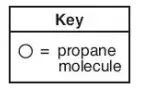
At standard pressure, the boiling point of propane is 231 K. Which particle diagram correctly represents the phase of the propane as it leaves the tank at 294 K?

diagram 1
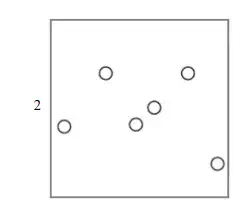
diagram 2
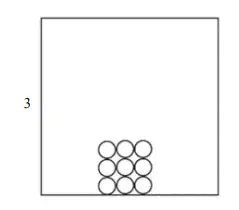
diagram 3
In which material are the particles arranged in a regular geometric pattern?
CO2(g)
NaCl(aq)
H2O(l)
C12H22O11(s)
Which conditions of pressure and temperature exist where ice melts at its normal melting point?
1 atm and 0°C
760 atm and 0°C
1 atm and 0 K
760 atm and 273 K
Which change results in a release of energy?
the melting of H2O(s)
the boiling of water (l)
the evaporation of H2O(l)
the condensation of H2O(g)
During which change is energy absorbed?
the melting of ice
the cooling of ice
the freezing of water
the condensation of water
Which is the first phase change that is most likely to occur as the pressure on nitrogen gas is increased and the temperature is decreased?
evaporation
condensation
crystallization
solidification
The melting of sodium is accompanied by the
destruction of energy
creation of energy
absorption of energy
release of energy
Which substance will sublime at 298 K?
CO2(s)
Al(s)
Si(s)
KOH(s)
Which phase change represents sublimation?
Answer Explanation: Sublimation is the process where a substance changes directly from a solid to a gas without passing through the liquid phase. An example is dry ice (solid carbon dioxide) turning directly into carbon dioxide gas.
solid to gas
solid to liquid
gas to solid
gas to liquid
Which phase change is an exothermic process?
CO2(s) → CO2(g)
Explanation: This is sublimation, which requires energy input (endothermic).
NH3(g) → NH3(l)
Explanation: This is condensation, where a gas turns into a liquid and releases energy (exothermic process).
Cu(s) → Cu(l)
Explanation: This is melting, which requires energy input (endothermic).
Hg(l) → Hg(g)
Explanation: This is vaporization, which requires energy input (endothermic).
Which phase change is endothermic?
H2O(l) → H2O(g)
Explanation: This is the process of vaporization (liquid to gas), which requires energy to overcome intermolecular forces. Therefore, it is an endothermic process.
I2(g) → I2(s)
Explanation: This is deposition (gas to solid), which releases energy, making it an exothermic process.
Hg(l) → Hg(s)
Explanation: This is freezing (liquid to solid), which releases energy, so it is exothermic.
H2S(g) → H2S(l)
Explanation: This is condensation (gas to liquid), which also releases energy, making it exothermic.

