
Font size
 Worksheets
Manifest Destiny and Westward Expansion
Total questions: 3
Worksheet time: 6mins
Manifest Destiny
John Louis O'Sullivan: (1813-1895) was an American editor who coined the phrase “Manifest Destiny” in 1845 to promote the annexation of Texas and the acquisition of the Oregon territory. Although called into name in 1845, manifest destiny was a widely held but vaguely defined belief that dated back to the founding of the nation. First, many Americans believed that the strength of American values and institutions justified moral claims to hemispheric leadership. Second, the lands on the North American continent west of the Mississippi River (and later into the Caribbean) were destined for American-led political and agricultural improvement. Third, God and the Constitution ordained an irrepressible destiny to accomplish redemption and democratization throughout the world. All three of these claims pushed many Americans, whether they uttered the words manifest destiny or not, to actively seek the expansion of democracy.
The Young America movement, strongest among members of the Democratic Party but spanning the political spectrum, downplayed divisions over slavery and ethnicity by embracing national unity and emphasizing American exceptionalism, territorial expansion, democratic participation, and economic interdependence.
However, many Americans, including famed poet Ralph Waldo Emerson & future president Abraham Lincoln disapproved of aggressive expansion. For opponents of manifest destiny, the lofty rhetoric of the Young Americans was nothing other than a kind of imperialism that the American Revolution was supposed to have repudiated. Many members of the Whig Party (and later the Republican Party) argued that the United States’ mission was to lead by example, not by conquest
Along the way, Americans battled both native peoples and foreign nations, claiming territory to the very edges of the continent. But westward expansion did not come without a cost. It exacerbated the slavery question, pushed Americans toward civil war, and, ultimately, threatened the very mission of American democracy it was designed to aid.
Who coined the phrase 'Manifest Destiny' in 1845?
John Louis O'Sullivan
Ralph Waldo Emerson
Abraham Lincoln
Thomas Jefferson
What was the main belief behind the concept of Manifest Destiny?
American values justified moral claims to expansion
It was a call for isolationism
It promoted peace with native peoples
It was a movement against territorial expansion
Which group downplayed sectional differences by embracing nationalism and emphasizing American exceptionalism, territorial expansion, democratic participation, and economic interdependence?
Young America movement
Whig Party
Republican Party
Federalist Party
What was a major consequence of westward expansion according to the passage?
It exacerbated the slavery question
It resolved the slavery question
It led to immediate peace with native peoples
It strengthened the mission of American democracy
Who were some notable opponents of Manifest Destiny mentioned in the passage?
Ralph Waldo Emerson and Abraham Lincoln
John Louis O'Sullivan and Thomas Jefferson
Andrew Jackson and James K. Polk
George Washington and John Adams
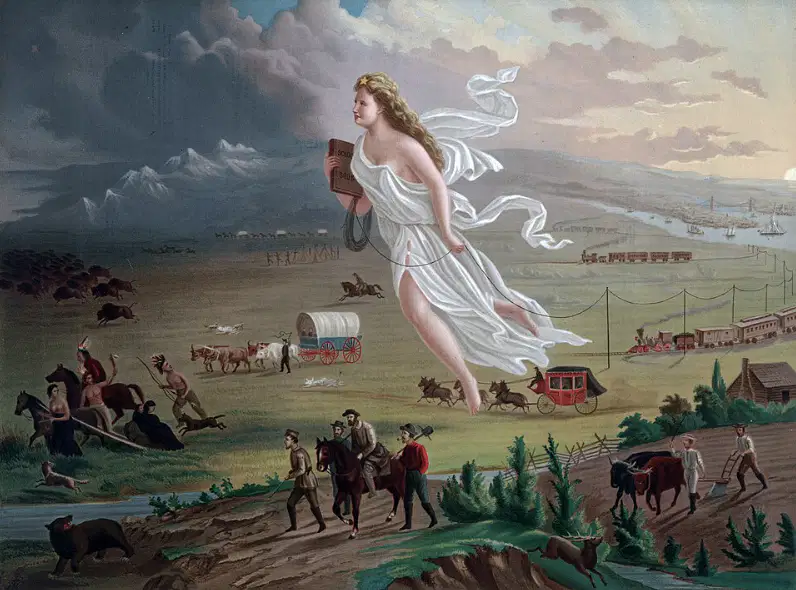
Pictured here is an 1872 painting titled "American Progress." How does the painting embody the idea of Manifest Destiny?
The painting depicts a peaceful coexistence between settlers and Native Americans.
The painting shows the westward expansion of settlers as a divine mission to spread civilization.
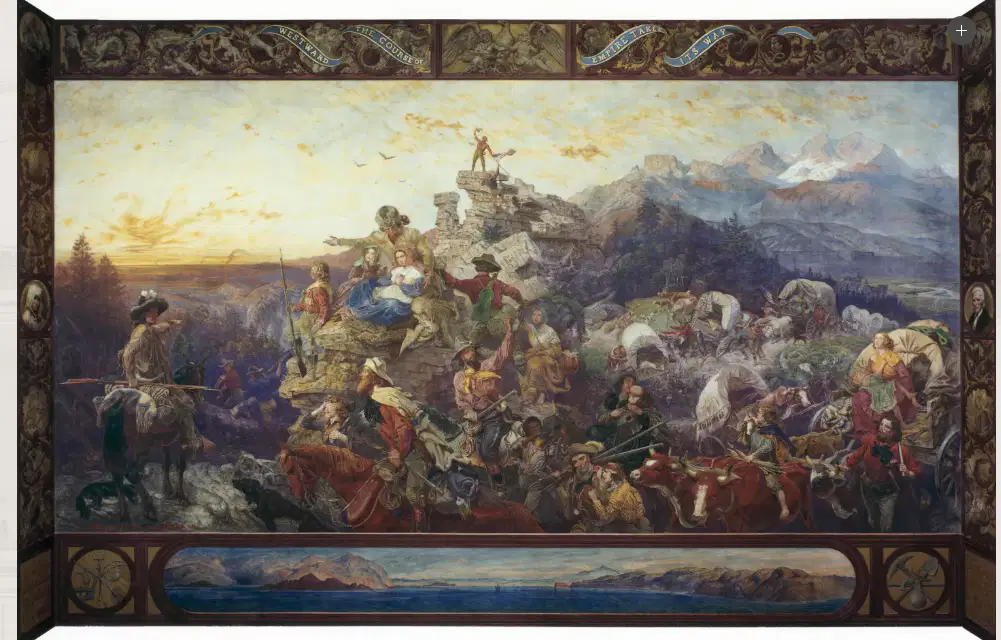
Pictured here is the 1861-1862 painting, "Westward the Course of Empire Takes Its Way." How does this represent the concept of Manifest Destiny?
It shows the westward expansion of settlers.

