
 Worksheets
Bio 2 Review 1
Total questions: 12
Worksheet time: 6mins
All organisms contain DNA, and every organism's DNA is made of the same four nucleotides. The differences between organisms is simply based on the order of these nucleotides. Since all organisms have the same basic, universal structure for DNA, which of these must also be universal?
All organisms have the same proteins
All living things must have the same amount of DNA
All organisms must be genetically identical to each other
All codons in all organisms' DNA code for the same amino acids
What determines the code, or information, of a DNA molecule?
The structure of the nitrogen bases
The size of the nitrogen bases
The number of nitrogen bases
The sequence of the nitrogen bases

A DNA nucleotide is shown. Four different parts are labeled.
Which part of the nucleotide is responsible for the coding of specific proteins and traits?
Part 3
Part 4
Part 2
Part 1
Given the sequence of DNA nucleotide bases TTAGCCTTG, give the complementary strand of mRNA produced during transcription.
AAAAAAAHH
AAGGUAGUA
AAUCGGAAC
AAUTGCCTA
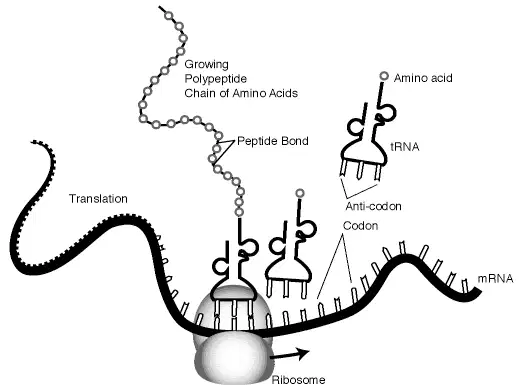
Translation and protein synthesis are taking place at the ribosome in this illustration. Where did the original instructions for this process originate?
RNA in nucleus
DNA in nucleus
tRNA in cytoplasm
mRNA attached to ribosome

What type of biomolecule will be produced at the end of the process shown in the illustration?
a fat
a sugar
a lipid
a protein
All organisms undergo protein synthesis. The first step of protein synthesis, in which a DNA strand is used to make a complementary mRNA strand, is called
messaging
replication
transcription
translation
What type of RNA acts like a delivery truck, delivers amino acids to the ribosome for protein synthesis, and then leaves empty again, to go collect another amino acid?
Transfer RNA
Messenger RNA
Ribosomal RNA
Mitochondrial RNA
Which is an accurate description of the processes used to turn the DNA code of a gene into a protein?
Transfer RNA molecules carry the messenger RNA to the ribosome.
Ribosomes go into the nucleus to read off the genes in the DNA.
It takes one DNA base to code for three amino acids in a protein.
Transfer RNA delivers specific amino acids to the ribosome, matching messenger RNA codons
The process of meiosis is essential in the sexual reproduction and life cycle of many organisms. The outcome of meiosis is haploid gametes. Which statements correctly describe the importance of meiosis to the life cycle of these organisms? (Choose 3)
Increasing genetic diversity ensures that no two haploid gametes are exactly the same
Taking a diploid cell to its haploid state occurs during the first cell division of meiosis
Checkpoints during meiosis ensure that chromosome separation occurs accurately, avoiding non-disjunction
DNA synthesis occurs before each cell division in meiosis ensures that the integrity of the chromosomes is maintained
Reducing the number of chromosomes by one-fourth during meiosis ensures the chromosome number is maintained during fertilization
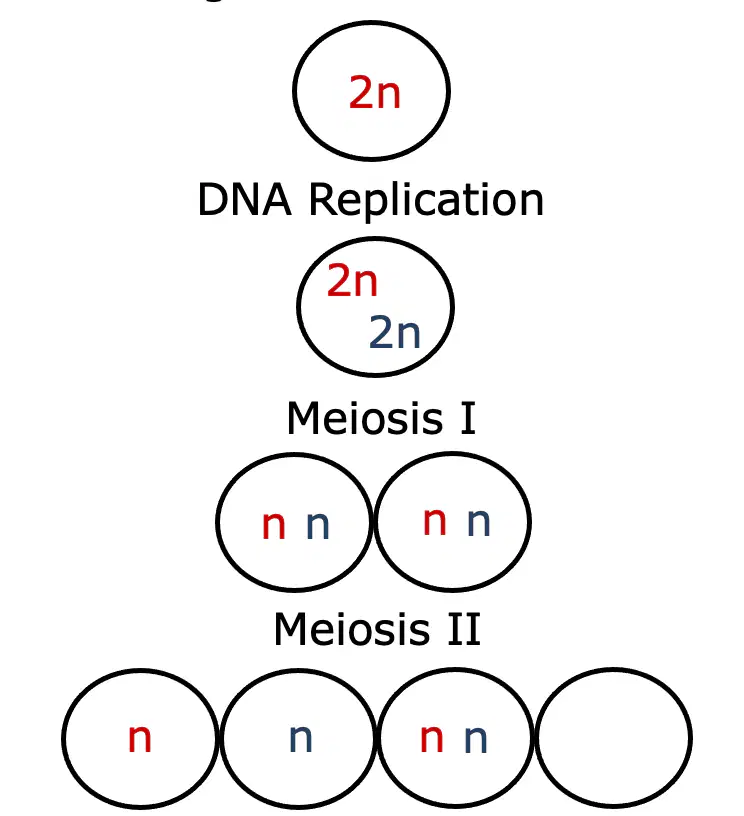
The function of meiosis is to produce gametes: eggs or sperm. During meiosis, a diploid (2N) mother cell undergoes two meiotic divisions to produce four haploid (N) daughter cells. Chromosome number is restored to 2N during fertilization. Consider the abbreviated model of meiosis. In this example, an error has taken place. Describe and name this error.
Nondisjunction of sister chromatids during meiosis II. Sister chromatids fail to separate
Translocation of sister chromatids during meiosis II. One chromatid is translocated into the incorrect cell
Separation mutation during meiosis I. Resulting gametes in meiosis II have incorrect chromosome number at end of meiosis
Replication error during meiosis I. Results of mutation show during meiosis II as incorrect chromosome number in two gametes
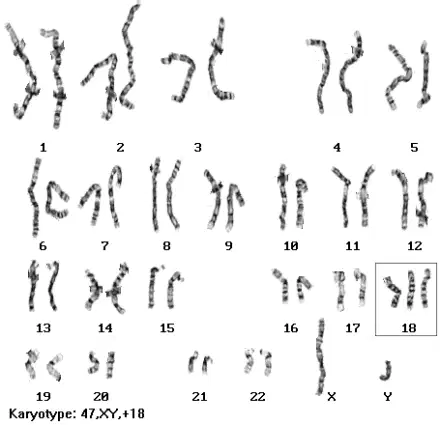
The incidence of Edward's Syndrome is estimated to be one in 3,000 live births and this increases as the mother's age increases. The syndrome has a very low rate of survival, resulting from heart abnormalities, kidney malformations, and other internal organ disorders. Based on the karyotype, what would be another name for Edward's Syndrome?
Trisomy X
Trisomy 18
Monosomy Y
Polyploidy 18

