
 Worksheets
Bone Disorders
Total questions: 28
Worksheet time: 14mins
A fracture is a "______" or "deformity" to the bone. Fill in the blank.
Fractured
Broken
Comminuted
Inflamed
Most fractures occur as a result of ______. Fill in the blank.
trauma
exercise
meditation
fasting
Which of the following diseases can cause fractures or deformities?
Cancer
Osteoporosis
Both A and B
None of the above
Fractures can be classified as:
Simple
Displaced
Non displaced
Open (compound)
All of the above
Simple, displaced, or non-displaced fractures do not rupture the skin.
True
False
Open fractures cause a rupture to the ______ or soft tissue. Fill in the blank.
skin
bone
muscle
cartilage
Open fractures must be treated with extreme importance to prevent complications such as ______. Fill in the blank.
infection
fracture healing
muscle gain
increased bone density
What type of fracture is described as the bone being crushed and/or shattered?
Compression
Colles
Comminuted
Greenstick
What type of fracture is described as the fractured area of bone collapsing on itself?
Compression
Colles
Comminuted
Spiral
What type of fracture is described as the break of the distal end of the radius at the epiphysis, often occurring when the patient has attempted to break his or her fall?
Compression
Colles
Comminuted
Transverse
Which type of fracture is described as 'the bone is broken and pierces an internal organ'?
Complicated
Impacted/Buckle
Hairline
Which type of fracture is described as 'the bone is broken, and the ends are driven into each other'?
Complicated
Impacted/Buckle
Hairline
Which type of fracture is described as 'a minor fracture not always appears, but as a thin line on x-ray and may not extend completely through the bone'?
Complicated
Impacted/Buckle
Hairline
What is a Greenstick fracture?
The bone is completely broken into two or more pieces
The bone is partially bent and partially broken; this is a common fracture in children because their bones are still soft.
Any fracture occurring spontaneously as a result of disease
A fracture of the epiphyseal plate in children.
What type of fracture occurs spontaneously as a result of disease?
Greenstick
Pathologic
Salter-Harris
Compound
A fracture of the epiphyseal plate in children is called _________.
Salter-Harris
Greenstick fracture
Comminuted fracture
Colles' fracture
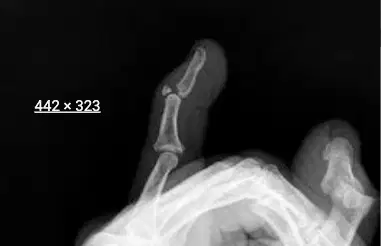
What is the name of this fracture?
Boxer Fracture
Colles Fracture
Galeazzi Fracture
Avulsion Fracture
What is the name of the fracture that involves a fragment of bone being pulled off by a tendon?
Avulsion Fracture
Greenstick Fracture
Comminuted Fracture
Transverse Fracture
What is the name of the fracture that occurs in the foot ?
Jones Fracture
Colles Fracture
Smith's Fracture
Boxer Fracture
What is the term for a fracture where the bone cracks either part or all of the way through, but maintains its proper alignment?
Non-displaced fracture
Displaced fracture
Comminuted fracture
Greenstick fracture
What is the term for a fracture where the bone fragments are not in their normal positions?
Displaced
Impacted
Greenstick
Comminuted
Which disease affects the bones and joints as well as other body systems?
Rheumatoid arthritis
Asthma
Diabetes mellitus
Conjunctivitis
Which degenerative joint disease seems to occur in obese patients or patients who may have suffered some type of joint trauma?
Osteoarthritis
Rheumatoid arthritis
Gout
Ankylosing spondylitis
Which disease typically affects only one joint and is characterized by crystal deposits in and around the affected point?
Gout
Rheumatoid arthritis
Osteoarthritis
Systemic lupus erythematosus
Which disease is seen in elderly women and is common in those patients who have been confined to bed for a long period of time?
Osteoporosis
Rheumatoid arthritis
Asthma
Diabetes mellitus
Which disease affects children who do not have enough Vitamin D and eventually causes the bones not to harden, resulting in deformities and bending of the bones?
Rickets
Scurvy
Kwashiorkor
Marasmus
Which disease is an inflammatory condition of the bursa?
Bursitis
Tendinitis
Arthritis
Osteoporosis
Which disease is characterized by a side-to-side curvature of the spine?
Scoliosis
Osteoporosis
Arthritis
Kyphosis

