
 Worksheets
Freshman Studies - Midterm Exam
Total questions: 40
Worksheet time: 20mins

In the goal: “I will complete one section of my English project every night to finish it by October 21st.”, what makes the goal time-bound?
Completing one section of the project every night
Finishing the project
October 21
English project
It is important for SMART goals to be realistic because:
it increases the likelihood of achieving them.
it makes them more difficult to accomplish.
it ensures they are vague and broad.
it allows for unlimited resources.
Which of the following is the most appropriate email greeting to your teacher?
Hey Ms.
Yo, Ms S
Dear Ms. Slothower
Sup Sloth
Below is the body of an email from a student to Ms. Slothower. Which of the given answers would be the best way to correct it?
“You gave me an F for my project outline but I already handed it in. When are you going to change my grade?”
Hey, I think you messed up my grade. When will you fix it?
Yo, I turned that paper in. Fix my grade ASAP.
I turned in my outline paper last week, but my grade still shows an F. Could you look into this for me when you have a chance? Thank you.
I need my grade fixed. I turned in my outline paper and shouldn’t have an F.
Which of the following should you not include in a school email?
slang or text language
correct spelling and grammar
a clear question or concern
a polite closing
What is the best subject line for an email to your teacher about the project?
HELP
Ms. Slothower, I need help on the Life of Pi project. I am not sure what I am supposed to do. Please let me know. Thanks.
Question about Life of Pi Project
Project
Why is it important to use proper grammar in an email?
Teachers like it.
Grammar isn’t important in emails.
It takes less time to write.
It makes you sound more professional and respectful.

What time is it?
9:45
9:35
8:45
8:30
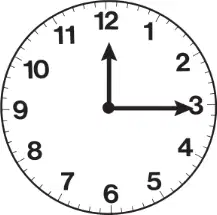
What time is it?
3:00
12:15
12:03
3:30
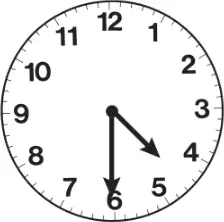
What time is it?
half past four
half past five
half past six
half past two
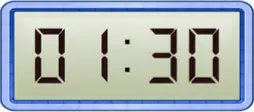
How can you write this time using words?
It's ten-thirty.
It's three after one.
It's one-thirty
The hour is one.
You set up an after school meeting with a classmate to work on your project and will meet at the library at 3:30 PM. You need to arrive 5 minutes early to claim a table and it is a 40 minute walk from your house. When should you leave to arrive on time?
2:30 PM
2:45 PM
2:50 PM
3:00 PM
Which of the following is the best example of self-advocacy?
Staying quiet when you’re confused
Complaining to a friend but not the teacher
Ignoring the assignment
Politely asking your teacher to explain the directions again
Who is self-advocacy for?
Only students with IEPs
Only low-income students
All students
Only students who are failing
A good self-advocate in class who is confused about a part of their assignment would most likely:
Ask the teacher or a classmate for help to understand the confusing part.
Ignore the confusion and hope to figure it out later.
Copy someone else's work without asking questions.
Leave the project incomplete because it is confusing.
A good self-advocate in a group project where a member is not doing their part would:
Talk to the group member and express their concerns respectfully.
Ignore the problem and hope it gets better.
Do all the work themselves without saying anything.
Complain to the teacher without trying to solve it first.
"Good morning," is an example of a _________.
Greeting
Signature
Closing
Subject

What time does the clock show?
(a)

What time does the clock show?
(a)
Lucy got to school at 10:15. School started at 8:30. How late was Lucy to school? (a)

Match the following terms to the definitions:
Good afternoon, Mrs. Jones.
Formal Greeting
Respectfully,
Rose Tyler
Formal Closing
Test Corrections
Subject
As you requested, I have completed the test corrections for the Unit I test. Please let me know if you need anything further.
Email Body
Which of the following is the most effective way to ask your teacher for an extension on an assignment?
Complain to your classmates about the due date.
Ignore the deadline and turn it in late without explanation.
Wait until the last minute and demand more time.
Politely explain your situation and request an extension in advance.
Which of the following is a SMART goal?
Math is hard, but I’ll try my best.
I hope to study more this year.
I will complete all my math homework on time for the next month to improve my grade by one letter.
I want to get better at math someday.
What is one benefit of setting specific and measurable goals for your schoolwork?
It makes your goals more confusing.
It helps you know exactly what you need to achieve.
It allows you to skip planning.
It encourages you to procrastinate.
If your class starts at 10:20 AM and lasts for 1 hour and 35 minutes, what time does it end?
12:05 PM
11:55 AM
12:00 PM
11:45 AM
Which of the following is the most appropriate closing for a formal email to your teacher?
Bye!
Sincerely, Jordan Smith
Later!
See ya!
What does the 'S' in SMART goal stand for?
Specific
Static
Sassy
Simple
What does the 'M' in SMART goal stand for?
Materialistic
Measurable
Metric
Monumental
What does the 'A' in SMART goal stand for?
Attainable
Amiable
Ambiguous
Ambitious
What does the 'R' in SMART goal stand for?
Regal
Realistic
Relevant
Relative
What does the 'T' in SMART goal stand for?
True
Traumatic
Try
Time-bound
Is this an example of a SMART goal?
"I will read twenty books by the end of the school year."
Yes
No
Is this an example of a SMART goal?
"I will graduate college with a bachelor’s degree in computer science in 2028."
Yes
No
Is this an example of a SMART goal?
"I will make one million dollars $$$."
Yes
No
Which of the following is NOT an example of self-advocacy?
Telling the teacher “I need a calculator for my math test.”
Highlighting my notes will help me understand the material.
Laying my head down on my desk when I don’t understand a math problem.
Recording the teacher’s lecture to make sure I get all the notes
You are confused about how to complete the daily assignment. Which of the following self-advocacy skill would help best in this situation?
Email your teacher asking to meet to work on it together
Call your counselor and ask them to put you in a new class.
Call a friend and ask them if they know.
Stop for now and come back to it later.
A person's self-advocacy abilities will influence...
their independence.
their relationships.
their success in school & the workplace.
All of the above.
The self-advocacy skill of asking questions is important for...
learning.
clarifying information.
gaining an understanding.
All of the above.
Self-advocacy is a skill, which means that...
it can't be learned.
only adults can learn this skill.
it can be learned and strengthened.
an expert must teach it to students.

