
 Worksheets
Unit 1 Review (7th Grade World History)
Total questions: 112
Worksheet time: 1hrs 11mins
As Muslims conquered new territories, they strived to maintain peaceful relationships with the people of these new territories. This is an example of a _________ impact.
geographic
social
political
economic
The expansion of Islam led to increased trade between Asia, Europe, and Africa.
This is an example of a __________ impact.
political
social
geographic
economic
As Muslims expanded from Arabia into new regions, they would have to adapt to new environments and would have access to more resources.
This is an example of a ___________ impact.
political
social
geographic
economic
As their empire grew, the Muslims had to rule over more people and make changes to the ways they ruled.
This is an example of a __________ impact.
political
social
geographic
economic
How did trade help Islam spread?
Muslim traders shared their beliefs with people in far away lands.
Islam was only spread through wars of conquest.
Muslims wrote letters to people and sent them with invading armies to convince them to convert.
Muslim traders included a copy of the Qu'ran with each sale.
How did Muslims treat people of other religions in the lands they conquered?
They persecuted people of other religions.
The adopted the religions of people they conquered.
They forced people to change religions in the lands they conquered.
They tolerated the religions of other people.
The title given to Muhammad's successors was:
Caesar
Caliper
Caliph
Bailiff
Which of these regions had Islam spread to by 720 A.D.? Multiple answers
Egypt
North Africa
Persia
Eastern Europe
How did the Muslims preserve the work of early Greek philosophers?
They translated their writings into Arabic and kept them in libraries
They buried them in underground vaults
They translated their writings into Arabic and then burned the originals
They traded them to scholars from India to be kept in libraries
Why were the Islamic lands ideally suited for spreading cultural elements to other places?
Muslim people were always on the move and never established permanent settlements.
All the people there spoke English, so they could share ideas with people from Asia, Europe, and Africa.
Many important trade routes linking Asia, Europe, and Africa met in the Middle East.
The isolated location of the Islamic lands protected them from outside influences.
Which would you NOT expect to see in Islamic art?
geometric patterns
vivid colors
human or animal figures
floral patterns
Hajj is a pilgrimage to the city of
Mecca
Medina
Massapequa
Mesopotamia
According to the Five Pillars, Muslims must fast from sunrise to sunset during the month of _.
Shahadah
Al-Jabar
Ramadan
Salat
What is the Kaaba?
Most sacred Muslim shrine in Mecca
A type of Islamic art
The holy book of Islam
The month of fasting
What is the holy text of Islam?
Bible
Koran
Torah
Kaaba
What are the basic tenants (beliefs) of Islam?
The Eightfold Path
Four Noble Truths
Ten Commandments
Five Pillars of Faith
Where did Islam originate?
India
Roman Empire
Arabian Peninsula
Mesopotamia
What area of mathematics did Muslim scholars develop?
Fractions
Calculus
Algebra
Geometry
Muhammad was born in this city...
Yathrib
Medina
Jerusalem
Mecca
According to Muslim tradition, the Ka'bah located in Mecca is believed to have been built by ______________and Ishmael.
Joshua
Jesus
Abraham
Moses
At age 40, Muhammad was called to be a "Messenger of God" by...
Khadijah
Jesus
God
the angel Gabriel
a follower of the Islamic faith (means "one who submits to God")
Muslim
Islam
Qur'an
Hijrah
The belief and religion in one God spread by Muhammad is called...
Muslim
Islam
Qur'an
Hijrah
the holy book of Islam, which contains the revelations and scripture of Muhammad.
Muslim
Islam
Qur'an
Hijrah
is a holy (or sacred) month of the year for Muslims as it seen as the month in which Muhammad received the first words of the Qur'an.
Christmas
Ramadan
Makha Bucha
Lent
The 1st Pillar of Islam is called the ____________, which is when Muslims say, "There is only one God, and the prophet Muhammad is his messenger."
Shahada
Salat
Zakat
Hajj
The 2nd Pillar of Islam is called Salat, which means...
listening
prayer
fasting
singing
The 3rd Pillar of Islam is called Zakat, which means...
giving money to the poor
prayer
fasting
pilgrimage to Mecca
The 4th Pillar of Islam is called Sawn (Siyam), which means...
giving money to the poor
prayer
fasting
pilgrimage to Mecca
The 5th Pillar of Islam is called Hajj, which means...
giving money to the poor
prayer
fasting
taking a pilgrimage to Mecca
The 4th Pillar of Islam is called Sawn (Siyam), which means...
giving money to the poor
prayer
fasting
pilgrimage to Mecca
____________ is a monotheistic religion based on submitting to God’s will. In Arabic, it means “peace through submission to the will of God”. Followers of this religion are called Muslims.
Judaism
Islam
Christianity
Hinduism


The city of _____________ was the capital of the Eastern Byzantine Empire.
Alexandria
Rome
Istanbul
Constantinople
Which Byzantine emperor rebuilt the Hagia Sophia?
Justinian
Constantine
Zeno
Irene
Emperor Justinian revised the Roman laws which then became known as?
Justinian's Code
Hammurani's Code
The Da Vinci Code
Chaussard's Code
The form of Christianity that developed in the Byzantine Empire became known as ___________.
Eastern Orthodox
Roman Catholic
Western Church
Judaism
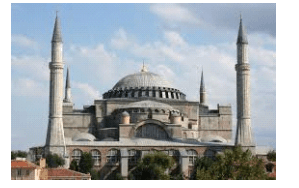
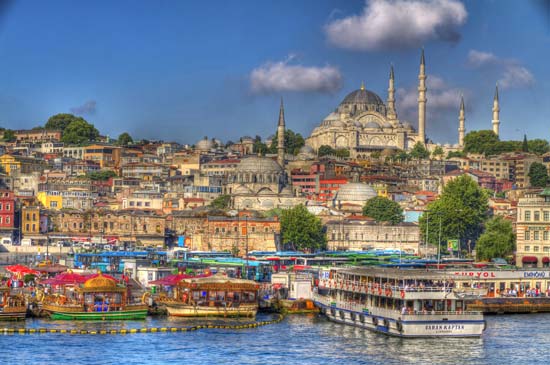
Which group conquered Constantinople?
Persians
Huns
Ottoman Turks
Carthage
Cultural diffusion means?
sharing of secrets
sharing and spreading of culture
practice of one religion such as Christianity
What was the primary language of the Eastern Roman Empire?
Greek
Latin
Rus
Arabic
The Great Schism split the Christian Church into what two groups?
Roman Catholic Church
Baptists
Eastern Orthodox Church
Lutheran

Muslim artists used this form of writing to create artistic depictions of animals and humans without disrespecting their religion.
Print Text
Calligraphy
Permanent Marker
Cursive

Which of the following is not a common architectural feature of mosques?
Domes
Minarets
Arches
Crosses

Muslim trade routes connected all of the following places EXCEPT
America
Europe
Africa
Asia

Muslims invented the armillary sphere and astrolabe to
find the nearest source of water
read the Quran and hadith.
find their location and time
build architectural domes
Under Islamic law _____________ had more rights than other ______ in India, Europe, and China.
Slaves
Converts
Women
Jews and Christians
Islamic _____________ became centers of learning and trade.
people
laws
cities
farms
Which of these is NOT an innovation that came from the golden age of Islam?
jewelry making
algebra
calligraphy
the oud
Islam was founded in
China
Middle East
Europe
North America
What is the name of the Holy Book in Islam?
Bible
Christanity
Quran
Twelve Tables
Where do Muslims worship?
Church
Temple
Mosque
What is a person who follows Islam called?
Christian
Jew
Buddhist
Muslim
What is name of the journey a Muslim should make to Mecca?
Hajj
Indian Ocean Complex
Ramadan
Trade
In what areas of study did Muslim Scholars make advances during the Golden Age?
Astronomy
Geography
Math
Philosophy
All of the Above
Why did Muslim Scholars study Astronomy?
To understand how to fish better
to paint more delicately
to educate young scholars
to understand time and clocks
How did maps helps the Muslim world?
Travelers and merchants had a better idea of where and how to travel
They could see where South America was
Sultans would know what resources were available in their empire
They could create a story about Carmen San Diego
What were the greatest architectural achievements of Islam?
The Mosques
The Churches
The Cathedrals
The Temples
The Palaces
Which factor contributed most to Ghana’s power?
resources
water routes
education system
taxing trade routes
Why do historians not know the location of the gold mines of Wangara?
The written records were lost.
Arab traders agreed not to tell.
Oral traditions name two places.
The miners kept the site a secret.
People who lived in the southern forests had to trade to get which essential product?
salt
gold
leather
iron
Early travelers described Ghana/Mali as a land of ......
gold.
taxes.
oases.
wonder.
Who is the richest man in the history of the world?
Elon Musk
Bill Gates
Mansa Musa
John Rockefeller
What religion was Mansa Musa?
Christian
Islam
Jewish
Buddhist
Which empire conquered Ghana?
Ghana
Russia
Songhai
Mali
Ghana was located between two areas that wanted to trade. The areas were
North Africa and West Africa
South Africa and West Africa
East Africa and South Africa
None of the options
West Africans used salt to _______________.
keep food from spoiling.
all the options
add taste to their food.
improve their diet/health.
build houses.
Why was travel across the Sahara dangerous?
You had to watch out for floods
You could get lost easily
One word: bacon!
The winds were harsh

What continent is displayed in green?
Africa
Asia
Europe
North America

What letter represents where the kingdom of Ghana is located?
A
B
C
D

What country is highlighted here?

Besides gold and salt, what was another major good that was traded in Medieval Western Africa?
Lion pelts
Camel
Ivory
Oil

Which area of medieval Africa was MOST associated with the production of salt?
desert
forest
mountains
savanna

Why was the Niger River important for the Mali Empire in medieval Africa?
It provided a way to access the Atlantic Ocean.
It provided a way to access the Mediterranean Sea.
It provided a way to transport large amounts of goods.
It provided a way to move troops to invade northern areas.

How did Ghana reach the height of their greatness?
Epic battles against Macedonia
Careful management of the gold trade
Their agricultural skills helped create a surplus
Their strict code of laws that focused on social structure

South Africa
North Africa


Which is a TRUE statement about Ghana?
Ancient Ghana was a very poor kingdom.
Ancient Ghana paid taxes to traders who entered the kingdom.
Ancient Ghana was rich in diamonds and silk.
Ancient Ghana was ruled by powerful kings who supported trade.

What was the name of the road that traders would use to get across the desert to trade with West African empires?
Trans-Continental railroad
The Silk Road
The Trans-Saharan Caravan road
The Suez Canal

The savanna is an area in Africa where_____?
the area south of the Sahara
wild plant life
zone of towering trees and dense leaves
grasslands with few scattered trees

Located in Africa, this is the largest desert in the world?
Savanna
Sahara
Shawarma
Sahel


What was the main reason Ghana profited from the trade industry?
They took half of the goods being traded.
They were the oness doing all the trading, so it was 100% profit

Grasslands, cover almost half of Africa, more than 13 million square kilometers
Savanna
Sahara
Sahel
South Africa
How did Islam affect the kings of Ghana?
The kings converted to Islam
The kings only traded with Muslims
The kings didn't allow Muslims to trade within their empire
The kings respected the Muslims and hired them
Which best describes Timbuktu under the Mali empire?
a trading post controlled by European merchants
A center of Islamic culture and learning
a port where Asian and European ships brought goods
A military station where traders would pick up weapons and locals would prepare for war
Mansa Musa is most known for his Islamic faith and practice of the religious pilgrimage, known as the _____.
Samudaya
Hajj
Talmud
Saludar
What impact did the acceptance of Islam have on the empires of Mali and Songhai?
it promoted isolationism
it has no impact
it encouraged trade with North Africa
it led to a large scale revolt
The Songhai Empire was similar to the Mali Empire by using the same trade materials of gold and salt
True
False
List the order of Empires from first to last
Mali, Ghana, Songhai
Songhai, Mali, Ghana
Ghana, Mali, Songhai
Ghana, Songhai, Mali
What led to the decline of the Songhai Empire?
The people of the Songhai Empire died out
The salt mines dried out
The region where the empire was located flooded
Invaders from Morocco took over the empire and the salt mines
Which river aided agriculture and trade for the medieval empire of Mali?
Nile River
Niger River
Amazon River
Indus River
Why did Ibn Battuta decide to leave his home?
Pilgrimage
Argument with his family
To collect airmiles
Boredom

Ibn Battuta Travelled On....
AeroPlanes and Cars
Camels And Horses
Trucks And Buses
On Foot
Only On Ships
If Marco Polo was motivated by trade and profit, what prompted Ibn Battuta to travel?
Religious
Desire to learn about the world
Political
All of the above
A caliph was considered ________.
a political leader but not a religious leader
both the head of government and the head of Islam
both the ruler of the east and the ruler of the west
the leader of the Mughal Empire
Why is the account of Ibn Battuta's travels so valuable to historians?
It is a classic example of historians needing to verify accounts from centuries ago. Historians can use the book, the Rihla, to demonstrate the importance of research and verification.
Ibn Battuta was one of the most widely traveled people in the world in his time. His writings on Muslim life and viewpoints, as well as his encounters with so many different cultures and foreign leaders, help historians understand a wide variety of topics.
Ibn Battuta’s book, the Rihla, wasn’t discovered by the world until the 17th century. All of this information is new and still needs to be further researched and translated by historians.
History is very centered on Europeans, and the world needs to better understand other perspectives and events outside of Europe.
Which of the following statements best describes Ibn Battuta’s childhood?
Ibn Battuta grew up in a family of judges, and he was inspired to become a judge and study Islamic law as an adult.
Ibn Battuta had to make his own fortune in the world, so he decided to travel in order to make a living.
Ibn Battuta was the first Muslim in his family, so he wanted to make the Hajj to Mecca in order to better understand the religion.
Ibn Battuta was from a family of nomads who were used to traveling around Africa.
Why are maps most important to Muslims?
To buy and sell
To visit family
To determine the direction of prayer

