
 Worksheets
Med Term - Q1 Exam (Ch. 1, 2, 3)
Total questions: 68
Worksheet time: 45mins
Ch. 1: Matching:
neur/o
nerve
my/o
muscle
thorac/o
chest
enter/o
intestines
Ch. 1: Matching:
peri-
around; surrounding
bi-
two; both
-ectomy
surgical excision; removal
-plasty
surgical repair
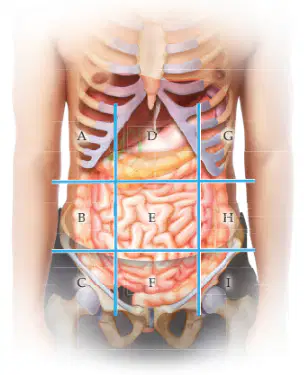
Ch. 1: Matching regions:
A
right hypochondriac region
D
epigastric region
G
left hypogastric region
E
Umbilical region
I
left iliac region
Ch. 1: Matching regions:
B
right lumbar region
H
left lumbar region
C
right iliac region
F
hypogastric region
Ch. 1: this plane divides the body into front and back sections
frontal plane
sagittal plane
transverse plane
Ch. 1: this plane divides the body into upper and lower sections
frontal plane
sagittal plane
transverse plane
Ch. 1: this plane divides the body into right and left halves
frontal plane
sagittal plane
transverse plane
Ch. 1: suffix for inflammation
-itis
-algia
-dynia
-ectomy
Mathcing:
hepat/o
liver
gastr/o
stomach
arthr/o
joint
cost/o
ribs
Ch. 2: Word Parts
brachi/o
arm
supra-
above
arthr/o
joint
meta-
change or beyond
chondr/o
cartilage
Ch. 2: Word Parts
spondyl/o
vertebrae or backbone
syn-
together; with
oste/o
bone
intra-
within; into
Ch. 2: suffix for process of condition
-ation
-malacia
-plasty
-ion
Ch. 2: suffix for softening
-ation
-malacia
-plasty
-ion
Ch. 2: suffix for abnormal condition
-ation
-malacia
-osis
-ion
Ch. 2: bones that are made of very dense, hard, and strong tissue; also called compact bones
cortical bones
cancellous bones
periosteum
medullary cavity
Ch. 2: bones that are made of spongy tissue; also called trabecular bones
cortical bones
cancellous bones
periosteum
medullary cavity
Ch. 2: suffix for surgical puncture to remove fluid
-ation
-centesis
-osis
-ion
Ch. 2: The _________________division of the skeletal system contains bones along the central line of the body.
appendicular skeleton
axial skeleton
Ch. 2: _____________ is the division of the skeletal system contains bones making up the arms, legs, and pelvic girdle.
appendicular skeleton
axial skeleton
Ch. 2: The procedure of inserting a needle into a joint to withdraw excess fluid is called ____.
Ch. 2: A birth defect of the foot that affects the talus (ankle bone) and is commonly referred to as clubfoot.
Ch. 3: Matching
articul/o
joint
-graphy
process of recording
flex/o
to bend
-esthesia
sensation
electr/o
electricity
Ch. 3: Matching
fasci/o
fascia; fibrous band
-plegia
paralysis
-trophy
condition of growth or development
-asthenia
weakness
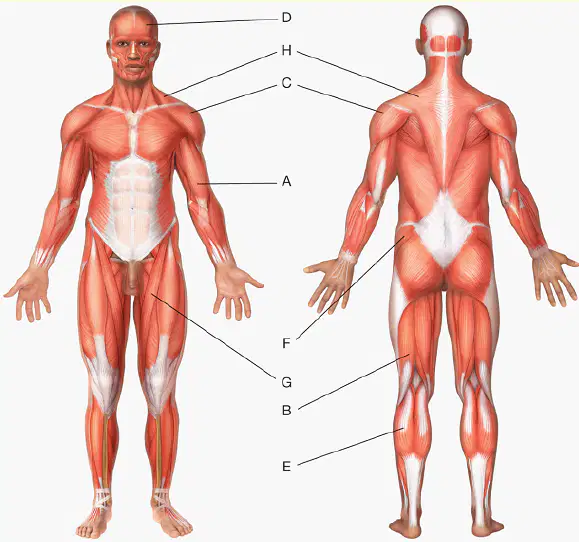
Ch. 3: Matching
frontalis
D
trapezius
H
deltoid
C
bicep
A
Ch. 3: Matching
gluteus medius
F
sartorius
G
biceps femoris
B
gastrocnemius
E
Ch. 3: A visual record of muscle contractions produced in response to electrical stimulation.
Ch. 3 Which type of muscle is attached to bones
skeletal muscle
cardiac muscle
smooth muscle
visceral muscle
Ch. 3 Which type of muscle is located in and around the internal organs
skeletal muscle
cardiac muscle
smooth muscle
voluntary muscles
3: A diagnostic imaging method that uses electromagnetic waves to produce internal body images, commonly known as X-rays.
3: Diagnostic imaging method involving the use of high-frequency sound waves to generate images of structures in the body.
3: involuntary, repetitive shaking or quivering
Ch. 3: the wasting away or shrinkage of muscle size
Ch. 3: involuntary sudden movement or convulsive muscular contraction
Ch. 3: Muscles that are stimulated to move through conscious control are called________
Ch. 3: Muscles that are stimulated to move through conscious control are called________
involuntary
voluntary
visceral
smooth
Ch. 3: Muscles that are not stimulated to move through conscious control are called ____________
involuntary
voluntary
visceral
smooth
Ch. 3: The ___________________ of a muscle is the attachment site that does not move when the muscle contracts
insertion
origin
Ch. 3: The ____________________ is the attachment site that moves during muscular contraction.
insertion
origin
Ch. 3: Prolonged immobilization or lack of muscle use can lead to_________________, a lasting tightening of the skin, muscles, tendons, ligaments, and fascia.
Ch. 3: a(n) ____________________ is the stretching or tearing of a muscle or tendon.
sprain
strain
Ch. 3: Ch. 3: A(n) ____________________ is the stretching or tearing of a ligament
sprain
strain
Ch.3: When muscles work in pairs, the_______________ causes the primary movement
antagonist
agonist
Ch.3: What is the primary function of an antagonist muscle?
To initiate movement by contracting
To relax and allow the prime mover (agonist) to create movement
To store energy for later use
To protect joints from injury
Ch. 3: Movement of a body part away from the midline of the body is known as _________________
adduction
external rotation
abduction
medial internal rotation
Ch. 3: Movement of a body part toward the midline is known as ______________________.
adduction
external rotation
abduction
medial internal rotation
Ch. 3: ____________ describes the lowering of a body part
elevation
pronation
depression
extension
Ch. 3: What movement describes the raising of a body part
elevation
pronation
depression
extension
Ch.3: The process of taking a small sample of living tissue for examination under a microscope.
Ch.3: Exercises designed to enhance or preserve joint mobility and flexibility.

