
 Worksheets
Q1, HW #34 - Wayground - Constructions
Total questions: 83
Worksheet time: 3hrs 26mins


What must be true?
1
2
3
4


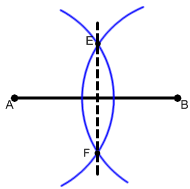
Eric was attempting to construct a perpendicular bisector to the segment AB with a compass and straight edge. Which of the below statements explains what Eric may have done wrong?
Eric should have started by putting the compass needle point at the midpoint of the segment AB.
On the second step, Eric should have placed the compass needle point where the first arc intersected the segment AB.
Erick just needed to open the compass more to create arcs that have a radius of more than half the length of the segment AB.
Erick didn’t do anything wrong he just needs to connect the opposite endpoints of each arc to finish the construction.
Which is the basis for the procedure used in the construction of a line parallel to a given line through a point not on the line?
Corresponding Angles Theorem
Alternate Exterior Angles Theorem
Alternate Interior Angles Theorem
Consecutive Interior Angles Theorem
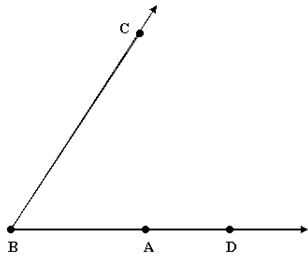
Alex needs to bisect ∠ABC using a compass and straightedge. He starts by performing the following steps. Step 1: Place the compass on vertex B of the angle. Step 2: Draw an arc that intersects both sides of the angle. Step 3: Label these intersections as point D and point E. Step 4: ________________________________. Step 5: ________________________________. What are the next two steps Alex should take in his construction?
Step 4: Adjust the compass width to be half the distance between point B and point E, and then place the compass on point E and draw an arc in the interior of the angle that crosses the other arc. Step 5: Place the compass at point D and draw an arc in the interior of the angle.
Step 4: Place the compass at point D and draw an arc in the interior of the angle. Step 5: Without adjusting the compass width, place the compass at point E and draw an arc in the interior of the angle that crosses the other arc.
Step 4: Adjust the compass width to be half the distance between point B and point E, and then place the compass on point E and draw an arc on the exterior of the angle. Step 5: Without adjusting the compass width, place the compass at point D and draw an arc on the exterior of the angle that is opposite the other arc.
Step 4: Without adjusting the compass width, place the compass at point D and draw an arc on the exterior of the angle that is opposite the other arc. Step 5: Adjust the compass width to be half the distance between point B and point E, and then place the compass on point E and draw an arc in the interior of the angle that crosses the other arc.
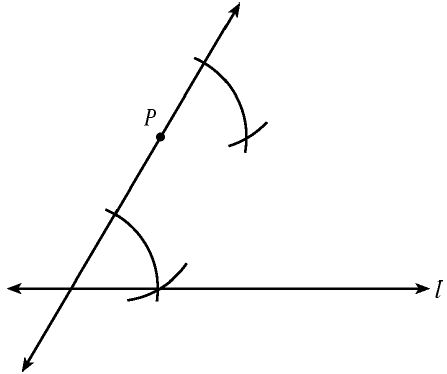

Give the correct sequence of steps for inscribing an equilateral triangle in a circle.
A, B, C, D, E, F
D, F, A, C, B, E
F, D, A, B, C, E
D, A, F, B, C, E

Which construction is shown?
the bisector of a given angle
an angle congruent to a given angle
the perpendicular bisector of a line segment
a perpendicular to a given line from a point not on the line

Which construction is shown?
the bisector of a given angle
a perpendicular to a given line at a given point on the line
a line parallel to a given line through a point not on the given line
a perpendicular to a given line from a point not on the line
Which construction is shown?
the perpendicular bisector of a line segment
a perpendicular to a given line at a given point on the line
a line segment congruent to a given line segment
a line parallel to a given line through a point not on the given line

Which construction is shown?
a line segment congruent to a given line segment
a line parallel to a given line through a point not on the given line
an angle congruent to a given angle
a perpendicular to a given line from a point not on the line

What is the first step in the construction?
Label points E and F
From E and F draw arcs that intersect segment AB
Draw an arc with center at A and draw an arc with center at B
Draw segment EF

What is the first step in the construction?
From M draw arcs that intersect line AB
From A and B draw arcs that intersect at point N
Draw segment NM
From N draw arcs that intersect line AB

Construct a line that is perpendicular to AB and passes through C. Through which other point does the perpendicular line pass?
M
N
O
P

Which of the following segments is congruent to AB?
AP
AQ
AR
AS

Through which point does the bisector of ∠ABC pass?
P
Q
R
S

Given the final product for the Perpendicular Through a Point Not on the Line construction. Which statement is not necessarily true?
ER = RF
EF = RG
EG =GF
EF ⊥ RG
A free hand of a picture
trace
sketch
construction
graph
A figure created with accurate measurements
drawing
construction
sketch
trace
A figure created with a compass and a straight edge
graph
sketch
construction
drawing
A line, ray, or segment that passes through the midpoint of a segment.
angle bisector
parallel line
plane
segment bisector
Two lines that do not intersect
rays that form an angle
perpendicular lines
parallel lines
segment bisector
A line, ray, or segment that cuts an angle in half
perpendicular
midpoint
segment bisector
angle bisector
Every point on an angle bisector is equidistant from the sides of the angle.
TRUE
FALSE
If a point is equally distant from the endpoints of a segment, then it must be the midpoint of a segment.
TRUE
FALSE
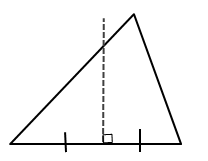

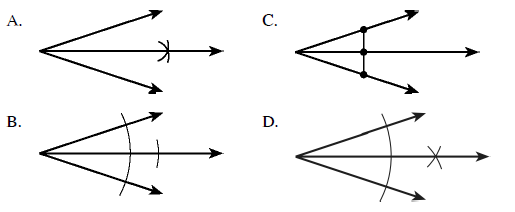
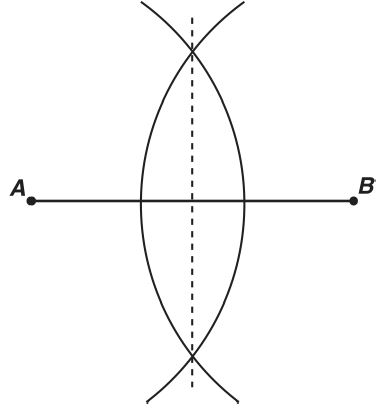


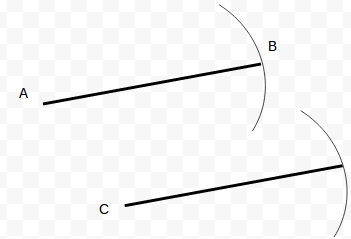
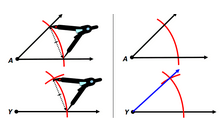
A geometric drawing that uses a limited set of tools like a compass or straightedge
Construction
Engineer
Physics
Kinesiology
What is a protractor?
a tool that measures the distance
a tool that measures the speed
a tool that measures angles
a tool that measures a circle
Which construction illustrates “copy an angle”?


Which of the following is a segment?


Which of these is a set of perpendicular lines?


Which image shows a ray?


Which image shows the construction of a perpendicular bisector?


Which is the best representation of a line?


Which image best represents an angle?


What does this symbol mean?
≅
not equal
congruent
equal
half
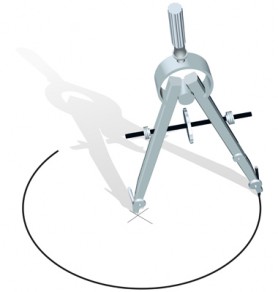
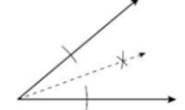
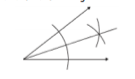
The drawing shows a compass and straight edge construction of...what?
the bisector of a given angle
a perpendicular to a given line at a point on the line
a perpendicular to a given line from a point NOT on the line
an angle congruent to a given angle
The midpoint is a point on a line segment that is the same distance from both endpoints.
TRUE
FALSE
What are parallel lines?
Intersecting lines at right angles.
Lines on the same flat surface that never meet.
A line segment that is divided into two equal parts.
Formed when a horizontal line and vertical line intersect.
They are always the same distance apart.
What are perpendicular lines?
Two lines that intersect at right angles.
Lines on the same flat surface that never meet.
A line segment that is divided into two equal parts.
They are always the same distance apart.
All of the above.
The drawing shows a compass and straight edge construction of...what?
the bisector of a given angle
a perpendicular to a given line at a point on the line
a perpendicular to a given line from a point NOT on the line
an angle congruent to a given angle
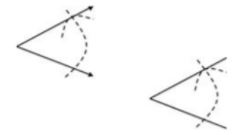
The given diagram is what kind of construction?
Perpendicular bisector
Congruent angles
Angle bisector
Congruent line segments
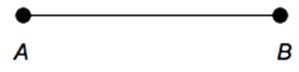
When copying line segment AB using a straight edge and a compass, the compass should be used to:
Draw an arc above point A
Measure the length of segment AB
Draw an arc between point A and point B
Measure half the length of line segment AB
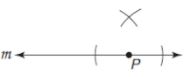
What is being constructed in the figure?
the perpendicular bisector of line m
the line perpendicular to line m through a point on the line
the line parallel to line m through a point NOT on the line
an angle that has line m as its bisector
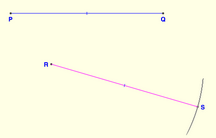
What was duplicated?
line
line segment
ray
angle
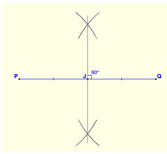
What type of construction do you see?
midpoint
angle bisector
perpendicular bisector
altitude
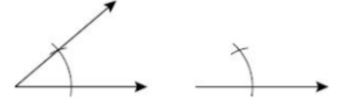
The drawing shows the arcs used to construct...what?
a bisector of a given line
a bisector of a given angle
a perpendicular of a given line at a point on the line
an angle congruent to a given angle
What does the word BISECT mean?
To cut something into more than five pieces.
It is a plane with two sets of wings.
A shape that has three sides.
To cut something into two congruent pieces or in half.


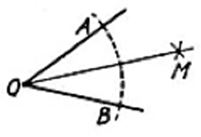
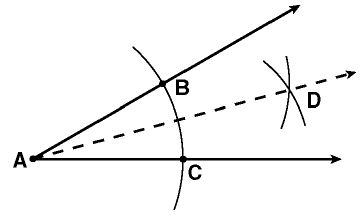
What is the first step in constructing the angle bisector of angle A?
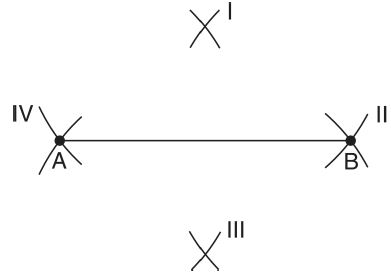

.
.
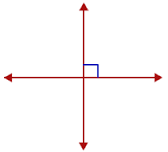
What kind of intersecting lines are these?
Parallel Lines
Perpendicular Lines
adjacent
opposite
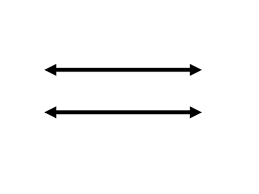
What kind of lines are these?
Parallel lines
Line segments
Perpendicular Lines
Intersecting lines

What is this?
Line
Parallel
Point
Line Segment

Eric was attempting to construct a perpendicular bisector to the segment AB with a compass and straight edge. Which of the below statements explains what Eric may have done wrong?
Eric should have started by putting the compass needle point at the midpoint of the segment AB.
On the second step, Eric should have placed the compass needle point where the first arc intersected the segment AB.
Erick just needed to open the compass more to create arcs that have a radius of more than half the length of the segment AB.
Erick didn’t do anything wrong he just needs to connect the opposite endpoints of each arc to finish the construction.

What is this?
ruler
compass
protractor
straightedge


What should be done next to construct a parallel line through a point?
Place compass on point A and draw an arc that intersects the large arc.
Place compass on point C and draw an arc that intersects the large arc.
Draw the line parallel through point A and the large arc.
Place compass on point B and draw an arc that intersects the large arc.
The picture construction, is a picture of (a) .

