wayground logo

Free Printable Worksheets

NEW

Font size

S
M
L
XL
Worksheets

Enzyme Review

Total questions: 24

Worksheet time: 43mins

Name
Class
Date
1.
What is a substance called if it speeds up a chemical reaction?
a)
reusable
b)
catalyst
c)
specific
d)
fragile
2.
With what 3 letters do enzymes typically end?
a)
-ose
b)
-ase
c)
-ese
d)
-tic
3.

Enzymes are an example of

a)

Lipids

b)

Carbohydrate

c)

Protein

d)

Nucleic Acid

4.
Each enzyme only has 1 substrate that will fit its active site.  What is this called?
a)
reusable
b)
catalyst
c)
specific
d)
fragile
5.
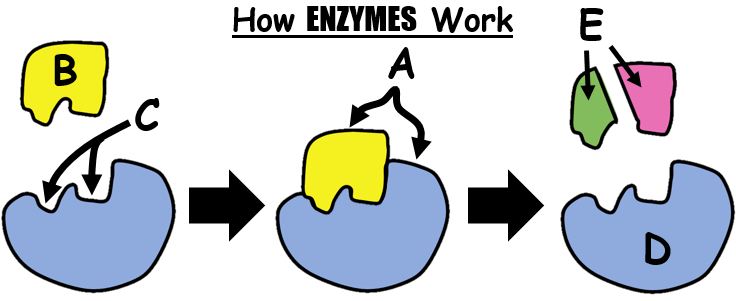
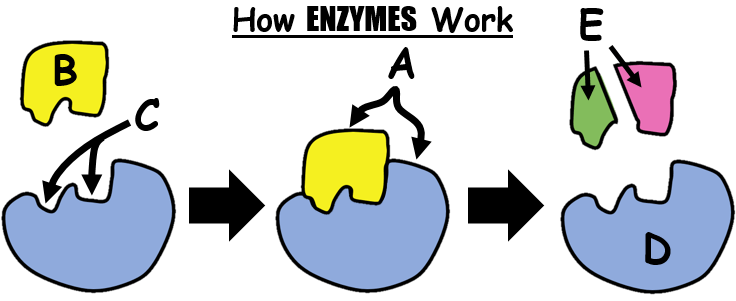
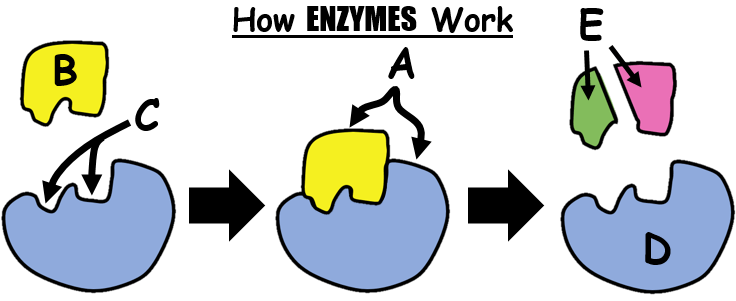
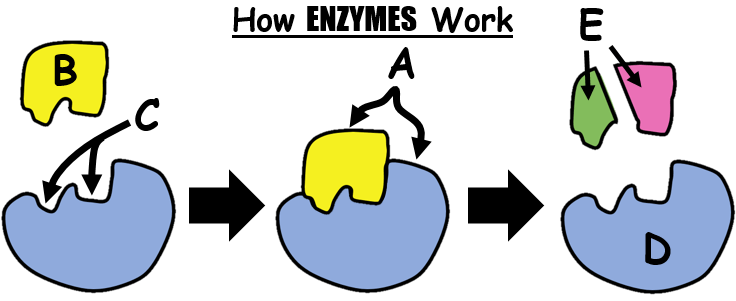
In the diagram, what is letter A? 
a)
product
b)
substrate
c)
enzyme-substrate complex
d)
active site
6.
Letter D...
a)
active site
b)
enzyme
c)
substrate
d)
products
7.
Letter B...
a)
active site
b)
enzyme
c)
substrate
d)
products
8.
Letter C...
a)
active site
b)
enzymes
c)
substrate
d)
products
9.
Letter E...
a)
active site
b)
enzyme
c)
substrate
d)
products
10.
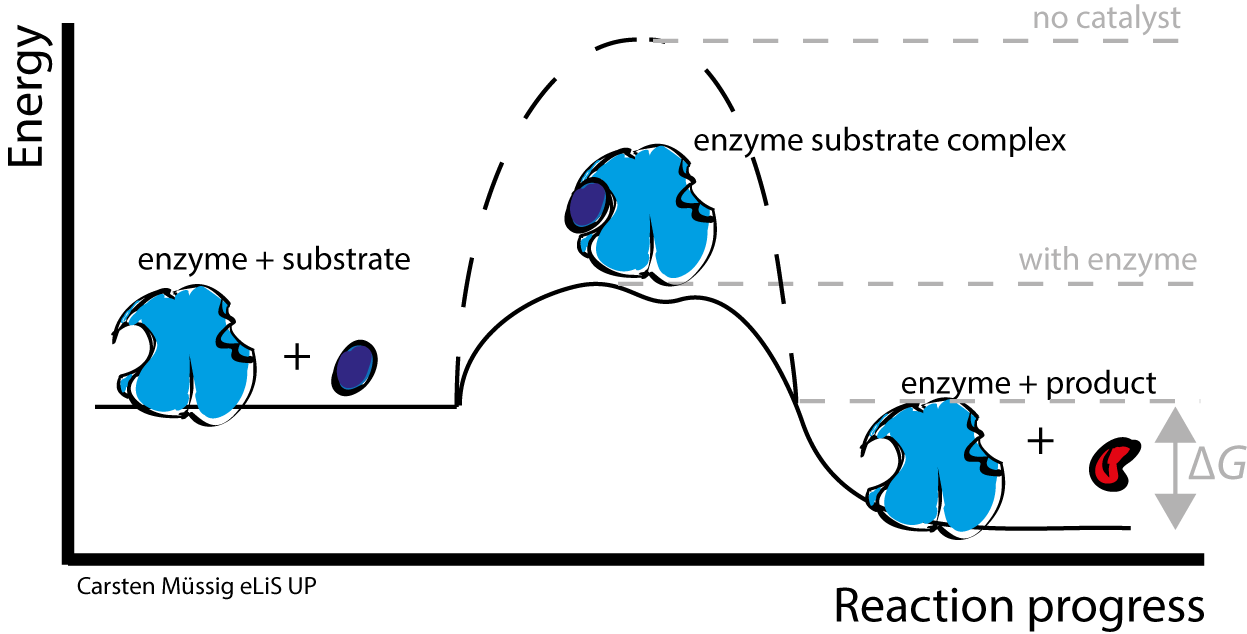
An enzyme speeds up a reaction by
a)
lowering the activation energy.
b)
raising the activation energy.
c)
releasing energy.
d)
absorbing energy.
11.

What happens when enzymes are heated to a high temperature?

a)

The enzymes die.

b)

The shape of the enzyme are changed and it denatures

c)

The enzymes' amino acid sequence changes.

d)

The enzymes remain the same

12.

When looking at the enzyme substrate model, the substrate turns into what at the end of the chemical reaction?

a)

Nothing

b)

It does not change

c)

Products

d)

Pieces

13.

What is the monomer for protein?

a)

Polymer

b)

Nucleic Acids

c)

Amino Acids

d)

Fatty Acids

14.

What are two factors that can affect an enzymes ability to function?

a)

No changing

b)

temperature and pH

c)

night and day

d)

hot and cold

15.
What is the function of an enzyme?
a)
enzymes break themselves into small pieces
b)
enzymes slow down chemical reactions
c)
enzymes speed up chemical reactions
d)
enzymes combine products to form reactants 
16.

How does an enzymes shape relate to its function?

a)

the shape of the enzyme has no relation to its function

b)

the enzyme is shaped specially for certain substrates to perform a specific reaction

c)

the enzyme shape acts as a receptor to certain products

d)

the enzyme shape can fit into specific substrates to cease a reaction
17.
An enzyme speeds up a chemical reaction in the cell but can only be used once.  True or False? 
a)
true
b)
false
18.
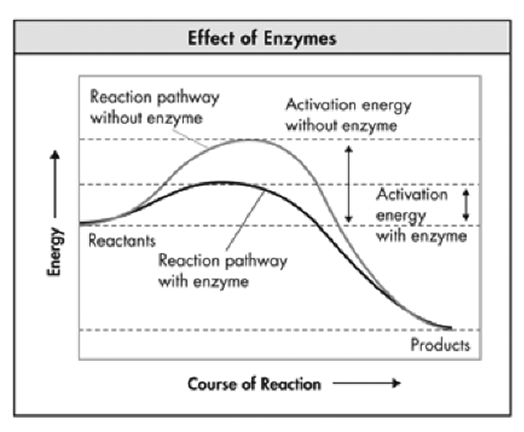
The graph shows how enzymes affect reactions in cells. Which statement best summarizes the information shown in the graph?
a)
Enzymes increase the energy of the reactants.
b)
Enzymes decrease the energy level of the products.
c)
Enzyme decrease the activation energy of the reaction.
d)
Enzymes reverse the direction of the reaction.
19.
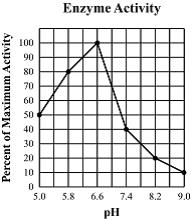
Which of the following conclusions can be drawn from this graph?
a)
The optimum pH of the enzyme is 6.6.
b)
The optimum pH of the enzyme is 5.8
c)
The enzyme’s activity increases as pH increases 5.0 to 9.0
d)
The enzyme’s activity is greater around pH of 8.0 .
20.

What do enzymes do?

a)

Build things up or break them down

b)

Help filter waste from the body

c)

Create environments where food can be eaten

d)

Add and remove water

21.
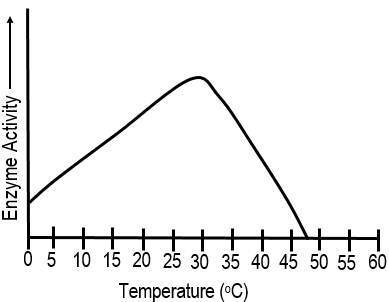
Based on the graph, what temperature does this enzyme work best? 
a)
15 C
b)
40 C
c)
30 C
d)
47 C
22.
Enzymes will make a reaction go _______ and use ______ energy.
a)
faster, less
b)
faster, more
c)
slower, less
d)
slower, more
23.
What happens to an enzyme when it is denatured?
a)
Activation energy is lowered.
b)
It becomes stronger.
c)
It loses its shape.
d)
Activation energy is raised.
24.

The graphs show the reaction rate for an enzyme across a range of temperatures and pH. Based on these data, the enzyme functions best at what temperature and pH?

a)

temperature of 27 degrees C and pH of 4

b)

temperature of 37 degrees C and pH of 6

c)

temperature of 40 degrees C and pH of 8

d)

temperature of 50 degrees C and pH of 10